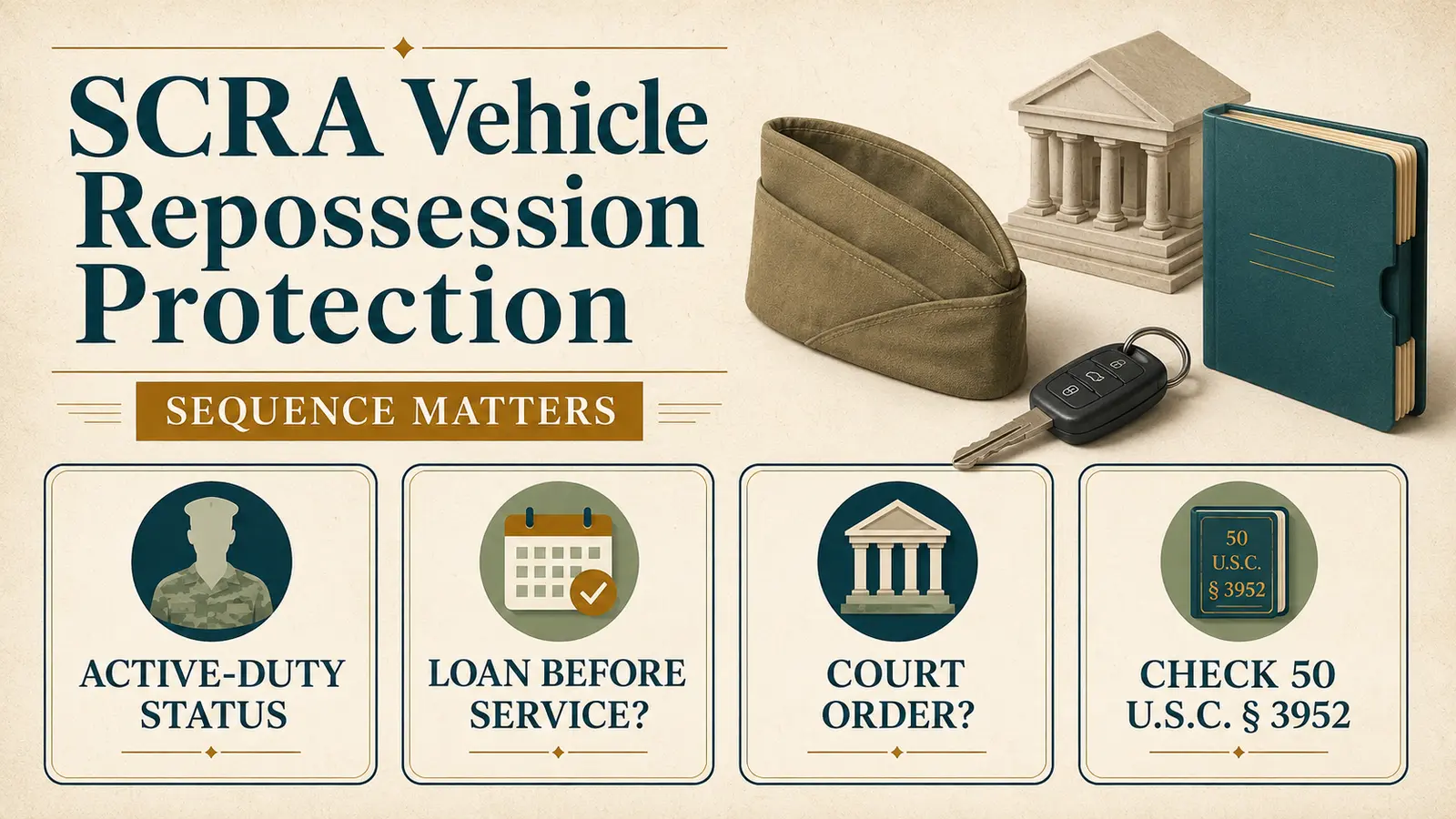
The contract generally must predate military service
50 U.S.C. § 3952 covers qualifying contracts for the purchase or lease of real or personal property, including motor vehicles, when the required payment or deposit was made before entry into military service.
Do not assume active-duty status alone is enough. Put the contract date, first payment or deposit date, and military entry date side by side.
A court order can be required before repossession
For covered contracts, the statute provides that after entry into military service the contract may not be rescinded or terminated for breach, and the property may not be repossessed for such breach, without a court order.
CFPB’s SCRA guidance summarizes the same protection for qualifying vehicle or property loans and leases.
Verify military status and orders
Keep orders, service verification, and contract records. The SCRA has definitions and procedural rules that determine who is protected and when.
A spouse or co-borrower may raise separate questions; do not assume the servicemember’s protection automatically resolves every obligor’s liability.
A repossession that already happened needs a fast record review
If a covered vehicle was taken without a court order, preserve the repossession record, contract, orders, and communications immediately.
Contact the servicer and a military legal assistance office or qualified counsel. The federal protection can create remedies, but the website should not prescribe litigation strategy.
State rights can exist in addition to SCRA
Cure, redemption, sale notice, and deficiency rules continue to come from state law and the contract unless federal law preempts or otherwise changes the sequence.
A servicemember can therefore have both an SCRA issue and an Article 9 sale issue in the same file.
Do not confuse SCRA with general military hardship programs
Lender deferments or military assistance plans can be voluntary contractual programs. SCRA is a statute with specific eligibility and court-order requirements.
Ask which protection the servicer is applying and get the answer in writing.
Check the statutory trigger before relying on the SCRA label
50 U.S.C. § 3952 applies to specified purchase, lease, or bailment contracts, including motor vehicles, when the servicemember paid a deposit or installment before entering military service. For a covered contract, after entry into service the property may not be repossessed for the described breach without a court order. The protection therefore turns on contract timing, payment timing, military-service timing, and the reason for the claimed breach—not simply on whether the borrower is currently in uniform.
Build a one-page chronology with contract date, down payment or first installment, entry-on-duty date, alleged default, any court filing or order, and repossession date. Keep orders or other service-status records and the complete contract. If a creditor points to a court order, obtain the actual docket and order rather than relying on a collector’s description of it.
A court can tailor relief; the statute is not an automatic vehicle giveaway
Section 3952 gives the court authority in a covered case to order repayment of prior installments or deposits as a condition of termination and repossession, stay proceedings when military service materially affects the servicemember’s ability to comply, or make another equitable disposition. That structure is why a procedural article should focus on whether the required court process occurred. Separate that federal question from state cure, redemption, sale-notice, and deficiency rules that may still apply.
Check for a real court order
If the creditor says SCRA process was satisfied, obtain the case name, docket number, court, and signed order. A collection letter, default notice, or repossession authorization generated inside the lender is not a court order. Where eligibility is uncertain, official military-service verification and qualified SCRA counsel can resolve the status question without guessing from uniformed-service labels.
Build the SCRA timeline around contract formation and entry into service
Section 3952 is not triggered merely because the borrower is currently in uniform. The statutory sequence matters: the servicemember must have entered the purchase or lease contract and paid a deposit or installment before entering military service. Put the contract date, first payment, service-entry date, default dates, and repossession date on one page. That timeline lets a lawyer or military legal-assistance office test the federal protection without guessing from current duty status alone.
If the protection applies, the statute says covered property may not be repossessed for the breach without a court order. So ask for the case number and a copy of the order rather than accepting a statement that the creditor “had legal approval.” Also preserve any orders showing periods of service. The court has authority to stay proceedings or make other equitable dispositions when statutory conditions are met, which is why this page treats SCRA review as a court-process question, not as an automatic cancellation of the auto debt.
Frequently asked questions
- When does the SCRA protect a servicemember’s vehicle from repossession?
- Under 50 U.S.C. § 3952, if the vehicle was purchased or leased and at least one payment was made before military service began, the creditor generally needs a court order to repossess during service. Verify the contract date and the entry-into-service date.
- Is the SCRA an automatic protection?
- No. It is a statutory trigger, not a hardship program, and a court can tailor relief rather than simply returning the vehicle. Check whether the specific requirements — pre-service contract, a pre-service payment, current service — are met.
- The repossession already happened — is it too late?
- Not necessarily. A repossession that occurred without a required court order needs a fast record review. State-law rights can also exist in addition to the SCRA.
Sources checked for this page
- 50 U.S.C. § 3952 — SCRA protection for installment contractsCurrent U.S. Code text for qualifying pre-service installment contracts.
- CFPB — Servicemembers Civil Relief Act (SCRA)CFPB explanation of SCRA protections, including qualifying vehicle repossessions.
- CFPB — What happens if my car is repossessed?Federal consumer overview of repossession, belongings, sale, redemption, deficiency, and credit reporting.