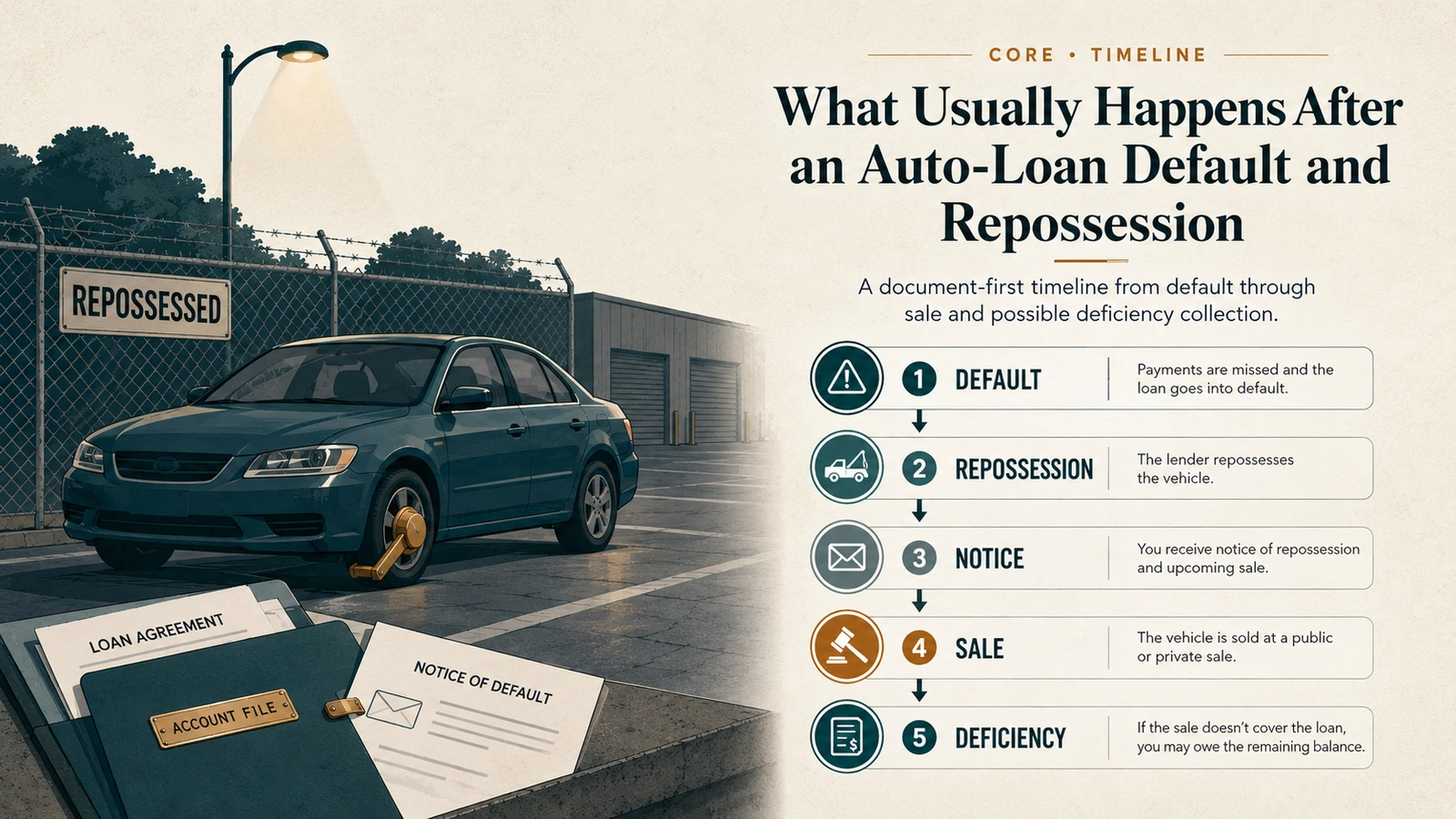
Start the timeline with the contract, not the tow truck
The first useful date is the default date under the retail installment contract or loan agreement. A missed payment is the most common trigger, but the contract may define other defaults. State law can require a cure notice before repossession in some jurisdictions, while other states do not create that extra pre-repossession window. That is why the same number of missed days can produce different procedures in different states.
Write down the payment due date, the date any grace period ended, every promise-to-pay or extension you received, and the date the vehicle was actually taken. If a servicer accepted a payment or told you a repossession hold was in place, keep the communication that proves it. CFPB supervision has repeatedly focused on repossessions that occurred after consumers made payments or obtained extensions, so payment-posting evidence belongs at the beginning of the file, not as an afterthought.
Repossession creates a possession question and a property question
UCC Article 9 generally allows a secured party to take possession after default without judicial process only if it can do so without breach of the peace. The repo of the vehicle does not automatically transfer ownership of personal items inside it. Treat those as two separate tracks: one concerns the collateral; the other concerns property that may need to be inventoried and returned.
On the day you discover the car is gone, record where it was parked, who confirmed the repossession, the repossession company or storage lot, and the condition of the location. Then make a written list of belongings while memory is fresh. That chronology can later matter if there is a dispute about property, damage, or whether the repossession agent crossed a boundary such as a locked garage.
The next major document is the disposition notice
Before a secured party disposes of consumer-goods collateral, Article 9’s notice rules generally require an authenticated notification. For a public sale, the notice framework focuses on the date, time, and place. For a private sale, it identifies the date after which disposition may occur. Consumer-goods transactions also have additional content rules under § 9-614.
Do not read only the bold sale date. Identify whether the notice describes a public or private disposition, where redemption information appears, who to contact for the amount needed to redeem, and whether the notice points to a number for additional information. Keep the envelope or electronic delivery record because the sending date can be as important as the sale date.
Redemption ends when disposition or an equivalent event cuts it off
Under the model UCC, redemption requires tender of the obligations secured by the collateral plus specified reasonable expenses. The right can be exercised before the secured party has disposed of the collateral, contracted for its disposition, collected it in the sense described by Article 9, or accepted it in satisfaction. A state-specific reinstatement right, when one exists, is different because it may let the installment contract continue after curing the default rather than requiring a full redemption amount.
If you are trying to get the vehicle back, ask the creditor to label the quote. A “reinstatement quote,” “cure amount,” “payoff,” and “redemption amount” may not mean the same figure. Request the amount, the expiration date, the accepted payment method, and the destination for payment in writing.
After sale, reconstruct the accounting
The sale does not make the old account balance disappear. Article 9 directs how sale proceeds are applied and recognizes both a surplus and a deficiency. In a consumer-goods transaction, § 9-616 addresses an explanation of the calculation. That post-sale statement should be reconcilable to the contract balance, sale proceeds, and the charges or credits that the creditor included.
Build a one-page ledger with four columns: pre-sale secured balance, permitted expenses, sale proceeds, and other credits or refunds. Keep add-on product cancellations, GAP-related refunds when applicable, insurance refunds, or other credits separate so you can see whether they were actually posted. A collector’s later demand is easier to evaluate when you can trace it back to the creditor’s original post-sale numbers.
A deficiency balance is not yet a deficiency judgment
A remaining balance is a claim that money is still due. A judgment is a court order entered after a lawsuit or other judicial process. If a creditor or debt collector files suit, the procedural deadline on the summons becomes the urgent date. CFPB guidance emphasizes responding by the deadline rather than assuming that talking with a collector substitutes for filing an answer.
State law controls important issues at that stage, including the limitation period, the effect of a defective sale notice, and what rule applies if commercial reasonableness is challenged. The practical handoff is from “repo file” to “court file”: preserve the same notices and ledger, then add the complaint, proof of service, docket number, and every filing.
Use the sequence as a sorting tool
When a new letter arrives, first place it on the timeline: pre-repo cure notice, repossession record, disposition notice, redemption quote, post-sale explanation, collection notice, or lawsuit. That keeps unrelated rights from being blended together and helps you know which source to read next.
The timeline is also a check against stale assumptions. A right that existed yesterday can end at disposition; a private-sale notice can use a different timing formulation from a public sale; and a collection letter months later does not tell you whether the earlier sale procedure complied with state law. Work forward from dated records rather than backward from the collector’s current number.
Frequently asked questions
- Where does the repossession timeline actually start?
- It starts with the default date under the retail installment contract or loan agreement, not the day the tow truck arrived. A missed payment is the most common trigger, but the contract can define other defaults, and some states require a cure notice before repossession while others do not.
- What is the most important document after the car is taken?
- The disposition (sale) notice. Before a secured party disposes of consumer-goods collateral, Article 9 generally requires an authenticated notification, and for consumer transactions § 9-614 adds content rules. Keep the envelope or delivery record, because the sending date can matter as much as the sale date.
- When does the right to redeem end?
- Under the model UCC, redemption ends once the secured party has disposed of the collateral, contracted for its disposition, collected it, or accepted it in satisfaction. A separate state reinstatement right, where one exists, works differently because it can let the contract continue rather than requiring the full redemption amount.
Sources checked for this page
- CFPB — What happens if my car is repossessed?Federal consumer overview of repossession, belongings, sale, redemption, deficiency, and credit reporting.
- CFPB Bulletin 2022-04 — Mitigating Harm from Repossession of AutomobilesCFPB supervisory and enforcement discussion of wrongful repossessions and servicing practices.
- UCC § 9-609 — Secured party’s right to take possession after defaultModel UCC text; the controlling law is the version enacted in the relevant state.
- UCC § 9-611 — Notification before dispositionModel UCC text; state enactments can add requirements.
- UCC § 9-614 — Contents of notification: consumer-goods transactionModel consumer-goods disposition notice rules and safe-harbor form.
- UCC § 9-615 — Application of disposition proceeds; deficiency and surplusModel rules for applying sale proceeds and calculating deficiency/surplus.
- UCC § 9-616 — Explanation of surplus or deficiencyModel consumer-goods rule for pre- or post-disposition explanation.
- UCC § 9-623 — Right to redeem collateralModel redemption right before disposition, collection, or acceptance.