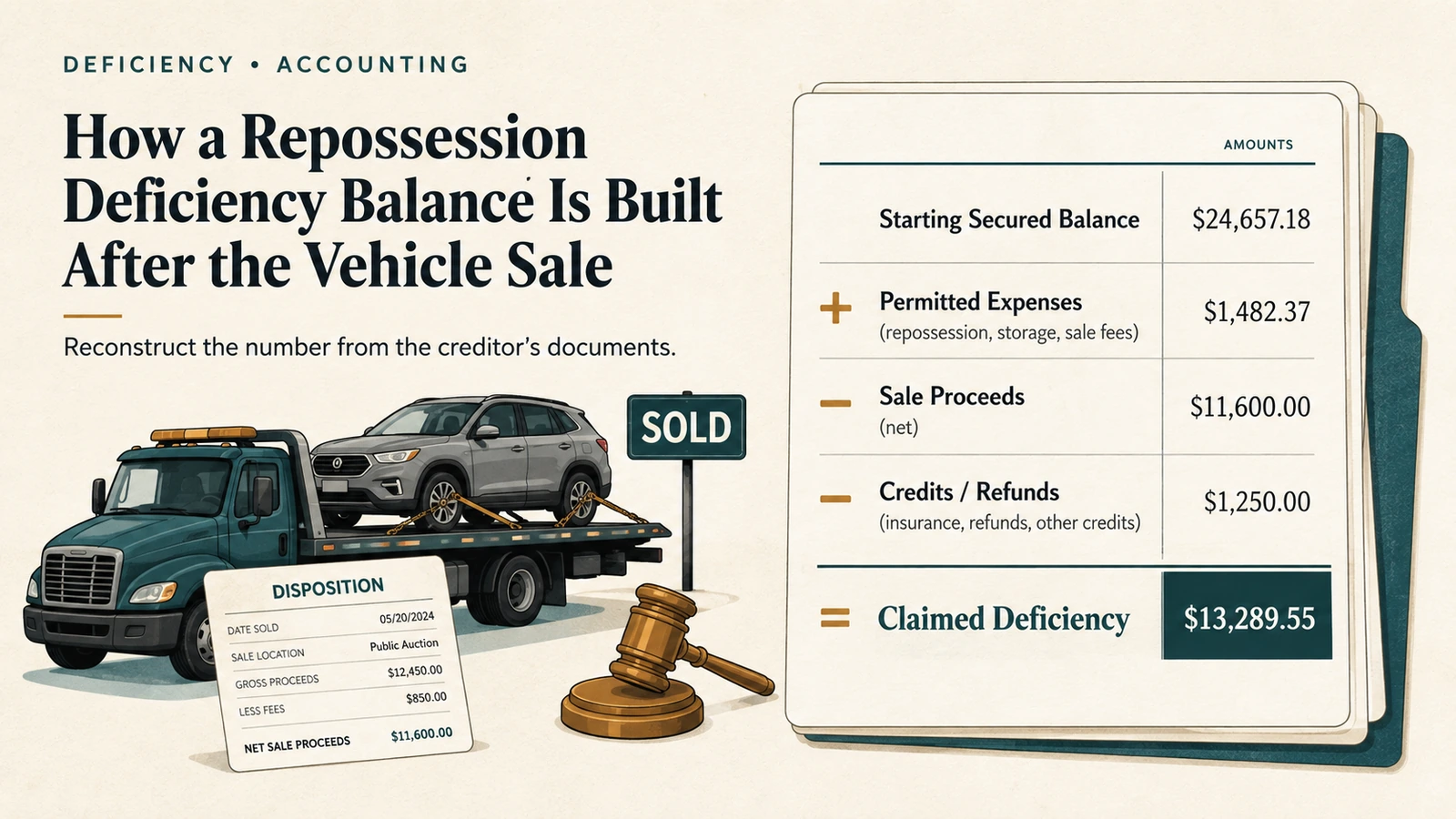
Build the calculation from source documents
The core inputs are the secured obligation, the reasonable expenses that the governing law and contract permit, the sale proceeds, and credits that reduce the balance. Model UCC § 9-615 directs the application of proceeds after disposition. In a consumer-goods transaction, § 9-616 addresses the explanation of a deficiency or surplus.
Request the payment history and a copy of the post-sale explanation if you do not already have them. Then list each fee by name instead of accepting one “repo costs” subtotal. Storage, towing, condition reports, auction charges, legal expenses, and other items can have different contractual or statutory treatment.
The sale price is one number, not the entire commercial-reasonableness inquiry
A low auction price is important evidence, but model § 9-627 states that a disposition is not automatically commercially unreasonable merely because a better price could have been obtained at another time or by another method. The inquiry can involve the method, manner, time, place, and other terms of the disposition.
That means a useful audit asks how the vehicle was marketed, whether it was a public or private sale, what condition information was available, whether the sale was to a related party, and whether the creditor followed the notice process. Price comparisons are strongest when paired with records showing why the actual disposition process was deficient.
Look for credits that may not be obvious on the first statement
Unused service-contract refunds, debt-cancellation or ancillary-product refunds, insurance refunds, returned payments, and later auction adjustments can change the balance depending on the contract and product terms. Do not assume they automatically apply; instead, ask whether a refund was due, who received it, and when it posted.
If the creditor’s explanation uses a category you do not recognize, request the underlying invoice or account code. A deficiency audit is not complete if the math adds up but one of the inputs is unexplained.
Separate the creditor’s claim from a collector’s itemization
A debt collector may later send validation information that itemizes interest, fees, payments, and credits from a specified itemization date. That document is useful, but it begins after the original creditor’s repossession accounting. Reconcile the collector’s opening balance to the creditor’s closing deficiency rather than treating them as separate debts.
If the two figures do not match, identify the exact date and transaction where they diverge. That creates a specific dispute that can be investigated, unlike a general statement that the balance “seems too high.”
Deficiency balance and deficiency judgment are separate stages
The post-sale balance is the amount asserted due. A deficiency judgment requires a court process when the creditor sues and obtains judgment. State law can restrict deficiency recovery or change the consequence of a defective notice or commercially unreasonable sale.
If suit is filed, the accounting work becomes evidence for the answer and defenses, but it does not replace the obligation to respond by the court deadline. Preserve the original sale documents in the same folder as the summons so the litigation record can be tied back to the repossession sequence.
Use a four-line reconciliation before deciding what is actually disputed
Write the secured balance immediately before applying sale proceeds; add only identified, documented charges; subtract the net sale proceeds; then subtract every later credit. Compare the result with the creditor’s deficiency explanation and the collector’s current itemization.
If the arithmetic matches, the remaining questions are legal or factual inputs: was the sale conducted properly, are the charges allowed, were all credits included, and is the claim timely? If the arithmetic does not match, you have a narrower first question—where did the ledger diverge?
Rebuild the balance from the lender’s own sale figures
A deficiency is not simply the unpaid monthly payments added together. Start with the secured obligation at the relevant pre-disposition date, then account for sale proceeds and permissible expenses under the contract and governing law. The lender’s explanation should make it possible to see how it moved from the loan ledger to the claimed post-sale amount. Ask for the sale date, gross price, costs of repossession and storage, preparation or disposition expenses, credits, payments, and any optional-product refunds.
A practical check is to place each amount on one dated ledger and mark whether it is a debit or credit. Do not use a retail asking price or an online valuation as a substitute for the actual sale record; use those only as context if you later question whether the disposition was commercially reasonable. If a line item is unclear, request the underlying invoice or an explanation instead of assuming all fees are automatically invalid.

| Ledger item | Example amount | Effect on claimed balance |
|---|---|---|
| Secured obligation at stated cutoff | $18,400 | Starting amount |
| Net sale proceeds credited | $12,250 | Subtract $12,250 |
| Documented repossession and sale costs | $730 | Add only costs allowed by contract and law |
| Optional-product refund credit | $420 | Subtract $420 if applied to the account |
| Illustrative remaining amount | $6,460 | Verify each line and the dates before accepting |
Use the notice and accounting as two different checkpoints
Before the vehicle is sold, the notification should tell a consumer whether the proposed disposition is public or private, how to obtain the redemption amount, and whether a deficiency may remain. After the sale, a consumer may be entitled to a more detailed explanation of the calculation. UCC § 9-616 sets an accounting framework for covered consumer transactions, and state versions may vary. A pre-sale notice is not itself the final sale statement.
Compare the sale date with the notice and with any stated redemption deadline. Then compare the final accounting with the loan history and sale receipts. If the creditor does not provide an explanation, ask in writing and identify the missing figures. A timely request may matter, but the applicable section and response period depend on the state’s enacted version and transaction. Keep a copy of your request rather than relying on a phone explanation.
Audit the claimed deficiency
- Choose the balance date and match it to the loan ledger.
- Verify gross sale price and net proceeds credited.
- Check each repossession, storage, preparation and sale expense.
- Subtract payments, surplus and applicable product-refund credits.
- Ask for documents supporting any disputed entry.
A sale-price dispute needs evidence, not just a low number
A low auction result can raise a question, but it does not alone establish that a sale was commercially unreasonable. Preserve the pre-sale notice, auction date and type, condition report, mileage, photographs, repair or cleaning records, bids if available, and the lender’s explanation of marketing and sale practices. UCC § 9-627 recognizes that a low price by itself does not necessarily make a disposition unreasonable; the surrounding method and process matter.
If the vehicle was sold privately, ask who bought it and how the creditor selected the sale method, within the limits of applicable law. If it went through an auction, request the sale record and expense breakdown. A documented discrepancy—such as a missing proceeds credit, unsupported charge, or notice sent to the wrong address—is more actionable than a general claim that the auction price should have been higher.

Frequently asked questions
- How is a deficiency balance calculated?
- It is the payoff amount, plus allowed repossession and disposition expenses, minus the net sale proceeds and any other required credits. Rebuild it from source documents — the account history, the sale record, and the post-sale explanation — rather than trusting one collection number.
- What credits are easy to miss?
- Rebates of unearned finance charges, cancelled add-on products such as GAP or a service contract, insurance proceeds, and any prior payments applied after repossession. A four-line reconciliation (payoff, expenses, sale proceeds, credits) usually exposes what is actually in dispute.
- Is a deficiency balance the same as a court judgment?
- No. A post-sale balance is stage one; a collection demand, a filed lawsuit, and a court judgment are later, separate stages. Keeping them labeled separately in your file changes what you need to respond to.
Sources checked for this page
- UCC § 9-615 — Application of disposition proceeds; deficiency and surplusModel rules for applying sale proceeds and calculating deficiency/surplus.
- UCC § 9-616 — Explanation of surplus or deficiencyModel consumer-goods rule for pre- or post-disposition explanation.
- UCC § 9-627 — Commercial reasonablenessModel guideposts for commercially reasonable disposition.
- CFPB — What happens if my car is repossessed?Federal consumer overview of repossession, belongings, sale, redemption, deficiency, and credit reporting.
- CFPB — Debt validation informationRegulation F validation-information overview.