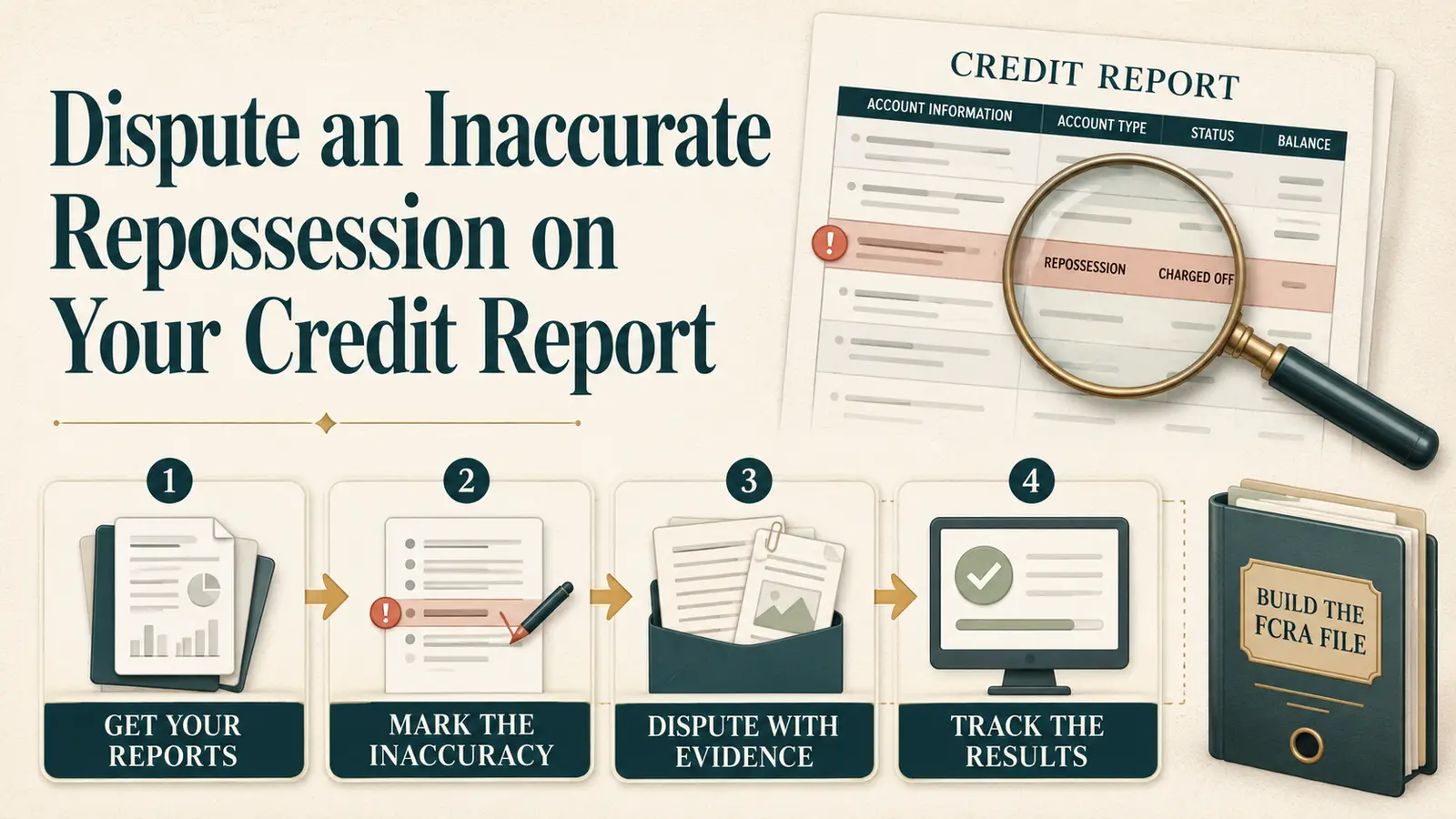
Pull the actual consumer reports
Obtain reports from the nationwide consumer reporting agencies and save them. Identify creditor name, account number, status, balance, date opened, date of first delinquency or equivalent field, and any collection account.
Do not rely solely on a credit-score app that may abbreviate or omit tradeline data.
Classify the error
Common categories include payment posted incorrectly, account shown repossessed when it was not, wrong deficiency balance, duplicate collection account, wrong ownership, or a delinquency date that appears re-aged.
Write one sentence per disputed field and cite the supporting record.
Use the FCRA dispute channel that fits
15 U.S.C. § 1681s-2 sets accuracy and furnisher duties. A dispute sent through a consumer reporting agency triggers statutory duties for the furnisher after CRA notice. Direct-dispute regulations can also apply.
Keep copies of submissions, supporting documents, and investigation results. Do not send original documents.
For a wrongful repossession, attach the servicer correction
If the lender returned the vehicle, reversed fees, or admitted an error, include the written admission or corrected account history.
Ask the servicer what it furnished to each bureau and the date of the correction.
For a deficiency amount, attach the sale reconciliation
Show the post-sale statement, sale proceeds, refund, or payment that makes the reported balance wrong.
A consumer-reporting agency is not the forum to litigate commercial reasonableness from scratch; present verifiable account facts.
Track results bureau by bureau
One bureau can update while another does not. Save each response and pull fresh reports after the investigation period.
If information remains inaccurate, identify what evidence was ignored before deciding the next escalation step.
Write the dispute around a verifiable field
Pull the current report and mark the exact field believed to be wrong: balance, payment history, account status, date, ownership, duplicate tradeline, or another item. Then attach the smallest set of records that proves the point, such as the lender’s post-sale statement, proof of payment, corrected account letter, court record, or identity information. A broad request to “delete the repossession” gives the furnisher or consumer reporting agency less concrete information to investigate.
15 U.S.C. § 1681s-2 sets duties for furnishers, and CFPB supervisory material has addressed inaccurate auto-repossession information and furnishing practices. Keep the dispute confirmation, date submitted, attachments, tracking information, and response. If a field changes, save the new report so the before-and-after record is preserved.
Do not use credit-report procedure to replace a sale-accounting challenge
If the reported balance mirrors the creditor’s current ledger but that ledger appears to omit sale proceeds or a refund, the underlying accounting may need to be challenged directly as well. Conversely, if the lender corrected its ledger but the credit report still shows the old balance, the reporting dispute is the more focused problem. Running the two tracks separately keeps the evidence and requested correction clear.
Compare all bureau versions if the error is not uniform
A furnisher may report differently across consumer reporting agencies or update them at different times. Save the report date and bureau for every version you use. If only one report contains the disputed field, say so; attaching a different bureau’s correct version can help show the inconsistency without turning the dispute into a general complaint about credit scoring.
Dispute the reporting field you can prove, not the repossession story in the abstract
A useful credit-report dispute identifies a specific field and the evidence that contradicts it: wrong balance, wrong date of first delinquency, duplicate tradeline, account reported as repossessed after the servicer rescinded the repo, or deficiency that does not reflect the sale and credits. Attach the narrow records that prove that point. The FTC explains that consumers can dispute with both the credit bureau and the business that furnished the information, and that furnishers have investigation duties when disputes are routed through a bureau or qualify as direct disputes.
Keep the Article 9 accounting file beside the FCRA file, but do not merge them. A disagreement about whether an auction was commercially reasonable is not automatically the same as a demonstrably inaccurate credit-report field. First reconcile what the creditor says happened to the account; then compare that with what each bureau reports. Track each bureau separately because one may update while another does not, and save the investigation results so a repeated error can be documented rather than re-described from memory.
Frequently asked questions
- How do I dispute a repossession on my credit report?
- Pull the actual consumer reports from each bureau, classify the specific error (wrong status, wrong balance, wrong delinquency date, or a repossession the servicer later admitted was wrong), and use the FCRA dispute channel that fits that error.
- What should I attach to the dispute?
- For a wrongful repossession, the servicer’s correction. For a wrong deficiency amount, the sale reconciliation. Write the dispute around a verifiable field, not the repossession story in the abstract.
- What if the bureaus report the account differently?
- Compare all bureau versions and dispute each one that is wrong, tracking results bureau by bureau. Keep this separate from any state-law challenge to the sale accounting.
Sources checked for this page
- 15 U.S.C. § 1681s-2 — Responsibilities of furnishersFederal duties concerning accuracy, disputes, and the date of delinquency.
- CFPB — What happens if my car is repossessed?Federal consumer overview of repossession, belongings, sale, redemption, deficiency, and credit reporting.
- CFPB Bulletin 2022-04 — Mitigating Harm from Repossession of AutomobilesCFPB supervisory and enforcement discussion of wrongful repossessions and servicing practices.