The rule limits the method, not just the reason for repossession
Model UCC § 9-609 separates two ideas. First, a secured party may take possession after default. Second, it may proceed without judicial process only if it does so without breach of the peace. A valid default does not erase the second requirement. That is why a dispute about repo-agent conduct is different from a dispute about whether a payment was actually late.
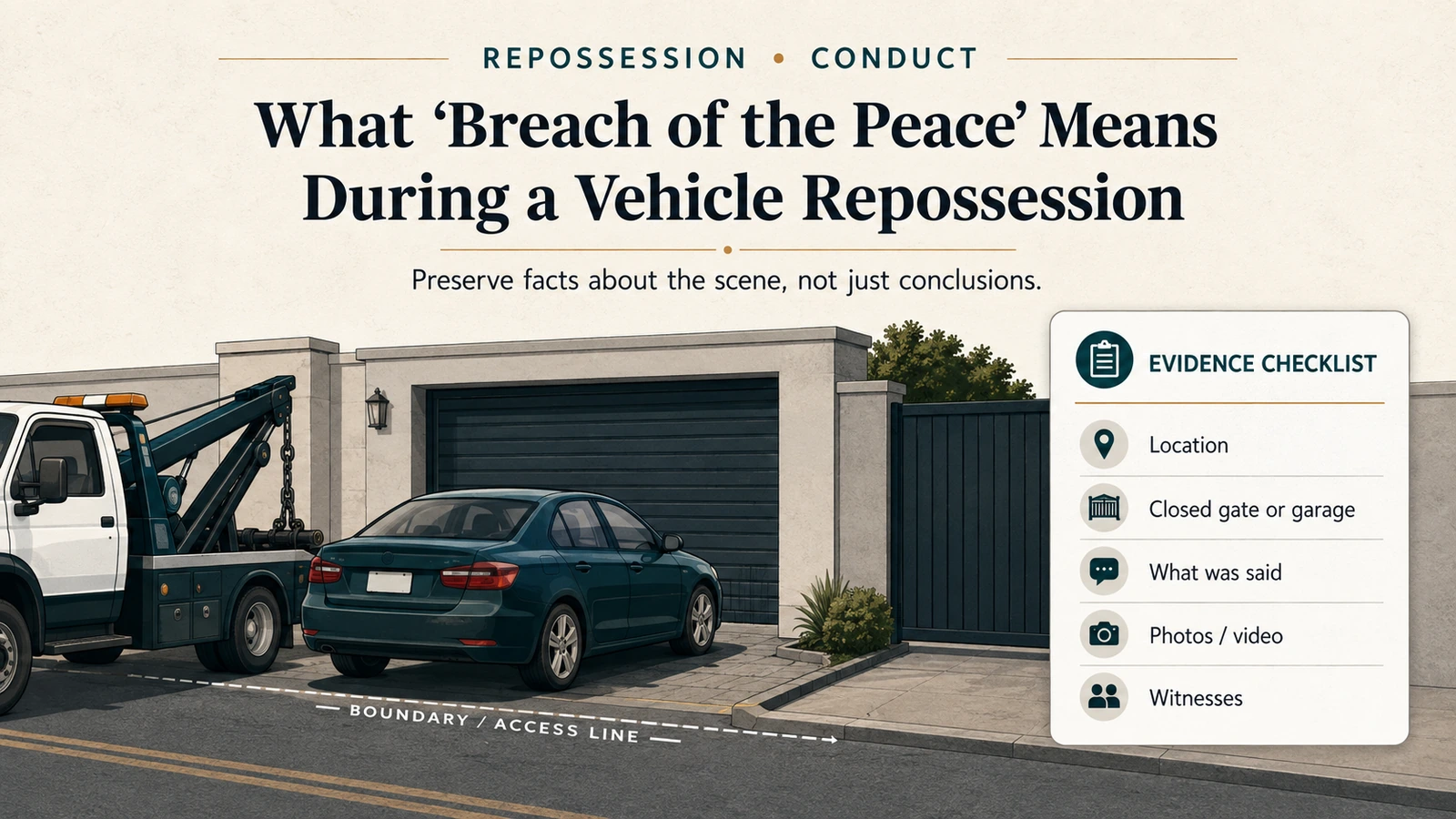
State courts give the phrase its working meaning. CFPB consumer guidance identifies common examples that can raise problems, including threats or force, taking a vehicle from a closed garage without permission, or continuing in the face of resistance. Those examples are useful warning signs, but they are not a substitute for the governing state cases.
Record facts, not legal conclusions
If a repossession is happening or just happened, write down observable facts: where the vehicle was located, whether a gate or garage was closed or locked, whether the agent entered a structure, what anyone said, whether anyone touched or threatened another person, whether the driver was already in the vehicle, and whether police were present. Preserve security-camera footage before it overwrites itself.
Avoid reducing the record to “they breached the peace.” That phrase is the conclusion a court may eventually evaluate. A contemporaneous note such as “agent cut the padlock at 2:17 a.m.; camera shows the gate closed beforehand” is far more useful because it can be compared to the state’s legal standard.
Objection can matter, but the state’s rule controls how much
Some state decisions treat a clear contemporaneous objection as important; others focus more heavily on force, threats, entry into a protected area, or escalation. The safest editorial rule is not to publish a national sentence saying that every verbal objection automatically stops a repossession. Instead, identify the state’s leading authority and describe the facts the court considered.
If a confrontation is developing, personal safety takes priority over preserving the vehicle in place. CFPB guidance notes that consumers can contact law enforcement if a breach of the peace occurs. A police response does not itself decide the civil issue, but the incident number, body-camera availability, and officer observations can become part of the evidence file.
Wrongful-repossession and breach-of-peace evidence may overlap
A repossession can be disputed because the account was not actually eligible for repossession—for example, a payment or extension was not processed—or because the method of taking the car violated the self-help limit. Those theories require different documents. Payment disputes need account histories, receipts, and servicing communications; conduct disputes need location evidence, recordings, witnesses, and damage photographs.
CFPB Bulletin 2022-04 is especially relevant to the first category because it describes supervisory concerns involving repossessions after borrowers made payments or otherwise took action that should have prevented repossession. Do not let a dramatic towing incident distract from a simpler account-status error that can be proved from the servicer’s own records.
Property damage should be documented separately
Photograph damaged gates, garage doors, locks, vehicle body panels, or other property before repairs. Keep repair estimates and invoices. Do not assume that every scratch proves a breach of the peace; damage can support a different claim or help establish how the repossession occurred.
If a repossessor gives you a condition report, preserve it even if you disagree with it. Compare it with pre-repossession photos, tow-lot photos, and the vehicle’s condition when released or sold. The chronology is often more persuasive than one isolated picture.
A breach-of-peace issue can affect the deficiency dispute later
Improper repossession conduct can have consequences beyond return of the car or damages, but the effect on a later deficiency depends on state law. Some jurisdictions may treat Article 9 noncompliance through damages or setoff; others may have state-specific rules affecting deficiency recovery. Model § 9-625 provides remedies, while § 9-626 deliberately does not prescribe a single consumer-transaction deficiency rule.
For that reason, preserve the conduct evidence even if the vehicle is later sold. The sale notice, commercial-reasonableness record, and post-sale accounting become a second layer of the case. A consumer can have more than one procedural issue in the same repossession sequence.
Frequently asked questions
- What counts as a breach of the peace during a repossession?
- Article 9 lets a secured party take the vehicle after default without a court order only if it can do so without a breach of the peace — the rule limits the method, not just the reason. Whether an objection, a locked garage, or a confrontation crosses the line is decided under your state’s cases, so record specific facts rather than legal conclusions.
- Does it help to tell the repo agent to stop?
- An objection can matter, but how much it matters depends on your state’s rule. Note who said what, when, and where, and whether the agent continued after the objection. Property damage and any physical confrontation should be documented separately.
- Can a breach of the peace affect what I owe?
- It can. A breach-of-peace problem is an Article 9 compliance issue that may feed into a later deficiency dispute or a wrongful-repossession claim, which is a separate track from the debt accounting. Preserve the evidence now even if you are not sure how it will be used.
Sources checked for this page
- UCC § 9-609 — Secured party’s right to take possession after defaultModel UCC text; the controlling law is the version enacted in the relevant state.
- CFPB — What happens if my car is repossessed?Federal consumer overview of repossession, belongings, sale, redemption, deficiency, and credit reporting.
- CFPB Bulletin 2022-04 — Mitigating Harm from Repossession of AutomobilesCFPB supervisory and enforcement discussion of wrongful repossessions and servicing practices.
- UCC § 9-625 — Remedies for secured party’s failure to complyModel remedies provision; consumer-goods consequences vary by state enactment and case law.
- UCC § 9-626 — Deficiency or surplus in issueModel burden/presumption rule; subsection (b) expressly leaves consumer-transaction rules to courts.