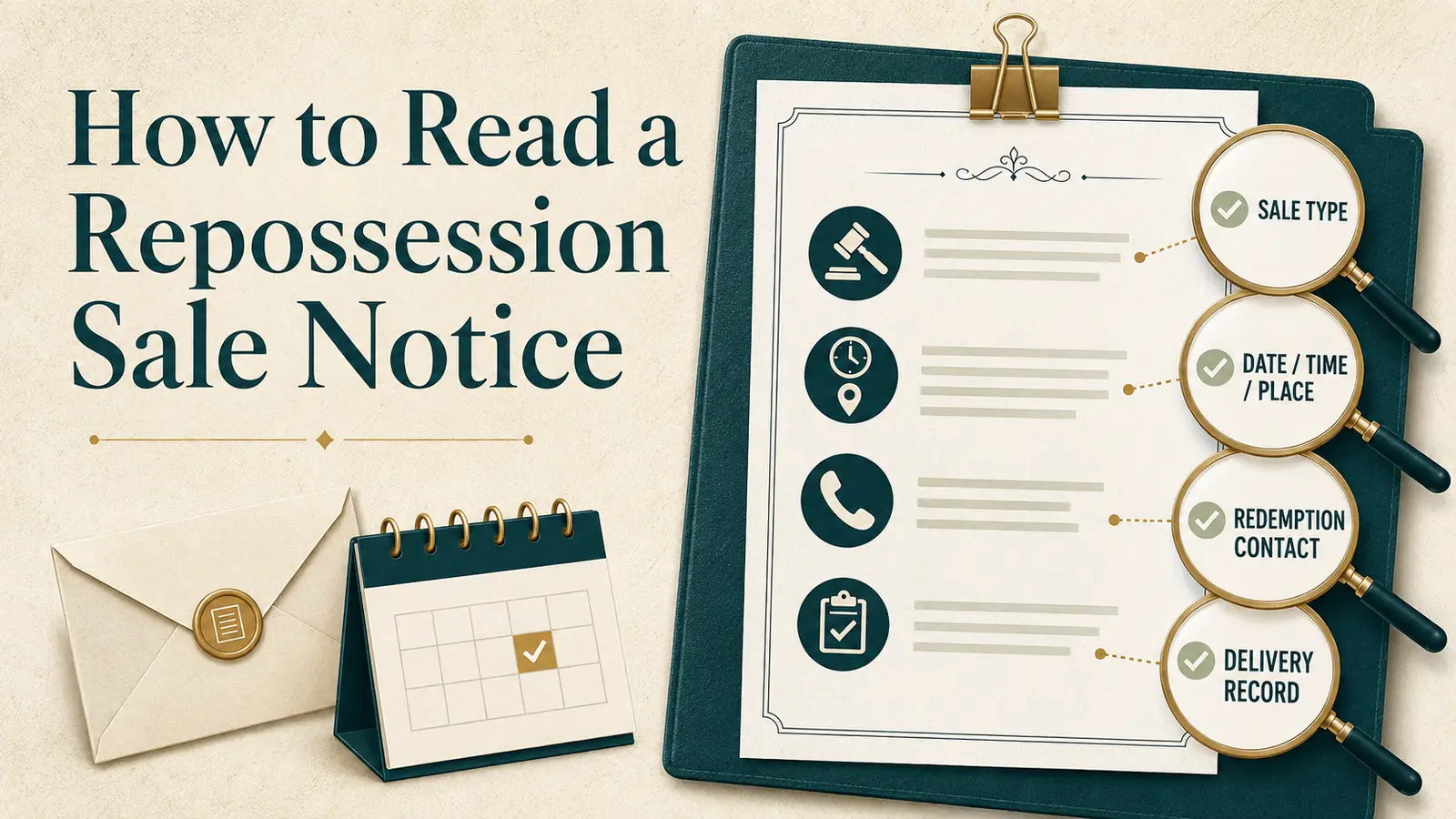
Identify whether the creditor describes a public or private disposition
Article 9 allows a secured party to dispose of collateral through public or private proceedings if the disposition is commercially reasonable. The notice rules distinguish those sale types. A public-sale notice is built around a specified time and place; a private-sale notice states a time after which the secured party intends to dispose of the collateral.
Circle the exact language that tells you which path the creditor selected. A phrase such as “may be sold at auction” is not enough by itself to understand access, timing, or whether the event is legally treated as public. If the notice provides a website or auction location, save the listing and bidder terms.
Separate the core notice facts from the consumer-goods additions
Model § 9-613 identifies general contents such as the debtor, secured party, collateral, method of disposition, and timing. Model § 9-614 adds consumer-goods information, including a description of liability for a deficiency, a telephone number for the redemption amount, and a telephone number or address for additional disposition information.
Make a checklist from the actual state enactment rather than from memory. A state may reproduce the model language closely, add motor-vehicle requirements elsewhere in its code, or have case law interpreting the form. The safest audit therefore starts with the state statute and then compares the creditor’s letter line by line.
Keep delivery evidence with the notice
Reasonable notification is not only a content issue. The sending date, address used, method of delivery, and returned mail can matter. Preserve the envelope, certified-mail record, email header, portal notification, or text alert that led you to the notice.
If the notice was sent to an old address, document when the creditor received the updated address. If the notice came electronically, save it as a file rather than relying on continued portal access. The timing question is easier to analyze when the record shows both when the notice was sent and when the sale occurred.
Do not overlook the redemption contact information
A consumer-goods notice should direct the debtor to information about redemption. The legal right itself comes from the state’s enacted Article 9 and can end before disposition or certain equivalent events. The contact number or address in the notice is therefore operationally important.
When requesting a redemption quote, ask for the amount in writing, the components of repossession-related expenses, how long the quote is valid, accepted payment methods, and the cutoff for receipt. If a separate reinstatement right exists under state law, request that amount under a different label.
Read the deficiency language as a warning, not as a final number
Before sale, the creditor cannot yet know the final net proceeds. The notice may explain that the consumer can remain liable for a deficiency. The actual balance is determined after disposition and application of proceeds.
After sale, match the notice to the post-sale explanation. If the creditor later claims a deficiency, you should be able to trace the vehicle, sale date, proceeds, expenses, and credits. A notice that looks compliant does not answer whether the sale itself was commercially reasonable.
Use the notice to create a task list
Record the earliest sale date or date after which a private sale may occur; request any cure, reinstatement, or redemption quote that could matter; arrange retrieval of personal property; preserve the notice and delivery proof; and start a folder for sale-result records.
If something appears missing or late, identify the exact statutory item rather than writing “bad notice.” That precision matters because state law controls the consequence of noncompliance, including how a later deficiency claim is treated.
Read the notice as a set of operational instructions
For consumer-goods transactions, model § 9-614 builds on § 9-613 and calls for additional information. Instead of checking only whether a notice exists, mark the debtor and secured-party information, description of collateral, method of intended disposition, time and place details required for a public sale or the earliest time for another disposition, and the consumer-oriented explanation and contact information required by the enacted law. A state may alter or supplement the model text, so the state statute remains the publication source for a state page.
Then test the notice against what actually happened. Compare the VIN or vehicle description, public-versus-private method, stated earliest date, auction record, and final sale date. Keep the envelope, email headers, portal timestamp, or other delivery evidence. A perfectly worded notice that was never sent through the claimed channel presents a different question from a notice that arrived but omitted a required item.
Use the notice to trigger a before-sale evidence check
Before the stated disposition window closes, preserve the vehicle’s pre-repossession condition records, repair receipts, mileage evidence, payoff or redemption requests, and any communications about extensions or accepted payments. If the notice identifies a public sale, record the auction address, date, time, registration terms, and whether the auction later changed those details. If it describes a private sale, record the earliest date and request the final disposition information afterward rather than assuming the vehicle sold on that first eligible date.
Frequently asked questions
- What should a repossession sale notice contain?
- For consumer goods, Article 9 (§§ 9-611, 9-613, 9-614) generally calls for the debtor and secondary obligors to be identified, the collateral described, the sale method stated (public or private), the relevant date or time, and information on redemption and on getting an accounting. Consumer transactions have extra content rules.
- Which date on the notice matters most?
- For a public sale, the date, time, and place of the auction. For a private sale, the date after which the vehicle may be sold. Also keep the delivery evidence, because the date the notice was sent can control a later timing dispute.
- Is the deficiency figure in the notice final?
- No. Language warning that you may owe a deficiency is a warning, not a settled number. Use the notice to build a before-sale task list — confirm the redemption contact, request an accounting, preserve the notice exactly as received.
Sources checked for this page
- UCC § 9-611 — Notification before dispositionModel UCC text; state enactments can add requirements.
- UCC § 9-613 — Contents of notification: generalGeneral notice content; consumer-goods transactions use § 9-614.
- UCC § 9-614 — Contents of notification: consumer-goods transactionModel consumer-goods disposition notice rules and safe-harbor form.
- UCC § 9-623 — Right to redeem collateralModel redemption right before disposition, collection, or acceptance.
- CFPB — What happens if my car is repossessed?Federal consumer overview of repossession, belongings, sale, redemption, deficiency, and credit reporting.