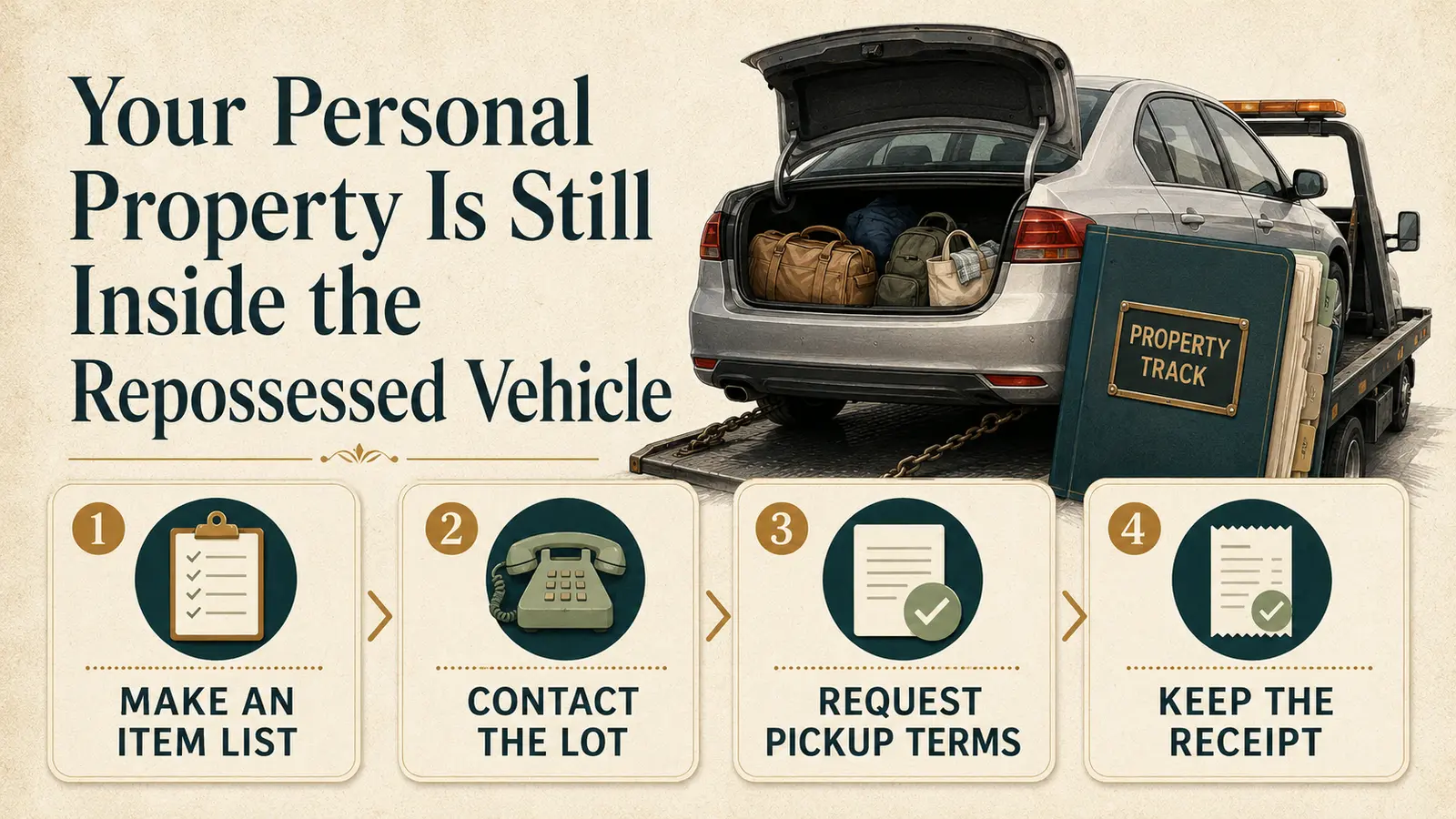
Write an inventory before calling the lot
List work tools, child seats, documents, medication, mobility equipment, electronics, clothing, cash, and other items you believe were inside. Include where each item was located and an approximate value for anything significant.
CFPB guidance recommends documenting belongings and contacting the lender promptly to arrange retrieval. A same-day inventory is more credible than a list reconstructed weeks later.
Find the actual custodian
The lender may use a repossession agency, forwarder, storage facility, or auction. Ask who physically holds the vehicle and property, the address, pickup hours, identification required, and whether an appointment is necessary.
Keep the names of every person who gives instructions. If the property has already moved to another location, ask for the transfer date and destination.
Ask for any inventory created by the repossessor
Many repossession companies photograph or inventory visible items. Request a copy or ask to inspect it at pickup.
Compare it with your own list. A discrepancy identified before leaving the lot is easier to document than a later claim.
Do not assume a fee is lawful merely because it is demanded
CFPB has publicly described unfair practices involving withholding consumers’ personal property unless an upfront fee was paid. State law can regulate storage, inventory, notice, and disposal in different ways.
If a fee is demanded as a condition of getting belongings back, ask for the legal or contractual basis in writing and check the state-specific source. Do not confuse vehicle storage fees with a right to hold unrelated personal property.
Document the pickup
Bring a witness if practical, photograph returned items, and make a written note of anything missing or damaged before leaving. Ask for a receipt showing the date of release.
If important documents or medication are urgently needed, say so in the written request. Some disputes can be avoided when the lot understands the property is not optional household clutter.
Escalate the property issue separately
If items are withheld, missing, or disposed of, the relevant state attorney general, licensing agency, or consumer-protection office may have a complaint process.
Keep the property dispute separate from the deficiency or redemption negotiation. Mixing them can make it harder to prove what the lender or repo company actually said about each issue.
Separate the lender’s collateral from items that were simply inside the car
A vehicle repossession gives the secured party rights in the collateral described by the security agreement; it does not turn every loose item in the cabin or trunk into collateral. State law and the contract can affect handling, storage, notice, and retrieval, so the practical move is to make an inventory rather than argue ownership over the phone. List each item, approximate location in the vehicle, distinguishing features or serial numbers, and whether it is medication, identification, work equipment, child equipment, or another time-sensitive item.
Contact the lender and repossession/storage company through a traceable channel and ask where personal property is held, available pickup windows, identification requirements, whether an appointment is needed, and what record will show the items returned. If a fee is demanded, ask what the fee is for and request the legal or contractual basis rather than assuming every storage charge is valid or invalid.
Create a pickup record that closes the inventory
Bring identification and, if allowed, a copy of the item list. Before leaving, compare what was returned against the list and note missing or damaged items immediately. Photograph the property if appropriate and keep the release or pickup receipt. Do not sign a broad release of unrelated loan or repossession claims merely because a form is presented at the property window without first understanding what the document says.
Escalate missing items with a precise list
If property is missing, send a written list identifying each item and the date you attempted retrieval, and ask the creditor or repo company to preserve its inventory, photographs, video, and chain-of-custody records. State law determines available remedies and any storage rules. The value of the file comes from specificity: “one DeWalt drill, model…, serial…” is easier to investigate than “tools missing.”
Frequently asked questions
- Do I have a right to the belongings left in a repossessed car?
- Yes. The lender’s interest is in the vehicle as collateral, not in your personal items. Write an inventory before calling the lot, find the actual custodian, and ask for any inventory the repossessor created.
- Can they charge me a fee to get my belongings back?
- A demanded fee is not automatically a lawful fee. Do not assume a storage or handling charge for personal property is proper just because it is demanded — check your state’s rule, and document the pickup.
- What if items are missing?
- Escalate the property issue separately from the loan dispute, with a precise list of what was in the vehicle and what came back. Create a pickup record that closes the inventory.
Sources checked for this page
- CFPB — What happens if my car is repossessed?Federal consumer overview of repossession, belongings, sale, redemption, deficiency, and credit reporting.
- FTC — Vehicle RepossessionFederal consumer guidance on default, repossession, personal property, sale, and deficiency.