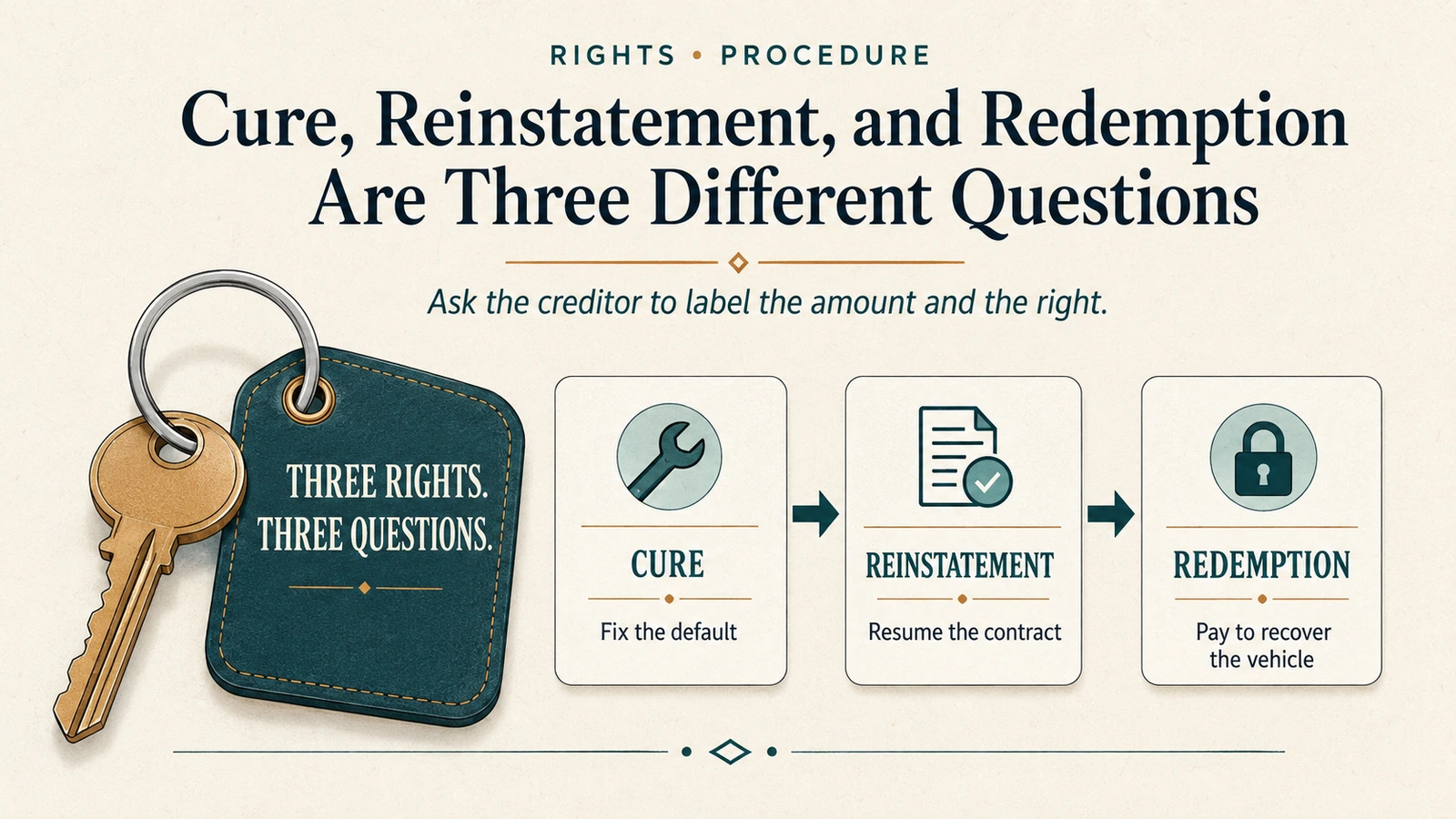
Cure fixes a default; redemption satisfies the secured obligation
A cure usually means bringing a delinquency current by paying missed installments and allowed charges so the contract is no longer in default. Reinstatement is often used for a post-repossession version of that idea: the borrower pays the required arrears and fees and the installment contract resumes. Whether either right exists can come from state consumer-credit law, a motor-vehicle retail installment statute, or the contract itself.
Redemption under Article 9 is different. The model § 9-623 requires fulfillment of all obligations secured by the collateral plus specified reasonable expenses and attorney’s fees. In a typical accelerated auto account, that can look much closer to a payoff than to “catching up.” The result is also different: redemption removes the collateral from the creditor’s disposition process instead of merely curing one overdue installment.
The fastest way to avoid a vocabulary mistake is to ask for two labeled quotes
Ask the servicer whether it offers a cure or reinstatement amount after repossession and, separately, what it requires for redemption. If the answer is that no reinstatement is available, request the source of that conclusion: state law, contract terms, or account status. Then ask for the redemption amount and the event or date that will end the opportunity.
A useful written request asks for the amount, a line-item explanation of repossession/storage fees, payment method, payoff good-through date, and where payment must be delivered. If a reinstatement is available only after proof of insurance or another condition, get that condition in writing as well. Do not assume a call-center phrase such as “bring the account current” is a legally complete quote.
State cure statutes often contain repeat-default rules
States that create a right to cure do not all use the same pattern. Some require a default to continue for a certain number of days before notice can be sent; some give a stated cure period after notice; and some limit how often a consumer can demand the cure process within a rolling period. Those details can make a prior default relevant to the current repossession.
That is one reason this site does not publish a national “you always have X days” number. The state page should identify the actual enacted section and explain whether the right is pre-repossession, post-repossession reinstatement, or both. A contract can sometimes provide a voluntary option that is more generous than the statute, but it should not be confused with a state-law entitlement.
Redemption is tied to disposition, not a universal day count
The model UCC describes redemption as available before the secured party disposes of the collateral or enters a contract for disposition, or before acceptance of collateral in satisfaction. That means the practical deadline often depends on the creditor’s planned sale rather than a fixed “30-day federal rule.” A consumer notice should therefore be read together with the state’s enacted Article 9 and any motor-vehicle-specific law.
If the vehicle is headed to a public auction, the notice should identify the sale details required by the applicable law. If it is a private disposition, the notice may state a date after which the creditor may sell. Waiting until the last hour creates payment-delivery risk, so verify the creditor’s cutoff and payment channel instead of relying only on the legal outer boundary.
A buy-back at auction is not redemption
At a public sale, a debtor may be able to bid like another participant if the auction is open and the terms permit it. But winning a bid is a purchase transaction governed by the auction terms; redemption is an exercise of the debtor’s right before the terminating event under § 9-623. The funds required, title paperwork, and timing can differ substantially.
This distinction matters when someone says, “I can just buy my own car back cheaper at auction.” The bid price may be lower than a redemption quote, but there is no guarantee the debtor will win, the auction may have registration rules, and the creditor may sell before the debtor completes a redemption if the legal deadline is missed. Treat them as alternative paths, not interchangeable labels.
Keep the three outcomes in a simple matrix
For cure: ask what default must be fixed and whether the contract continues. For reinstatement: ask whether it is available after repossession and what conditions must be satisfied. For redemption: ask for the full secured-obligation figure, expenses, and the last point before disposition or acceptance.
Then compare the source behind each answer. The creditor’s notice is evidence of what it is offering or asserting; the contract explains agreed terms; the state statute controls statutory rights; and Article 9 supplies the general redemption framework. When those sources appear to conflict, that is the moment to stop relying on a verbal summary and get state-specific help.
Frequently asked questions
- What is the difference between curing and redeeming?
- Cure or reinstatement fixes the delinquency — you pay the past-due amount plus allowed fees and the contract continues. Redemption satisfies the entire secured obligation plus reasonable expenses. They use different dollar amounts and different legal triggers, so ask the creditor for two separately labeled quotes.
- Can I always cure a default before repossession?
- No. Cure rights come from a state statute or the contract, not a universal rule, and many states have no general statutory right to cure. Where a cure right exists, it often carries repeat-default limits — for example, available only once in a 12-month period.
- Is buying the car back at auction the same as redeeming it?
- No. Redemption is a debtor right exercised before the sale by tendering the payoff; an auction purchase is a new sale transaction at the sale price. Choosing one over the other can change the deficiency math, so decide based on legal effect rather than the headline price.
Sources checked for this page
- CFPB — What happens if my car is repossessed?Federal consumer overview of repossession, belongings, sale, redemption, deficiency, and credit reporting.
- UCC § 9-623 — Right to redeem collateralModel redemption right before disposition, collection, or acceptance.
- UCC § 9-611 — Notification before dispositionModel UCC text; state enactments can add requirements.
- UCC § 9-614 — Contents of notification: consumer-goods transactionModel consumer-goods disposition notice rules and safe-harbor form.