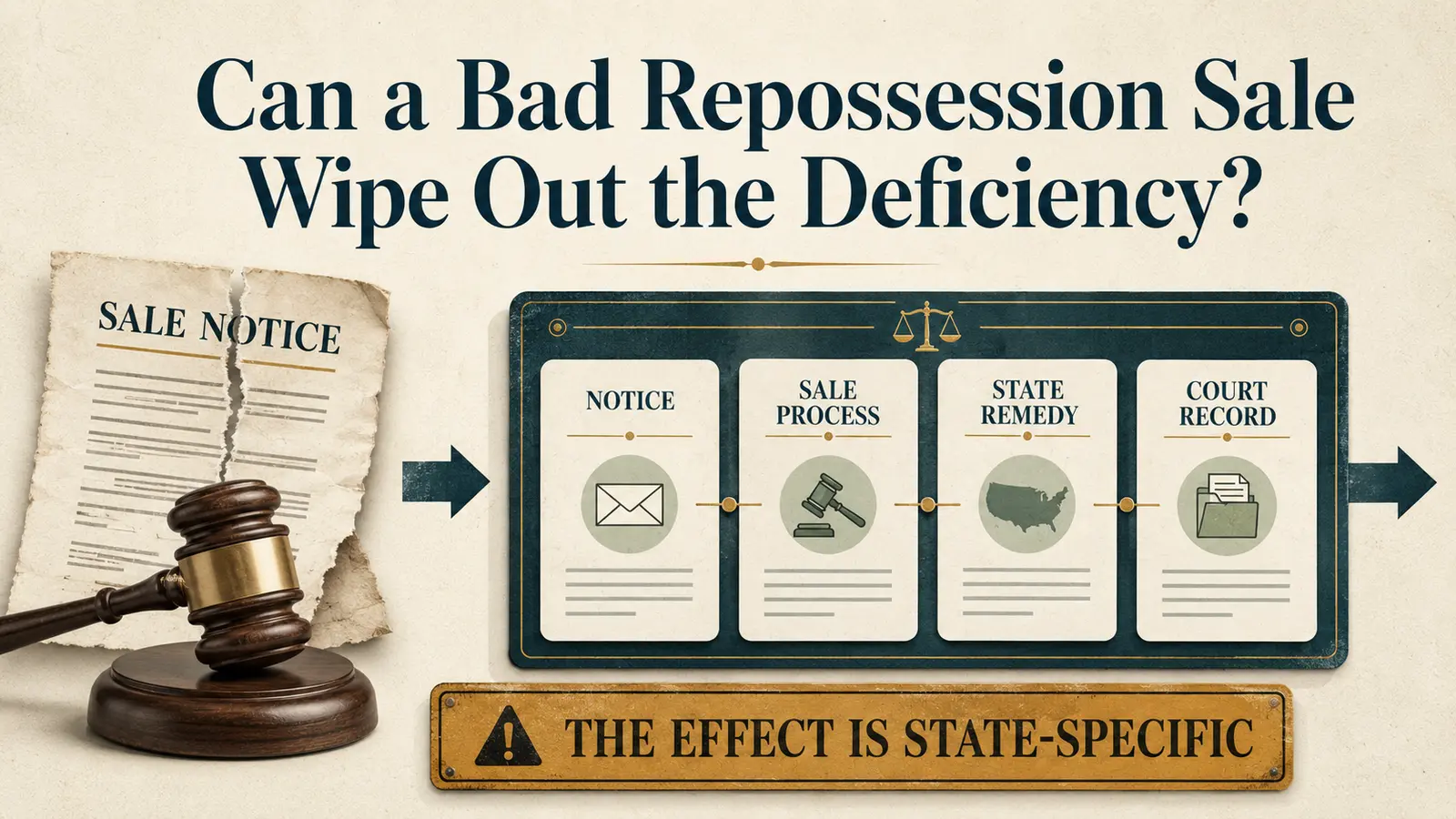
Model § 9-626 is not a nationwide consumer formula
For nonconsumer transactions, § 9-626 contains a rebuttable-presumption structure for deficiency disputes. Subsection (b) says that the limitation of deficiency rules for consumer transactions is left to the courts rather than prescribed by the model section.
That drafting choice is why two neighboring states can reach different deficiency outcomes after similar notice defects.
Absolute-bar rules can eliminate deficiency recovery in defined circumstances
Some states or state cases treat specified noncompliance as an absolute bar to a deficiency. The rule may be limited to a particular motor-vehicle statute, notice requirement, or creditor category.
Do not summarize an absolute-bar case without identifying its scope. A dealer-seller covered by a retail-installment act may face a different rule from a bank enforcing a different type of security agreement.
Rebuttable-presumption rules change the burden and calculation
Under a rebuttable-presumption approach, noncompliance can create a presumption that the collateral’s value equaled the debt or that a compliant sale would have produced a different amount, while allowing the creditor to rebut with evidence.
The exact formulation is state-specific. The consumer still needs records showing the violation, and the creditor may present valuation or market evidence.
Other states use damages or setoff approaches
A court may allow deficiency recovery while awarding statutory or actual damages for noncompliance, or offsetting those amounts. Model § 9-625 supplies a remedies framework that states can enact and supplement.
The practical result can be very different from “no deficiency,” even when the creditor clearly violated a rule.
Identify the violation before asking about the remedy
Missing notice content, unreasonable timing, breach of the peace, commercially unreasonable sale, and bad accounting are different kinds of noncompliance. A state may attach different consequences to each.
Write the issue in one sentence with the controlling section: for example, “The consumer-goods disposition notice omitted X required by state § ___.” Then research the remedy for that exact defect.
The state page should cite controlling authority
A reliable 50-state article must link to the enacted statute and, where the remedy comes from case law, the controlling state appellate decision or official court source.
This is one of the areas where mail-merge content is especially dangerous: the headline issue is common, but the legal consequence is not.
Remedy rules are one of the areas where a state page must do real work
Article 9 supplies remedies for noncompliance, but the effect of a defective notice or commercially unreasonable disposition on a consumer deficiency is not safely reduced to one national sentence. Model § 9-626 contains a rebuttable-presumption framework for specified non-consumer transactions and expressly leaves consumer-transaction rules to other law. States have developed different approaches, including rules that can reduce, bar, or shift the proof on a claimed deficiency.
That means a consumer article should identify the defect first—notice content, timing, delivery, sale method, price/process, or accounting—and then research the state’s enacted statute and controlling cases. “The lender made a mistake” is not yet an answer to “what happens to the deficiency.” The consequence is the state-specific issue that needs a citation.
Preserve evidence before arguing the remedy
Keep the complete disposition notice, proof of sending, sale advertisement, auction run or buyer information, condition report, gross and net sale figures, itemized expenses, § 9-616 explanation, and account history. If the creditor sues, those records let the court issue be framed around a specific statutory obligation and a specific dollar consequence rather than a general complaint that the auction felt unfair.
Consumer transactions require state-specific consequence research
Do not quote the non-consumer rebuttable-presumption provision as though Congress or the UCC drafters selected one consumer remedy nationwide. For each state article, search the enacted Article 9 remedies section and recent controlling appellate decisions that address consumer collateral. If the state authority is unclear, say that rather than assigning the state to an “absolute bar” or “rebuttable presumption” column from a secondary chart.
Separate the accounting problem from the remedy problem
A defective notice or disposition can affect the creditor’s ability to prove a deficiency, but the path is not uniform across states. Start by preserving the original notice, proof of sending, auction or private-sale record, bids, condition report, and the post-sale calculation. Then identify the state enactment of UCC § 9-626 and any consumer-goods rule or appellate decision that says what follows from noncompliance. This keeps two questions apart: whether the sale process complied with Article 9, and what remedy the controlling state law attaches to that failure.
Do not assume that a low price alone proves an unreasonable sale or that a notice defect automatically cancels the balance. Some jurisdictions use a rebuttable-presumption approach, some have consumer-specific rules, and older cases may use different terminology. A useful file therefore records the defect precisely—wrong timing, missing required content, wrong sale method, inadequate marketing, or unsupported expenses—and then matches that defect to the state authority before calculating what, if anything, remains collectible.
Frequently asked questions
- Can a bad repossession sale eliminate the deficiency?
- Sometimes, depending on the state. Model § 9-626 is not a nationwide consumer formula — states use absolute-bar, rebuttable-presumption, setoff, or damages approaches after Article 9 noncompliance.
- What is the difference between absolute-bar and rebuttable-presumption?
- An absolute-bar rule can eliminate deficiency recovery in defined circumstances. A rebuttable-presumption rule instead shifts the burden and changes the calculation, presuming the collateral was worth the debt unless the creditor proves otherwise.
- What comes first — the violation or the remedy?
- Identify the specific Article 9 violation first, then research the consequence under your state’s controlling authority. Preserve the evidence before arguing the remedy, and keep the accounting problem separate from the remedy problem.
Sources checked for this page
- UCC § 9-626 — Deficiency or surplus in issueModel burden/presumption rule; subsection (b) expressly leaves consumer-transaction rules to courts.
- UCC § 9-625 — Remedies for secured party’s failure to complyModel remedies provision; consumer-goods consequences vary by state enactment and case law.
- UCC § 9-614 — Contents of notification: consumer-goods transactionModel consumer-goods disposition notice rules and safe-harbor form.
- UCC § 9-627 — Commercial reasonablenessModel guideposts for commercially reasonable disposition.