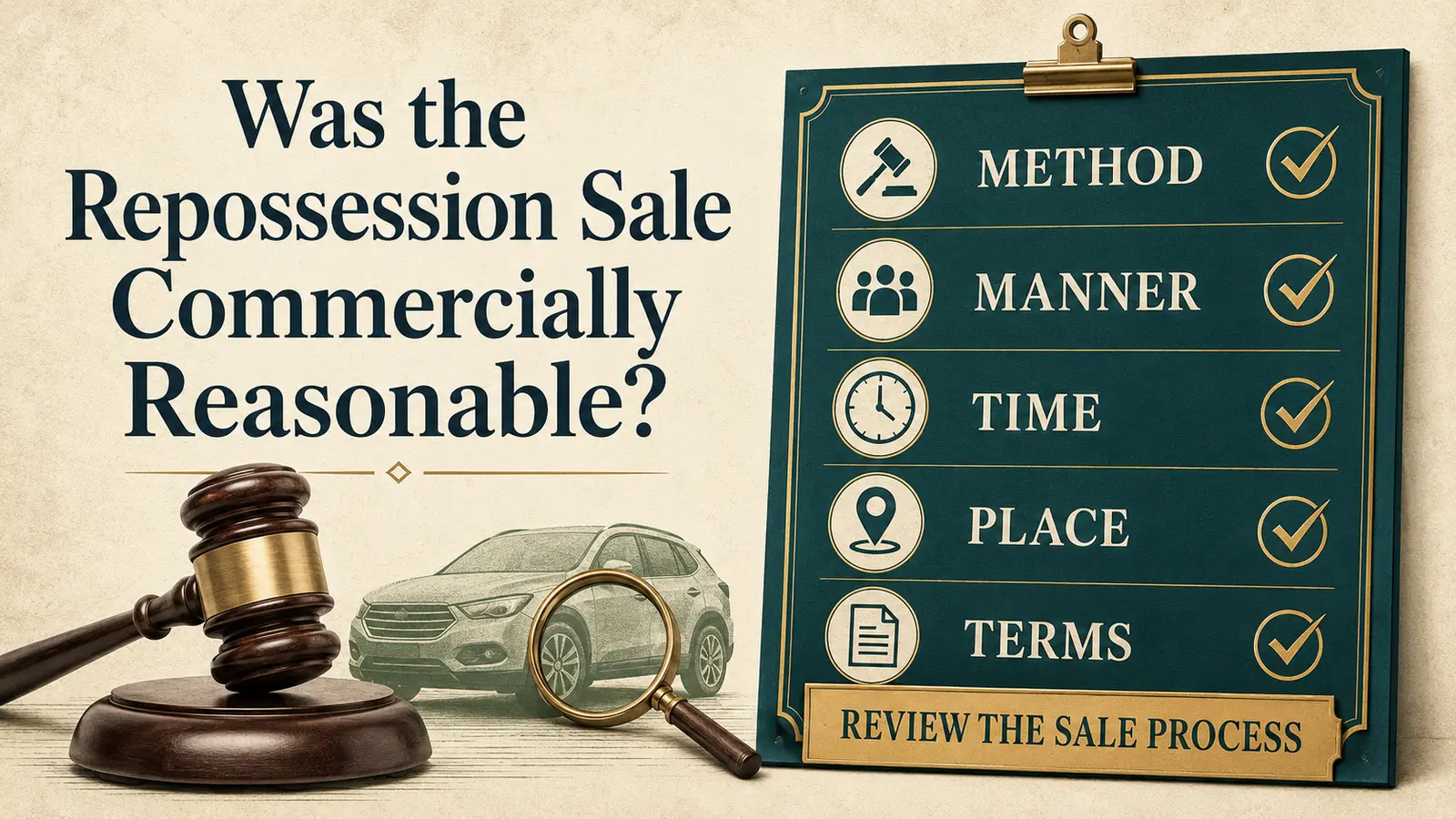
Start with the statutory dimensions of the sale
Model § 9-610 says every aspect of disposition—including method, manner, time, place, and terms—must be commercially reasonable. Model § 9-627 then gives guideposts, including conformity with recognized-market practices or reasonable commercial practices among dealers in the type of property sold.
Create a five-column worksheet using those statutory words. Put every piece of evidence under the right column. This prevents an appraisal number from swallowing the rest of the inquiry.
Method asks how the vehicle was exposed to buyers
Identify whether the creditor used a public auction, dealer auction, online platform, direct dealer sale, or another channel. Determine whether that channel is commonly used for similar repossessed vehicles and whether access rules reduced competition.
A dealer-only auction can still be commercially reasonable; a retail listing is not automatically required. The question is whether the chosen method and its execution fit reasonable commercial practice for the type and condition of vehicle.
Manner focuses on how the chosen method was carried out
Look for advertising, photographs, condition reports, title status, mechanical disclosures, inspection opportunities, reserve price, bidder notices, and sale-day procedures. A reasonable channel can be used unreasonably if the vehicle is poorly presented or essential information is withheld.
Save the auction run sheet and listing before it disappears. Ask the creditor for the sale report and invoices used in the deficiency calculation. Small procedural details can explain a large price difference.
Time and place can affect exposure and value
A quick sale is not automatically improper, and a delayed sale is not automatically reasonable. Consider whether storage costs were increasing, whether the vehicle was seasonally sensitive, whether the market location was suitable, and how much notice buyers received.
If the sale occurred far from the repossession location, determine whether transport expenses were charged to the account and whether the destination was a normal wholesale market. The deficiency calculation and commercial-reasonableness analysis can overlap through those costs.
Price evidence should be comparable to the actual vehicle and sale level
Use VIN-specific history, mileage, trim, condition, accident history, wholesale data, and contemporaneous comparable sales where possible. A dealership’s asking price for a reconditioned retail vehicle is not the same thing as a wholesale auction value.
The strongest price evidence explains the adjustments instead of simply presenting a higher number. If the creditor’s sale price looks low even after wholesale and condition adjustments, the process records become more important.
The consequence of an unreasonable sale is a state-law question in consumer cases
Model § 9-626 contains a rebuttable-presumption rule for nonconsumer transactions but expressly says courts may continue to apply established approaches in consumer transactions. States therefore differ on whether noncompliance bars a deficiency, creates a presumption, allows a setoff, or produces damages.
Do not copy a deficiency remedy from another state. The state article should cite the controlling statute or appellate decision that describes the consumer consequence.
Build the review around process evidence, not one price comparison
Model § 9-627 expressly says a disposition is not commercially unreasonable merely because a greater amount could have been obtained at another time or by another method. That means a retail listing, valuation guide, or dealer quote is useful context but is not a complete legal test. Collect facts about how the secured party marketed the vehicle, where it sold, whether the method is recognized in the vehicle-finance market, the condition and mileage represented to bidders, timing, inspection access, and the relationship between seller and buyer.
Compare like with like. A dealer retail asking price usually includes reconditioning, warranty risk, overhead, and margin that may not exist in a wholesale auction. Better comparators can include same-model wholesale results, condition-adjusted market reports, the actual auction run list, or expert appraisal evidence. Record VIN, trim, options, mileage, title status, damage, and mechanical condition so that a price comparison is not built on a different vehicle specification.
Preserve the creditor’s explanation before the records disappear
Ask for the sale date, gross price, sale channel, auction or buyer, itemized disposition expenses, and any condition report or inspection information that supports the account. Save the disposition notice and delivery evidence too. If the creditor later sues for a deficiency, model § 9-626 addresses the effect of noncompliance in specified non-consumer contexts, while consumer-transaction consequences are often heavily state-specific. Do not publish a national “bad sale cancels the deficiency” rule.
Frequently asked questions
- What does “commercially reasonable” actually mean?
- It is a process test across statutory dimensions: the method the vehicle was exposed to buyers, the manner that method was carried out, and the time, place, and terms of the sale. A price alone does not answer it.
- Is a low sale price proof of an unreasonable sale?
- Not by itself. Price evidence has to be comparable to the actual vehicle, its condition, and the market level of the sale (wholesale vs. retail). The stronger showing is about process — how the vehicle was marketed and sold.
- What happens if the sale was not commercially reasonable?
- The consequence in a consumer case is a state-law question — states use absolute-bar, rebuttable-presumption, setoff, or damages approaches. Preserve the creditor’s written explanation of the sale before the records disappear.
Sources checked for this page
- UCC § 9-610 — Disposition of collateral after defaultModel UCC text for public/private disposition and commercial reasonableness.
- UCC § 9-627 — Commercial reasonablenessModel guideposts for commercially reasonable disposition.
- UCC § 9-626 — Deficiency or surplus in issueModel burden/presumption rule; subsection (b) expressly leaves consumer-transaction rules to courts.
- UCC § 9-625 — Remedies for secured party’s failure to complyModel remedies provision; consumer-goods consequences vary by state enactment and case law.