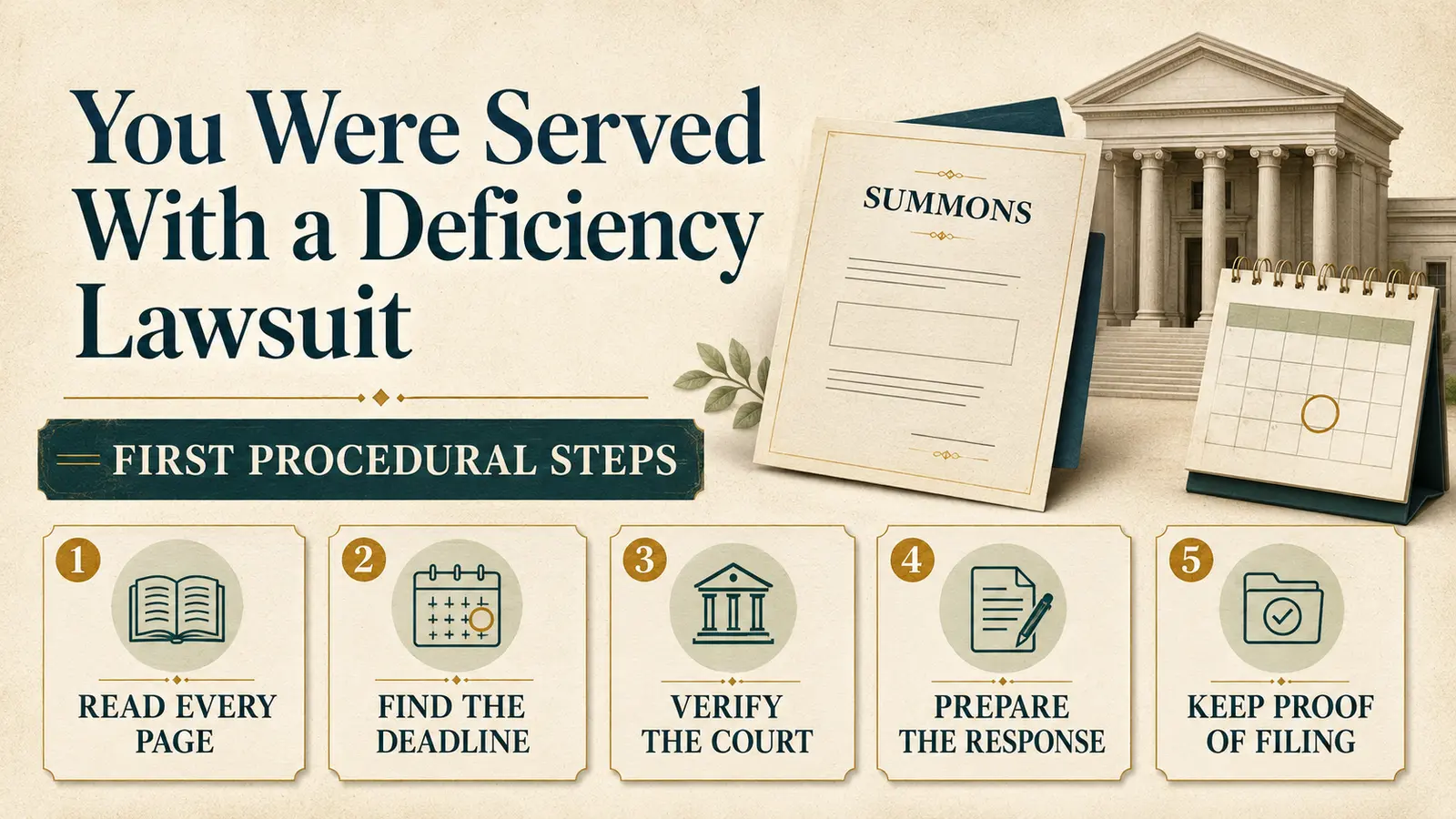
Read the caption and response instructions
Identify the court, case number, plaintiff, defendants, filing date, service date, and the document that states how and when to respond.
CFPB guidance warns that ignoring a debt lawsuit can lead to default judgment. Calling the collector does not necessarily count as filing an answer.
Verify the plaintiff’s chain to the debt
If the plaintiff is the original creditor, match the account and vehicle. If it is a debt buyer, identify assignment or account-sale records supporting ownership.
Do not assume a name you do not recognize means the case is fake; verify through the court docket and pleadings.
Build the repossession evidence packet
Include contract, payment history, cure notices, repossession record, disposition notice, delivery proof, sale report, § 9-616 explanation, credit/refund records, and collector validation information.
Label documents by date. A chronological packet makes notice and limitation issues much easier to spot.
Check the state-specific limitation period
The deadline for filing a deficiency action can depend on how the state classifies a retail installment contract and when the claim accrued. Some courts apply the UCC Article 2 four-year period; others use a written-contract statute or a specific vehicle-finance rule.
Use the state page and controlling authority. Do not import another state’s number.
Separate factual disputes from legal defenses
A wrong balance, missing credit, or payment-posting error is a factual issue. Defective notice, unreasonable sale, limitation, standing, or statutory bar are legal issues.
Organize both, but do not assume a website can select which defenses should be pleaded in a particular court. Court forms or counsel control the answer format.
Preserve negotiation without missing filing deadlines
Settlement discussions can continue, but get any extension or agreed dismissal in writing and confirm it with the docket when required.
If the plaintiff promises not to seek default while discussing settlement, do not rely on that promise unless it is enforceable under the court’s procedures.
Extract the court instructions before researching defenses
On the day the papers are received, record the court, case number, plaintiff, named defendants, date and method of service, response deadline printed or supplied by local rule, hearing date if any, and filing method. Verify the case on the official court docket where available. A letter to the collector is not a court answer, and a phone call does not extend a deadline unless the court actually enters an order or the governing procedure says so.
Next, separate the complaint’s allegations into a checklist: existence of the contract, default, repossession, notice, disposition, sale proceeds, claimed expenses, credits, deficiency calculation, assignment or ownership of the account, and requested interest or fees. Match each allegation to a document. This approach does not choose a legal defense for the consumer; it makes gaps and disputed facts visible before the answer is prepared under state court rules.
Preserve proof about the sale because deficiency cases are accounting cases too
Keep the disposition notice and delivery record, auction or buyer information, gross and net proceeds, condition evidence, § 9-616 explanation, payment history, contract, and collector validation information. State law can make notice or commercial-reasonableness issues important to the amount recoverable. If a default judgment already exists, the procedural question has changed; retrieve the judgment and docket before using an “answer” guide designed for a newly filed case.
Use the court’s form and local rules, not a national answer template
Answer format, filing fee or waiver procedure, service on the plaintiff, affirmative-defense practice, and response time vary by court. Download forms and instructions from the actual court system shown on the summons. A national guide can teach the document triage, but it should never publish one fill-in-the-blank answer as valid nationwide.
Build a docket checklist before writing anything about the merits
Record the court name, case number, plaintiff, every defendant, date of service, response deadline, hearing date if any, and the exact method the court permits for filing. Then obtain the court’s current answer form or local instructions. A debt complaint can attach an account statement, contract, assignment record, sale information, or none of those; list what is actually present before deciding what evidence is missing. CFPB guidance emphasizes responding to a lawsuit rather than ignoring it because failing to respond can lead to a judgment.
The merits file comes next. Match the amount demanded to the repossession ledger, § 9-616 explanation, sale proceeds, and any credits. Preserve the disposition notice and envelope because notice and commercial-reasonableness issues can affect a deficiency under state law. Do not let settlement discussions consume the response period. If the plaintiff offers more time, obtain a written stipulation or court order where required; a collector’s informal promise is not a substitute for the deadline printed by the court.
Frequently asked questions
- I was served with a deficiency lawsuit — what is the first thing to do?
- Read the caption and the response instructions and calendar the deadline to file a written answer, which is often just a few weeks. Missing it can lead to a default judgment.
- What should I verify about the plaintiff?
- Verify the plaintiff’s chain to the debt — whether the suing party is the original creditor or a debt buyer, and whether it has documentation connecting it to your account.
- What evidence should I gather?
- The repossession evidence packet: contract, payment history, every notice with its delivery date, and the sale accounting, because deficiency cases are accounting cases. Check the state limitation period and use the court’s own answer form and local rules.
Sources checked for this page
- CFPB — What should I do if I’m sued by a debt collector or creditor?Federal consumer guidance to read the papers and respond by the court deadline.
- UCC § 9-616 — Explanation of surplus or deficiencyModel consumer-goods rule for pre- or post-disposition explanation.
- UCC § 9-626 — Deficiency or surplus in issueModel burden/presumption rule; subsection (b) expressly leaves consumer-transaction rules to courts.
- CFPB — Debt validation informationRegulation F validation-information overview.