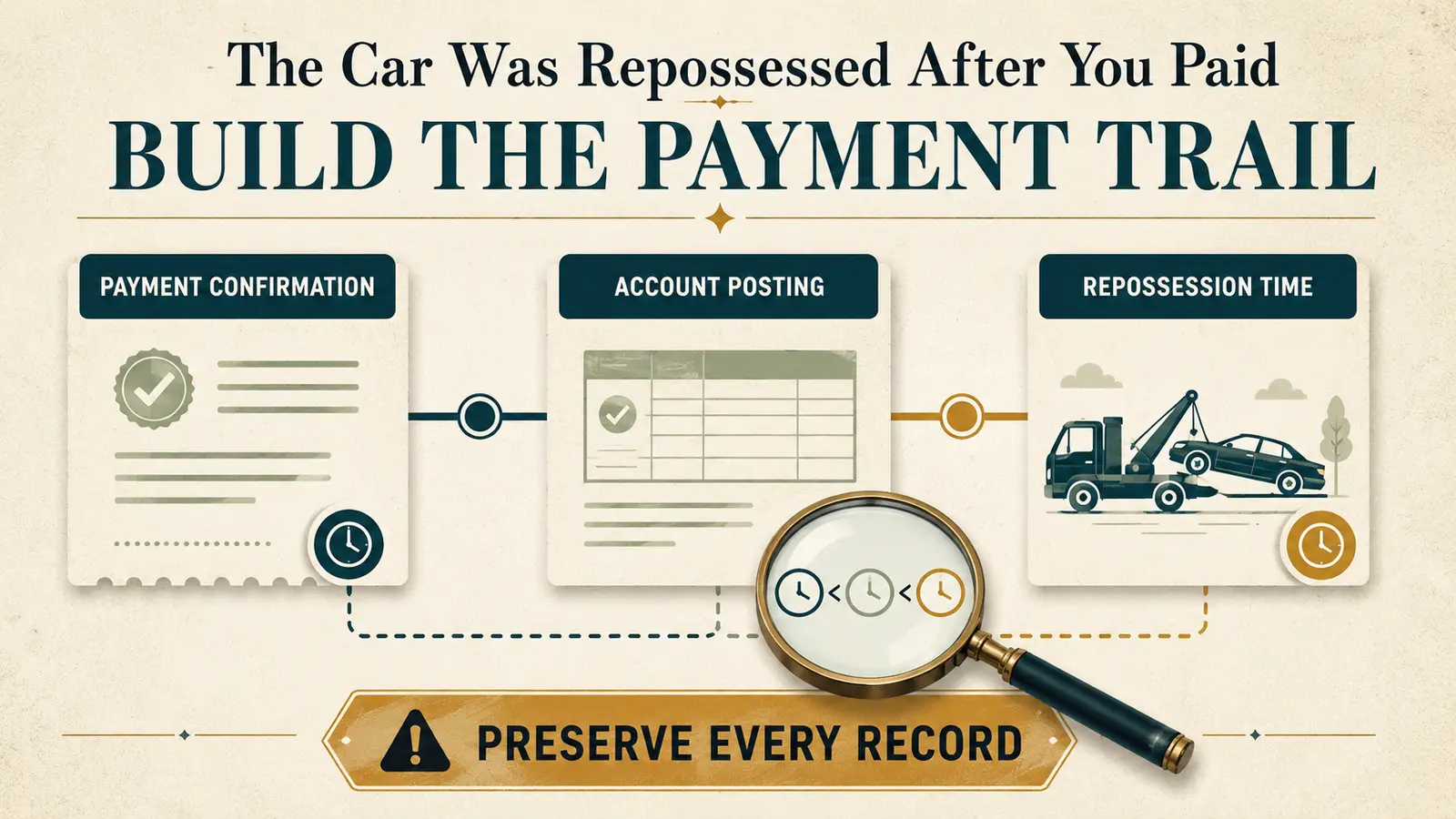
Capture proof of the payment or agreement
Save the receipt, bank confirmation, card transaction, ACH trace, money-order record, or cash receipt. Record when the payment was initiated and when the servicer posted it.
If the servicer granted an extension, due-date change, forbearance, or promise-to-pay hold, save the written confirmation and the exact terms. A vague note that “they said I was okay” is harder to investigate.
Get the repossession assignment timeline
Ask when the account was assigned for repossession, when the order was canceled or updated, when the forwarder or repo agent received each status, and when the vehicle was taken.
CFPB Bulletin 2022-04 describes supervisory findings involving repossessions after consumers made payments or otherwise took actions that should have prevented repossession. The timing between servicer systems and third-party agents can be central.
Request the servicer’s account notes
Ask for payment history, delinquency status, call notes, secure messages, and any repossession-hold or cancellation record.
Compare the internal chronology with your bank records. A payment can be received but misapplied, reversed, or posted after an automated repossession trigger.
Document expenses caused by the error
Keep receipts for rides, lost towing fees, replacement transportation, property retrieval, and other direct costs.
Whether those amounts are recoverable is a legal question, but contemporaneous evidence preserves the issue.
Check the credit-reporting follow-through
If the servicer admits the repossession was erroneous, ask what correction it will send to consumer reporting agencies and when.
Pull updated reports later and dispute any inaccurate status with the relevant evidence under the FCRA process.
Do not let a servicing error obscure state procedures
If the creditor still intends to repossess because another default exists, cure or redemption rights may still have deadlines.
Resolve the error while also reading any current notice. A corrected payment does not automatically tell you whether the account is now current or whether another contractual default remains.
Reconstruct exactly what the lender knew before the tow
Put the payment and repossession timeline down to the hour when possible: payment authorization, bank posting, lender posting, returned-payment status, extension or promise-to-pay confirmation, repossession order placement, any cancellation request, and the tow. A payment visible in a bank account does not always prove the lender received good funds, while a lender acceptance or written extension may be important. The goal is to establish what changed and when rather than starting with the conclusion that the tow was wrongful.
Preserve the receipt or confirmation number, bank statement, ACH/card record, screenshots from the lender portal, call logs, text or email promises, and any notice of reversal. Ask the lender to identify the contractual default it relied on and whether the repossession order had been canceled or should have been canceled after the payment or extension. CFPB supervisory material has specifically discussed harm from wrongful or inaccurate repossessions, making precise servicing records especially important.
Correct the account and reporting as separate follow-up tasks
If the lender acknowledges an error, ask what will happen to repossession fees, storage charges, late fees, vehicle return, and any credit reporting. Save written confirmation of each correction. A vehicle being returned does not automatically prove every account field was fixed, and a corrected tradeline does not prove the fee ledger was corrected. Review both.
Do not assume a pending payment cured the contractual default
Some payments can be reversed, held, misapplied, or insufficient to satisfy the contractual amount required. Record exactly what the lender told you the payment would accomplish. If the lender accepted a written extension or reinstatement arrangement, preserve the agreement and all conditions. The legal issue is the status of the contract when possession occurred, not simply whether money moved around the same date.
Separate payment authorization, payment posting, and repossession cancellation
A bank statement showing money left the borrower’s account is important, but it does not by itself answer every timing question. Record when the payment was authorized, when the servicer credited it, whether it was later returned, and when the repossession assignment was created or cancelled. If there was a telephone promise to hold repossession, preserve the call date, representative name, confirmation number, and any follow-up message. CFPB enforcement guidance has focused on wrongful repossessions that occur after consumers made payments or entered arrangements that should have stopped the repossession process.
Ask the servicer to investigate both systems: the servicing ledger and the repossession vendor workflow. A corrected payment history does not automatically prove the vendor received a timely cancellation, and a vendor note does not establish how the servicer applied the money. When the facts are disputed, the strongest chronology shows each system event in order. Then handle return of the vehicle, fees, credit reporting, and out-of-pocket losses as separate remediation questions instead of trying to solve all of them with one complaint sentence.
Frequently asked questions
- My car was repossessed right after I paid — what do I do first?
- Build the payment trail: proof of the payment or the extension or promise-to-pay, with dates and confirmation numbers. Then request the servicer’s account notes and the repossession assignment timeline to reconstruct what the lender knew before the tow.
- Does a pending payment mean the default was cured?
- Not necessarily. Payment authorization, payment posting, and repossession cancellation are three separate events. A payment that had not posted, or an extension that was never recorded, can leave the contractual default technically open.
- What should I document besides the payment?
- Any expenses the error caused (towing, rides, storage), and the credit-reporting follow-through. Correcting the account and correcting the reporting are separate follow-up tasks.
Sources checked for this page
- CFPB Bulletin 2022-04 — Mitigating Harm from Repossession of AutomobilesCFPB supervisory and enforcement discussion of wrongful repossessions and servicing practices.
- CFPB — What happens if my car is repossessed?Federal consumer overview of repossession, belongings, sale, redemption, deficiency, and credit reporting.
- 15 U.S.C. § 1681s-2 — Responsibilities of furnishersFederal duties concerning accuracy, disputes, and the date of delinquency.