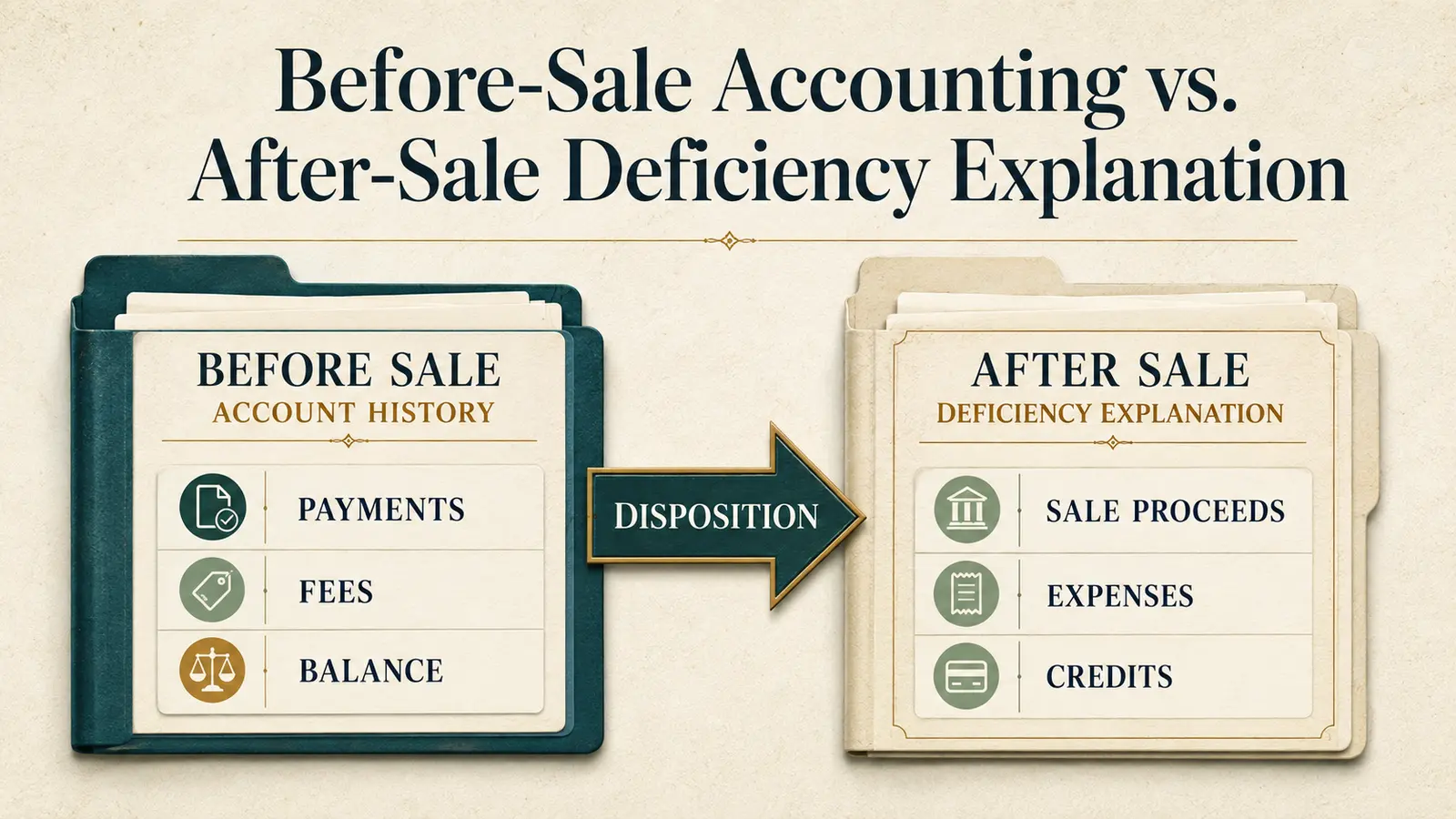
Before sale, focus on the secured obligation and redemption amount
If the vehicle has not yet been disposed of, the urgent number may be the redemption amount or a state-law reinstatement amount. Request the current secured obligation, repossession-related expenses, and payment instructions.
Model § 9-623 defines what must be tendered to redeem. A creditor’s payoff quote should be checked against the contract and account history.
An Article 9 accounting request can address the obligation
Article 9 § 9-210, enacted by states, provides a mechanism for a debtor to request an accounting of the unpaid obligations secured by collateral. It is distinct from the post-sale § 9-616 explanation.
If using that statutory tool, verify the state section number, permitted frequency, form of request, and response time.
After sale, the deficiency explanation adds disposition data
Once the vehicle is sold, the calculation now includes sale proceeds and disposition expenses. Model § 9-616 is designed for that consumer-goods surplus/deficiency explanation.
A pre-sale payoff cannot tell you the final deficiency because it predates the sale credit.
Keep quotes with their good-through dates
Interest and storage can change daily. Label every payoff or redemption quote with its issuance date, expiration, and assumptions.
A later discrepancy may be explained by the quote expiring, but an unexplained fee or missing credit still deserves investigation.
Use one ledger across both phases
Start with the last pre-sale account balance, then append the sale transaction and later credits. This creates continuity from default to current collection balance.
If the collector’s number cannot be connected to that ledger, request an itemization rather than guessing which phase created the difference.
State law controls the exact statutory request rights
The model UCC is a framework. The relevant state has enacted its own numbering and may add consumer-credit provisions.
The state article should link to the enacted § 9-210 analogue and any motor-vehicle-specific accounting rule before a form letter is published.
A § 9-210 accounting request addresses the secured balance before the sale
Model UCC § 9-210 defines an authenticated request for an accounting as a record asking for the unpaid obligations secured by collateral and reasonably identifying the transaction. Subject to the statute’s exceptions, the secured party responds within 14 days after receipt. The model section also addresses requests regarding a list of collateral or a statement of account, and generally provides one response without charge during a six-month period before allowing a limited charge for additional responses.
That tool can be useful when a borrower is trying to understand the secured amount before a redemption or disposition. It is not the same document as the consumer-goods explanation of surplus or deficiency under § 9-616 after a disposition. Label the request by purpose—current secured balance versus post-sale calculation—so the file does not mix two different statutory stages.
A redemption quote can contain different numbers for a legitimate reason
A current balance, accelerated payoff, redemption amount, and post-sale deficiency are snapshots taken at different points. The redemption amount under § 9-623 can include fulfillment of secured obligations and specified expenses, while a later deficiency reflects the disposition proceeds and application rules. When two statements disagree, first compare their “as of” dates and purpose before assuming one is erroneous.
Use dates in every balance request
State the account number and an “as of” date, and keep the creditor’s answer with that request. Balance figures can change because payments clear, fees accrue, refunds post, or a vehicle is sold. A dated record lets a later reviewer distinguish a genuine contradiction from two accurate snapshots taken at different stages.
Do not treat a payoff quote, redemption quote, and § 9-616 explanation as interchangeable
These documents answer different questions at different moments. A payoff quote may address the amount needed to satisfy the contract on a stated date. A redemption quote adds the Article 9 requirement to fulfill the secured obligations and permitted expenses before the redemption right ends. A post-disposition explanation under § 9-616 must show the sale proceeds and the sequence of obligations, expenses, credits, and the resulting surplus or deficiency. The numbers can therefore differ without one of them necessarily being wrong.
For audit purposes, write the “as of” date beside every balance. If interest accrues daily, storage continues, a warranty refund posts, or sale proceeds arrive after the quote, the later statement should show the change rather than silently replacing the earlier figure. A clean file lets you move from pre-sale obligation to redemption amount to post-sale deficiency one date at a time. That is far more useful than comparing two totals generated weeks apart and assuming the difference is an unexplained fee.
Frequently asked questions
- Which records answer the balance question before the sale?
- A § 9-210 accounting request addresses the secured obligation before disposition, and a redemption quote gives the payoff figure. A payoff quote, a redemption quote, and a § 9-616 explanation are not interchangeable.
- What records become available only after the sale?
- The post-sale deficiency explanation, which adds disposition data — sale proceeds, expenses, and credits — on top of the obligation figure. Use one continuous ledger across both phases.
- Why might the redemption quote differ from the account balance?
- A redemption quote can legitimately contain different numbers because it includes reasonable expenses the secured party is entitled to recover. Put a date on every balance request so the figures can be compared.
Sources checked for this page
- UCC § 9-623 — Right to redeem collateralModel redemption right before disposition, collection, or acceptance.
- UCC § 9-616 — Explanation of surplus or deficiencyModel consumer-goods rule for pre- or post-disposition explanation.
- UCC § 9-615 — Application of disposition proceeds; deficiency and surplusModel rules for applying sale proceeds and calculating deficiency/surplus.
- UCC § 9-210 — request for accounting or statement of accountModel Article 9 text; verify the state enactment.