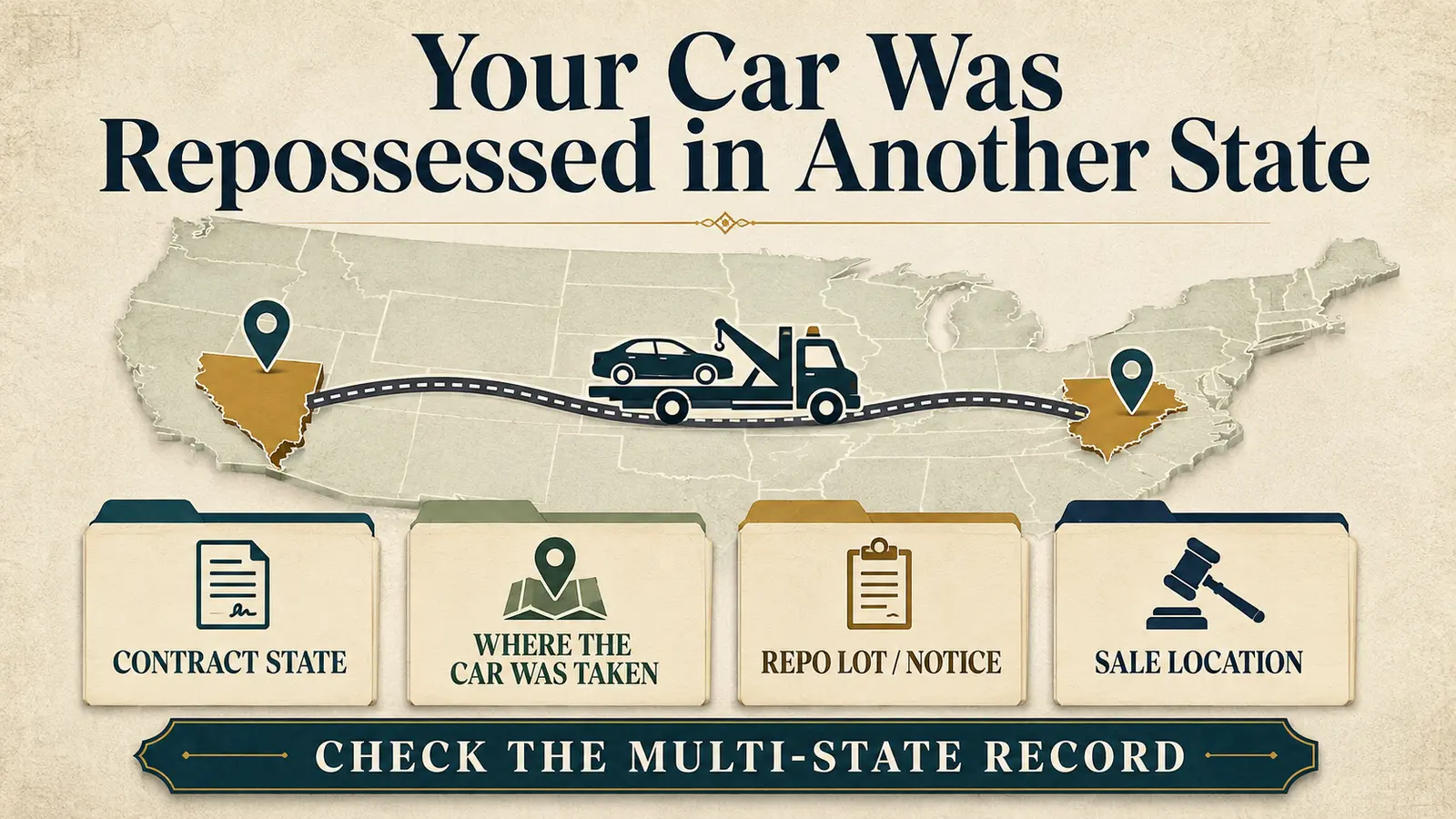
Map the states before researching law
Write down where the contract was signed, your residence when the loan was made, current residence, location of the vehicle when taken, location of the storage lot, and planned sale location.
These facts help identify which state’s statutes and cases may govern different questions.
The security agreement may include a governing-law clause
Read the contract for choice-of-law and forum terms. Article 9 itself has conflict-of-laws provisions for perfection and other issues, while enforcement questions can follow different rules.
A contract clause is not always conclusive for every consumer-protection issue, so treat it as one source rather than the answer.
Repo-agent conduct is tied to the place where it happened
Licensing, breach-of-peace cases, towing conduct, and police-notification requirements can be location-specific.
If the agent entered property or damaged a gate in State B, research State B’s repossession conduct rules even if the loan was originated in State A.
Notice and deficiency rules may point back to the governing contract law
Retail installment statutes and Article 9 enactments differ. The creditor may apply the law specified by the contract, but mandatory consumer rules can complicate that assumption.
Preserve every notice because the form itself may reveal which state law the creditor believes applies.
Personal-property retrieval follows the actual custodian
Whatever law governs the loan, the immediate practical task is to identify the lot holding the belongings and its release procedure.
Ask which regulator licenses or bonds that repossessor in the state where it operates.
A cross-border case is a strong reason to get local legal help
Choice-of-law analysis can determine cure rights, deficiency defenses, and limitation periods.
The website can map the facts and sources but should not declare one state controlling without reviewing the contract and relevant statutes.
Record three locations, not just the place where the tow occurred
Cross-state cases can involve the borrower’s residence, the state identified in the contract or governing-law clause, and the physical location where the vehicle was taken or sold. Those may be three different places. Write each one down together with dates of any move, address-change notice, registration, and where the vehicle was normally garaged. A national guide cannot safely choose the controlling state from geography alone.
Preserve the repossession company’s invoice or release, sale notice, storage location, auction venue, contract choice-of-law language, and any communications showing the lender knew about the move. The law governing perfection, possession, consumer-credit rights, breach-of-peace conduct, notice, and deficiency can involve different choice-of-law rules. That is why a state page should not say “the law where the car was towed always controls.”
A move can also create a notice-address problem
Compare the address used on the disposition notice with the lender’s account records and any written address update. Keep forwarded envelopes, returned mail, portal messages, and proof of the new address. Even if a contract chooses one state’s law, the factual question of what address the creditor used and what notice was sent remains important to the repossession file.
The sale state can differ from the tow state
A vehicle can be transported to an out-of-state auction after repossession. Record where possession occurred, where the vehicle was stored, and where disposition occurred. The sale location can matter to evidence and procedure even when it does not by itself choose the governing law for every issue.
Create a jurisdiction worksheet before searching for a single “repossession law”
Write down the contract state, the borrower’s current residence, the place of repossession, the storage location, and the planned place of sale. Then add the governing-law clause from the contract and the address to which the creditor sent notices. Those facts may point to different bodies of law for different questions. Conduct at the tow scene, for example, is tied to the law governing the repossession event, while contract interpretation and notice issues may require a separate choice-of-law analysis.
Do not assume that crossing a state line creates a new cure period or erases the creditor’s security interest. Instead, use the worksheet to frame precise questions: which state’s breach-of-peace rule governs the taking, which enacted Article 9 governs disposition, whether a motor-vehicle statute applies, and where personal property can actually be retrieved. Cross-border cases deserve source-by-source research because a national summary that names only the borrower’s home state can miss the law connected to the actual conduct.
Frequently asked questions
- My car was repossessed in a different state than where I signed — which law applies?
- It depends on the question. Map the states first: the contract/governing-law state, the state where the repossession happened, and the state where the sale occurs. The security agreement may contain a governing-law clause.
- Which state’s rules govern the repo agent’s conduct?
- Repo-agent conduct — breach of the peace, licensing, bonding — is generally tied to the place where it happened, while notice and deficiency rules may point back to the governing contract law.
- Where do I go to retrieve my belongings?
- Personal-property retrieval follows the actual custodian — the lot or storage facility holding the vehicle, wherever that is. A cross-border case is a strong reason to get local legal help and to build a jurisdiction worksheet.
Sources checked for this page
- UCC § 9-609 — Secured party’s right to take possession after defaultModel UCC text; the controlling law is the version enacted in the relevant state.
- UCC § 9-611 — Notification before dispositionModel UCC text; state enactments can add requirements.
- CFPB — What happens if my car is repossessed?Federal consumer overview of repossession, belongings, sale, redemption, deficiency, and credit reporting.