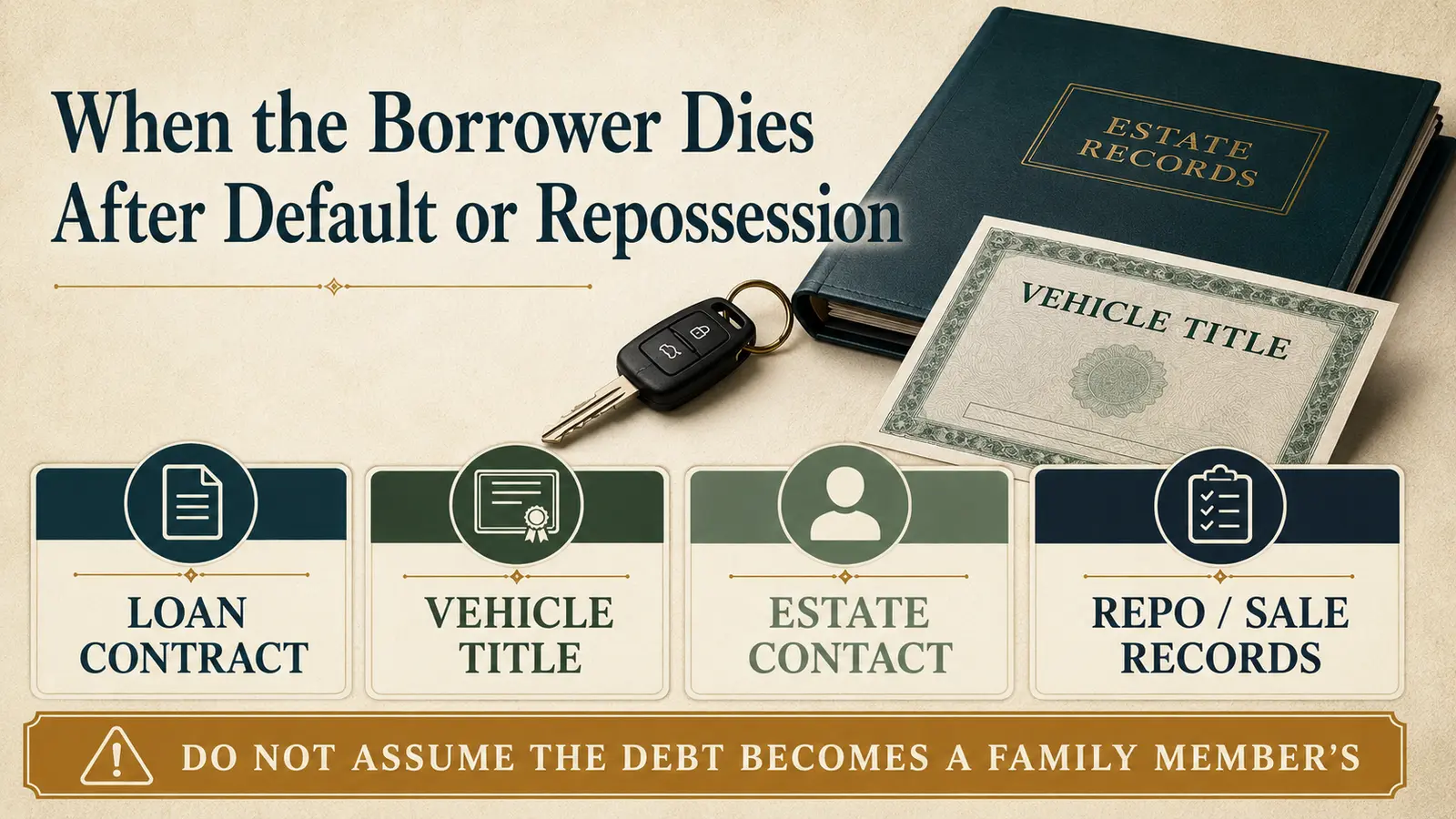
Identify every person legally on the contract and title
A surviving co-borrower or co-signer can have contractual liability independent of the deceased borrower. A family member who never signed generally stands in a different position.
Obtain the contract and title record before discussing who “owes the car.”
Notify the creditor through the estate process
The personal representative or other authorized person can request payoff, account history, and information about the creditor’s secured claim.
State probate law controls claim presentation and estate deadlines, so use the relevant probate court or official state source.
The vehicle remains collateral
If the loan is in default, the creditor may have repossession rights subject to state law and any probate/bankruptcy constraints.
A voluntary return by family should be documented carefully and should not be described as accepting personal liability.
Post-sale deficiency is an estate claim unless another obligor is liable
After sale, the creditor may assert a deficiency against the estate and against any surviving contractual obligor.
Whether and how the estate pays claims depends on probate priority, exemptions, and claim deadlines—not on ordinary collection assumptions.
Personal belongings and estate property need inventory
Items inside the vehicle may belong to the estate or another person. Create a retrieval list and document ownership where possible.
Do not allow estate documents, keys, or valuables to be disposed of with the vehicle.
Use probate counsel for state-specific deadlines
Creditor claim windows and notice rules can be short and vary widely.
This site can explain the repossession accounting, but estate-administration strategy belongs to the probate process in the relevant state.
Separate the estate, the collateral, and other obligors
A borrower’s death does not answer who owns the vehicle, who is obligated on the retail installment contract, or who has authority to act for the estate. Obtain the contract and title record, identify any co-borrower or cosigner, and determine who has been appointed personal representative or otherwise has legal authority under state probate law. Family relationship alone does not automatically make someone personally liable for the deceased borrower’s debt.
If the vehicle is repossessed or surrendered, preserve the same Article 9 records as in any other case: taking or surrender date, personal-property inventory, disposition notice, sale record, proceeds, expenses, and deficiency or surplus explanation. Direct creditor communications through the authorized estate representative where appropriate so requests and notices do not disappear among relatives.
A deficiency claim against an estate follows probate procedure as well as secured-credit rules
After sale, the creditor may assert a remaining claim, but deadlines and presentation requirements for claims against an estate are state-specific. Do not publish a universal probate deadline. Compare the creditor’s accounting with the estate records, and separately identify any living co-obligor the creditor claims is liable. A surplus, if one exists, can likewise be an estate asset that needs to be accounted for.
Protect personal property before the vehicle moves again
If family or estate property remains in the vehicle, inventory and request it promptly before auction or transport. Keep authority documents needed by the storage company, but provide only what is necessary. The personal-property task can be urgent even while probate authority and loan liability are still being sorted out.
Find the estate representative before anyone makes promises about the debt
A family member calling the lender is not automatically the personal representative of the estate and is not automatically personally liable for the loan. Gather the death certificate, probate case information if one exists, letters of administration or other authority, title, contract, and any co-signer documents. Then identify who has legal authority to receive information, arrange personal-property pickup, address the vehicle, or negotiate an estate claim under the relevant state probate rules.
Repossession accounting still matters after death. If the collateral is sold, the sale proceeds and permitted charges feed the same surplus-or-deficiency calculation under the applicable secured-transactions law. But collection of any remaining claim against a deceased borrower also intersects with probate deadlines and priority rules, which vary by state. Keep those systems separate: one folder for collateral and sale records, another for the estate claim, and a third for any living co-obligor. That prevents a relative’s voluntary payment from being mistaken for a legal conclusion about personal liability.
Frequently asked questions
- Who owes the deficiency if the borrower died?
- Identify everyone legally on the contract and the title. A post-sale deficiency is generally an estate claim handled through probate unless a co-borrower or guarantor is independently liable.
- How is the creditor notified?
- Through the estate process. The vehicle remains collateral and can still be sold, so a deficiency claim against the estate follows probate procedure as well as secured-credit rules.
- What about belongings and the car itself?
- Personal belongings and estate property need an inventory, and personal property should be protected before the vehicle moves again. Find the estate representative before anyone makes promises about the debt, and use probate counsel for state-specific deadlines.
Sources checked for this page
- CFPB — What happens if my car is repossessed?Federal consumer overview of repossession, belongings, sale, redemption, deficiency, and credit reporting.
- UCC § 9-615 — Application of disposition proceeds; deficiency and surplusModel rules for applying sale proceeds and calculating deficiency/surplus.
- UCC § 9-616 — Explanation of surplus or deficiencyModel consumer-goods rule for pre- or post-disposition explanation.