Audit the balance before bargaining
Request the post-sale explanation and, for a covered debt collector, validation information. Compare the starting deficiency with current interest, fees, payments, and credits.
Negotiating from an unexplained number can cause a consumer to settle a balance that was miscalculated.
Identify the party with authority to settle
A collection agency may collect for the creditor without owning the debt. A debt buyer may own it. Ask who has authority to release or satisfy the balance.
The agreement should name the creditor, account, vehicle or contract, and the settling party.
Define what the payment accomplishes
Look for clear language stating whether the payment satisfies the account in full, settles only the collector’s claim, waives a specified amount, or creates an installment settlement.
Avoid relying on shorthand such as “paid” or “closed” without defining what happens to the unpaid remainder.
Address timing and default terms
If the settlement is paid over time, identify due dates, acceptable payment methods, grace provisions if any, and what happens after a missed payment.
A discount can disappear under a default clause, so read it before sending the first payment.
Ask how the account will be reported
Do not assume a settlement requires deletion from credit reports. Accurate negative history can remain subject to FCRA time limits.
The agreement can state what balance/status the creditor intends to report, but it should not promise something contrary to law or bureau policy.
Keep proof of final performance
Save the agreement, payment confirmation, and final zero-balance or satisfaction letter.
If a later collector appears, those records are the evidence that the resolved amount should not be collected again.
Define the exact balance and authority before discussing a number
Ask for the current creditor or collector name, account number, itemized balance, sale credit, fees, interest, and any prior payments or adjustments. If the account has been sold or placed with a collector, confirm who owns it and who has authority to settle. A settlement percentage is meaningless if the starting balance is wrong or the caller cannot bind the party that owns the debt.
Keep the accounting review separate from the negotiation. A consumer can ask for the § 9-616 explanation or other account records and still evaluate a practical settlement, but paying first can make later fact-finding harder. If a lawsuit is pending, a settlement discussion does not automatically stop court deadlines. Any extension, dismissal, or stay should be reflected in the court record or written agreement.
The written agreement should answer what happens after payment
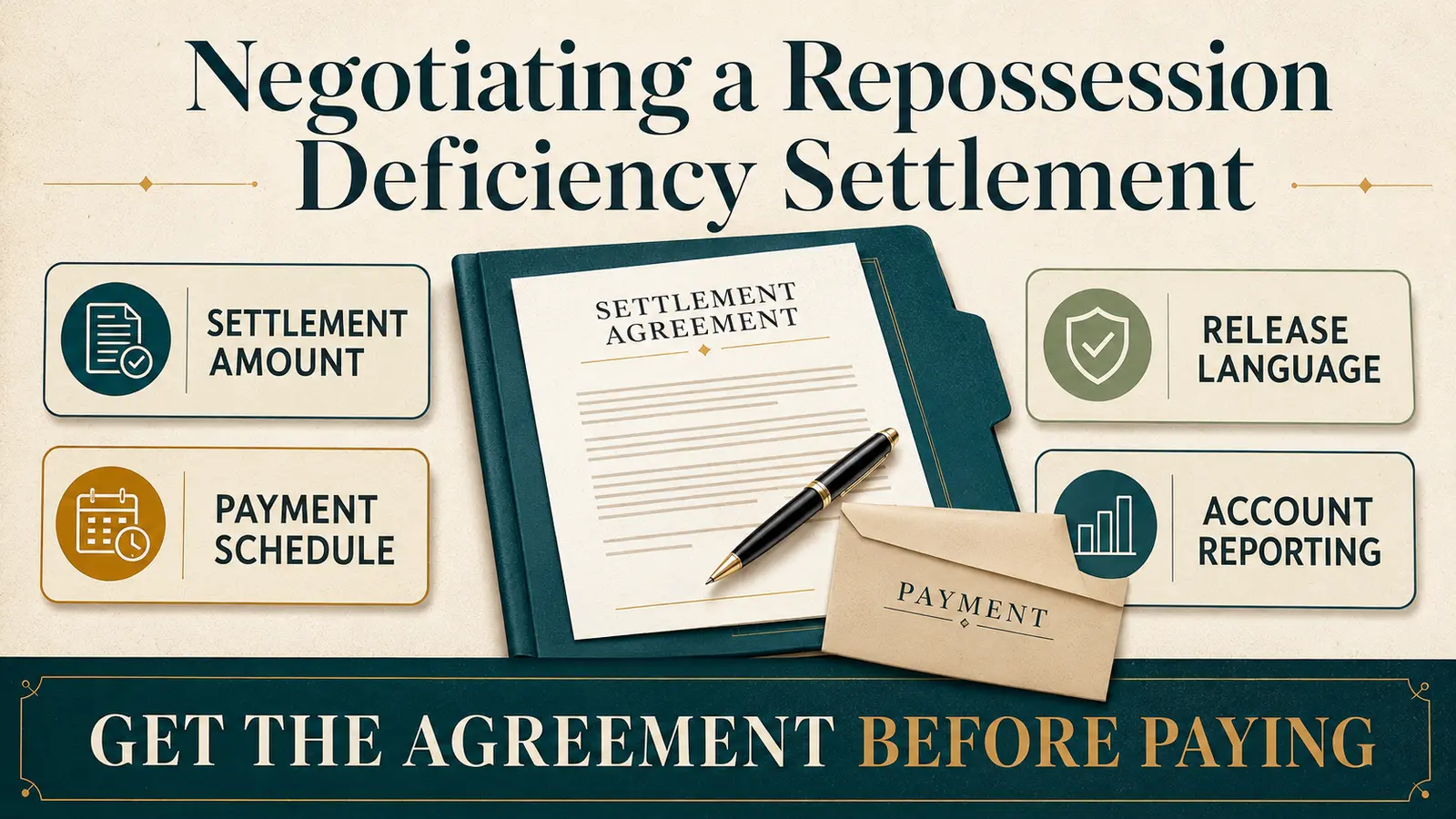
Before sending money, make sure the writing identifies the account, settlement amount, due date or installment schedule, whether the payment resolves the remaining claim, what happens to any pending lawsuit or judgment, and any agreed credit-reporting treatment. Avoid relying on an oral “settled in full” description that is absent from the document. After payment, keep proof of funds and obtain the promised closing letter or court filing.
Plan for tax and judgment questions before signing
A reduced settlement can have consequences outside the payment amount, including possible tax reporting or an existing judgment that needs a satisfaction filing. The agreement should say what happens to any case or judgment, and the consumer can ask a tax professional about cancellation-of-debt reporting when relevant. Do not let a collector’s payment deadline substitute for understanding the written terms.
A settlement letter should close the loop on the specific obligation
Before sending money, make the document identify the creditor or current owner of the deficiency, the account, the agreed amount, the due date, and what happens to the remainder after timely payment. Phrases such as “payment arrangement” or “reduced payment” can mean very different things from a full settlement. If a lawsuit or judgment exists, the writing should also address the expected court filing or satisfaction document rather than leaving that issue for a later phone call.
Do not promise a particular tax or credit-report outcome unless the responsible party has actually agreed to it and the law permits it. Reporting must remain accurate; a creditor may agree to report a zero balance or settled status, but an accurate history is not automatically erasable. Save the signed agreement before authorizing payment, use a traceable payment method, and keep the receipt with the later account statement. The objective is a file that proves both the bargain and performance without relying on a representative’s memory.
Frequently asked questions
- What should I do before negotiating a deficiency settlement?
- Audit the balance first — reconcile the payoff, expenses, sale proceeds, and credits — and identify the party with authority to settle (original creditor vs. collector). Bargaining before the number is checked risks settling an inflated figure.
- What must the written agreement say?
- What the payment accomplishes (full settlement of the specific obligation), the timing and any default terms, and how the account will be reported afterward. Get the terms in writing before paying, and keep proof of final performance.
- Are there tax or judgment issues?
- Forgiven debt can raise tax questions, and an existing judgment changes the picture. Plan for both before signing, and make sure the settlement letter closes the loop on that exact obligation.
Sources checked for this page
- CFPB — Debt validation informationRegulation F validation-information overview.
- 15 U.S.C. § 1681s-2 — Responsibilities of furnishersFederal duties concerning accuracy, disputes, and the date of delinquency.
- UCC § 9-616 — Explanation of surplus or deficiencyModel consumer-goods rule for pre- or post-disposition explanation.