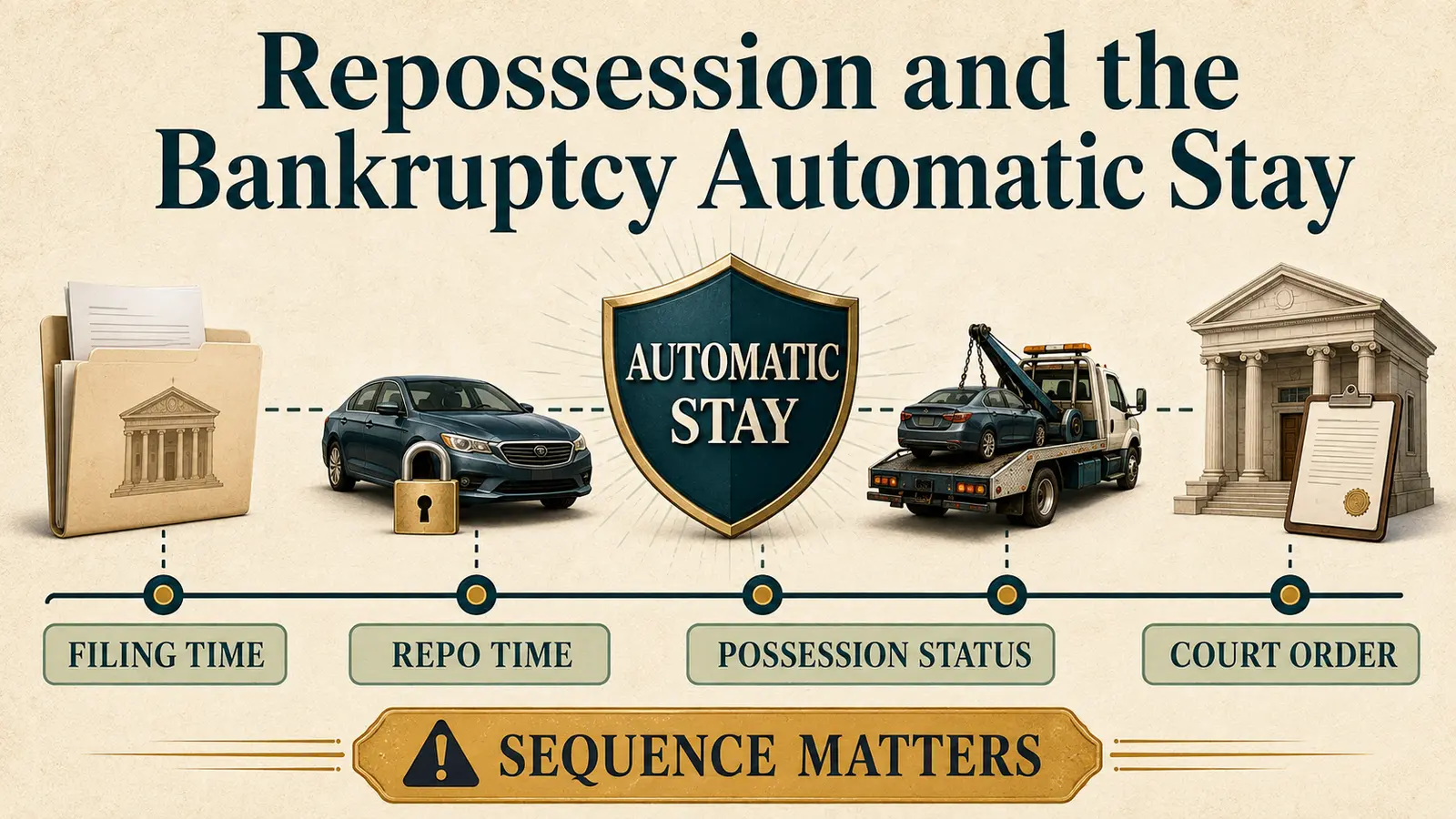
Put the petition time and repossession time on one line
11 U.S.C. § 362 stays a broad range of collection and enforcement activity when a bankruptcy petition is filed, subject to statutory exceptions. A post-petition repossession can raise a different issue from a vehicle already in the creditor’s possession before filing.
Save the bankruptcy case number and filing timestamp, tow record, police notification if any, GPS or lot record, and creditor communications.
Do not assume pre-petition possession means automatic return
In City of Chicago v. Fulton, the Supreme Court held that mere retention of estate property does not violate § 362(a)(3). The Court distinguished that issue from turnover under § 542 and other stay provisions.
That means a slogan such as “bankruptcy forces the lender to hand the car back immediately” is unsafe. Turnover procedure and adequate protection can require bankruptcy-court action.
Turnover is a separate statutory path
11 U.S.C. § 542 addresses delivery of property of the estate in specified circumstances. Whether a debtor can obtain return of a repossessed vehicle can depend on property interests under state law, the bankruptcy chapter, adequate protection, and local precedent.
This is an area for a bankruptcy attorney or court process, not a generic self-help letter.
A creditor may seek relief from the stay
Secured creditors can ask the bankruptcy court for stay relief under § 362. A borrower should track the docket for motions, hearing dates, and orders.
Do not rely only on collection calls; the bankruptcy docket is the authoritative record of what relief the court granted.
Sale after filing is a separate event to monitor
Even if possession occurred pre-petition, a post-petition sale can implicate stay, turnover, and property-of-estate issues.
Tell bankruptcy counsel promptly if a sale notice arrives or an auction is scheduled. Waiting until after disposition can narrow available remedies.
Article 9 and bankruptcy law intersect rather than replace each other
State law helps define the debtor’s property and redemption interests, while bankruptcy law governs the federal case.
Keep both source sets in the file: the state repossession documents and the bankruptcy docket.
Separate taking the vehicle from retaining and selling it
A bankruptcy timeline can contain three different acts: repossession before the petition, continued possession after the petition, and disposition after the petition. City of Chicago v. Fulton held that mere retention of estate property is not itself a violation of § 362(a)(3). The decision did not erase turnover law or answer every other stay subsection. That makes it unsafe to publish the shortcut “filing bankruptcy automatically forces the lender to hand the car back.”
For a real file, capture the exact petition timestamp, repossession invoice/tow time, notice of bankruptcy sent to the creditor or repo agent, any sale date, and the bankruptcy docket. Check whether the creditor filed a motion for relief from stay and whether the court entered an order. If a sale is imminent, that is a court-procedure issue that should be raised promptly with qualified bankruptcy counsel rather than handled as an ordinary customer-service complaint.
Property rights still depend in part on state law
Bankruptcy law determines the federal stay, estate, and turnover framework, but state law often helps define what ownership, redemption, or other property interest existed when the petition was filed. A vehicle taken pre-petition but not yet sold can present a different state-law posture from one already disposed of. Keep the state repossession notice and sale records in the bankruptcy file so the federal and state timelines can be read together.
Track every post-petition communication
Save notices of sale, payment demands, repossession-agent calls, portal messages, and any vehicle-release conditions sent after filing. The legal effect can vary by the act and stay subsection, so a dated communications log is more useful to bankruptcy counsel than a single statement that the creditor “kept collecting.”
Record the exact bankruptcy and repossession sequence
The automatic stay analysis is intensely chronological. Write down the petition date and time, the repossession date and time, whether the creditor had actual or electronic notice, whether the vehicle was already sold, and whether any motion for relief from stay was filed. A repossession that happened before the petition can raise a different issue from a tow ordered after filing, and a later sale can create a separate stay question even when possession changed earlier.
If the vehicle was taken before filing, do not promise that filing by itself forces immediate physical return. The Bankruptcy Code, Supreme Court precedent, local bankruptcy practice, the debtor’s proposed treatment of the secured claim, and any request for turnover or adequate protection can matter. Preserve the creditor notices and bankruptcy docket entries so a bankruptcy lawyer or court can evaluate the actual sequence rather than a simplified “repo before or after bankruptcy” label.
Frequently asked questions
- How does bankruptcy affect a repossession?
- The automatic stay under 11 U.S.C. § 362 halts most collection activity once the petition is filed. Put the petition time and the repossession time on one line, because pre-petition possession is treated differently from a post-petition tow or sale.
- If the car was taken before I filed, does filing automatically return it?
- Not by itself. Turnover is a separate statutory path, and the creditor may ask the court for relief from the stay. Article 9 and bankruptcy law intersect rather than replace each other.
- What should I track after filing?
- Every post-petition communication, and any move toward a sale, which is a separate event to monitor. Record the exact sequence of the bankruptcy filing and the repossession.
Sources checked for this page
- 11 U.S.C. § 362 — Automatic stayCurrent U.S. Code automatic-stay provision.
- 11 U.S.C. § 542 — Turnover of property to the estateCurrent U.S. Code turnover provision.
- U.S. Supreme Court — City of Chicago v. Fulton, 592 U.S. 154 (2021)Holding that mere retention of estate property does not violate § 362(a)(3); turnover is a separate issue.