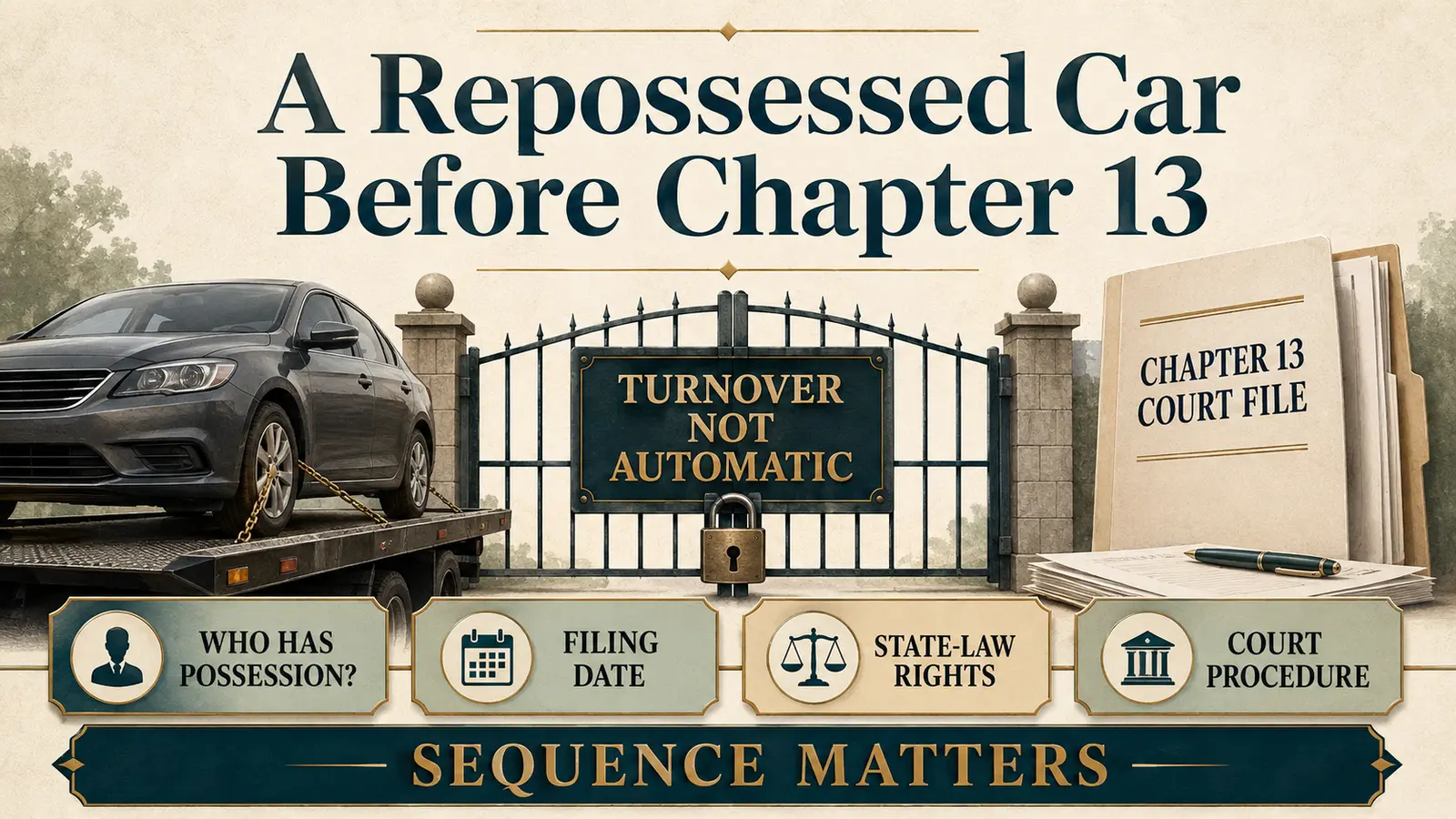
Confirm that the car has not already been sold
The debtor’s remaining property interest can change at disposition under state law. A repossession followed by immediate bankruptcy is different from a case filed after auction.
Obtain the sale notice, auction date, and any post-sale statement before discussing turnover.
The automatic stay stops many collection acts after filing
Section 362 applies broadly to collection and enforcement, subject to exceptions and court orders. A creditor planning a post-petition sale should be evaluated under the stay and any relief-from-stay order.
Track the docket; do not rely on a telephone statement that the lender “has permission.”
Fulton makes the retention question more precise
The Supreme Court held that retaining possession of property seized before filing does not, by itself, violate § 362(a)(3).
A debtor may still pursue turnover under § 542 or rely on other Code provisions, but that can require an affirmative bankruptcy-court process.
Adequate protection and plan treatment can be central
A secured creditor may seek protection against decline in collateral value, and Chapter 13 plan treatment of the secured claim can affect whether return is feasible.
These are case-specific bankruptcy issues. The site should point readers to counsel or court resources rather than giving a payment formula.
State-law redemption can remain relevant
If state law preserves a redemption interest before sale, that interest can be part of the bankruptcy analysis.
The state page should identify the redemption cutoff so counsel can see what right existed at filing.
Do not wait for the first plan hearing if a sale is imminent
A scheduled disposition can occur quickly. Provide counsel with the creditor, repo company, sale notice, and exact auction timing immediately.
Emergency motion practice may be required; a web article cannot substitute for the bankruptcy docket.
The moment of filing can determine which fight comes next
Put the repossession, bankruptcy petition, and any scheduled sale on a single timeline. A vehicle taken after the petition raises a different stay question from a vehicle taken before filing. If the creditor already had possession when the case began, Fulton means that mere retention is not automatically a § 362(a)(3) violation; turnover and other stay provisions require separate analysis. A later sale can be another distinct act, so the sale date must be tracked even when the tow happened earlier.
Chapter 13 also adds plan and adequate-protection issues that a generic repossession article cannot resolve. Preserve the retail installment contract, current payoff, vehicle value evidence, proof of insurance, notice of repossession, storage information, and the case docket. Those records let bankruptcy counsel address return, treatment of the secured claim, stay relief, and plan feasibility without reconstructing the vehicle file from memory.
Do not promise that filing alone will physically return the car
Return can depend on whether the vehicle remained property in which the debtor had a sufficient interest, state repossession law, turnover rules, local bankruptcy procedure, and any stay-relief order. A responsible guide should therefore explain the documents and sequence, not advertise Chapter 13 as a guaranteed “get the car back” button. The time-sensitive action is to surface the tow and sale dates to the bankruptcy professional handling the case.
Insurance and storage facts belong in the first conversation
The creditor and court may care about whether the vehicle is insured, its condition and value, and ongoing storage costs. Collect the declarations page, location of the vehicle, storage rate if known, and current condition along with the loan documents. Those concrete facts are often more useful to counsel than a generic estimate of how much the car is worth.
Ask four status questions before assuming a Chapter 13 plan can solve the vehicle problem
The first call should establish whether the car has been sold, where it is being held, whether insurance remains in force, and whether a sale date is scheduled. Those facts determine the urgency of the bankruptcy analysis. Filing a petition invokes the automatic stay against many collection acts, but the Supreme Court’s decision in City of Chicago v. Fulton held that merely retaining estate property does not itself violate § 362(a)(3). That is why “the stay started, so the lender must hand over the car immediately” is too simple.
Turnover under § 542, adequate protection, state-law ownership and redemption interests, and the proposed Chapter 13 treatment can all matter. None should be assumed from a generic national checklist. Preserve the repossession and sale notices for bankruptcy counsel and flag any imminent disposition date. A plan can address secured claims, but the procedural route to getting physical possession back may require a separate request or court order, depending on the facts and controlling law.
Frequently asked questions
- Will filing Chapter 13 get my repossessed car back?
- Not automatically. First confirm the car has not already been sold. The automatic stay stops many collection acts after filing, but turnover is a separate question, and recent case law (Fulton) made the retention analysis more precise.
- What issues drive whether I keep the car in Chapter 13?
- Adequate protection for the lender and the treatment of the loan in the plan are often central, and state-law redemption can still be relevant. Insurance and storage facts belong in the first conversation.
- The lender says it will sell the car soon — can I wait for the plan hearing?
- Do not wait if a sale is imminent. The moment of filing can determine which fight comes first, and a sale can foreclose options before the first plan hearing.
Sources checked for this page
- 11 U.S.C. § 362 — Automatic stayCurrent U.S. Code automatic-stay provision.
- 11 U.S.C. § 542 — Turnover of property to the estateCurrent U.S. Code turnover provision.
- U.S. Supreme Court — City of Chicago v. Fulton, 592 U.S. 154 (2021)Holding that mere retention of estate property does not violate § 362(a)(3); turnover is a separate issue.
- UCC § 9-623 — Right to redeem collateralModel redemption right before disposition, collection, or acceptance.