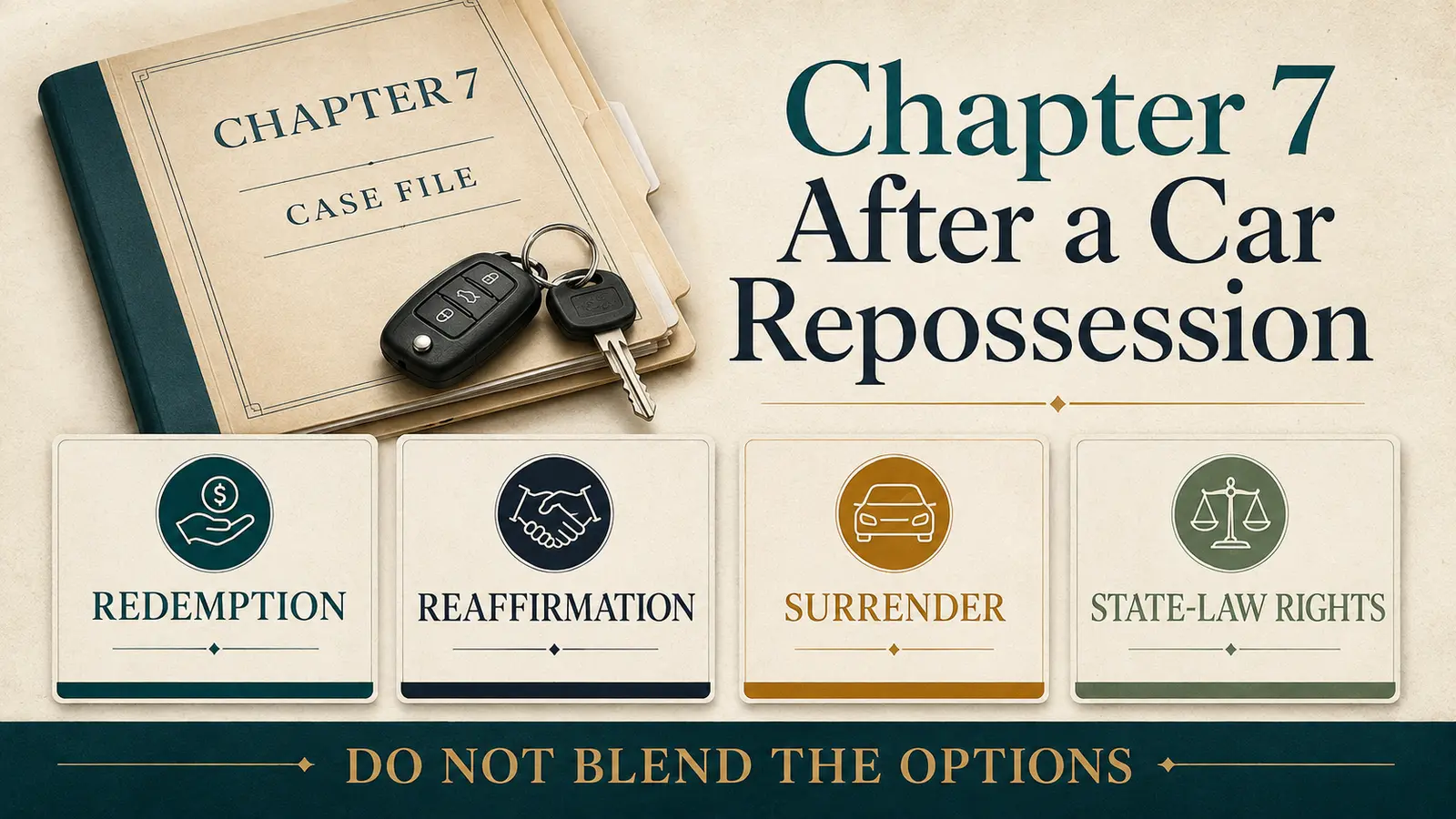
Start with whether the vehicle is still property of the estate
State law can affect what ownership or redemption interest remains after repossession. Bankruptcy law then determines how that interest enters the estate.
If the vehicle was sold before filing, the analysis is different from a vehicle merely held by the creditor.
Section 722 is a bankruptcy-specific redemption right
11 U.S.C. § 722 allows an individual Chapter 7 debtor to redeem qualifying tangible personal property intended for personal, family, or household use from a lien securing a dischargeable consumer debt if the property is exempt or abandoned, by paying the allowed secured claim in full at redemption.
That federal bankruptcy redemption is not the same as UCC redemption under state law. The amount can be different because § 722 refers to the allowed secured claim.
Reaffirmation is another distinct mechanism
A reaffirmation agreement can keep a debt legally enforceable after discharge under statutory procedures. It is not a cure, redemption, or ordinary payment plan.
The consequences are significant because reaffirmed debt can survive discharge. Use bankruptcy forms and legal advice rather than a lender’s informal description.
Pre-petition retention does not equal a stay violation by itself
City of Chicago v. Fulton held that mere retention does not violate § 362(a)(3), although turnover and other stay provisions remain separate.
A debtor seeking return may need bankruptcy-court relief. Do not promise immediate turnover based only on filing.
Sale timing is critical
If the creditor has not sold the vehicle, state redemption rights and bankruptcy rights may still exist. If disposition occurs, those rights can change rapidly.
Send every sale notice to bankruptcy counsel and compare it with docket orders or stay-relief motions.
Keep deficiency treatment separate
A deficiency after sale can be affected by the bankruptcy discharge and claim process, but the underlying sale still should be documented.
A bankruptcy discharge question is federal bankruptcy law; a defective-sale question remains rooted in state secured-transactions law.
Bankruptcy redemption under § 722 is not the same as Article 9 redemption
11 U.S.C. § 722 allows an individual Chapter 7 debtor to redeem tangible personal property intended primarily for personal, family, or household use from a lien securing a dischargeable consumer debt when the statutory exemption/abandonment condition is met. The debtor does so by paying the holder the amount of the allowed secured claim in full at the time of redemption. That federal remedy is conceptually different from UCC § 9-623, which focuses on tendering fulfillment of secured obligations and specified expenses before disposition or acceptance.
The distinction matters because a borrower can hear the word “redemption” from a bankruptcy lawyer, a repossession notice, and a lender while those speakers mean different calculations. Label every quote by legal path and date. Do not publish an expected dollar amount from a website formula because valuation, allowed secured claim, lien status, exemptions, and case procedure belong to the actual bankruptcy record.
Reaffirmation and redemption are separate decisions
A reaffirmation agreement keeps a debt obligation under the Bankruptcy Code’s reaffirmation rules; § 722 redemption pays the allowed secured claim in full for qualifying property. Neither should be described as an automatic right to force the lender into any proposed payment plan. If a Chapter 7 case is already open, track the statement-of-intention deadlines, motions, creditor communications, and court filings with bankruptcy counsel rather than relying on pre-repossession customer-service promises.
A sale can eliminate practical redemption options quickly
If the vehicle has not yet been sold, give bankruptcy counsel the disposition notice and earliest sale date immediately. Article 9 redemption ends at specified disposition/acceptance events, and bankruptcy remedies have their own procedure. Waiting for the next routine creditor statement can allow the factual posture to change before the court can address it.
Identify which redemption right is being discussed before comparing dollar amounts
Chapter 7 can put two very different concepts on the same desk. UCC § 9-623 concerns redemption of collateral before disposition by tendering the secured obligations and permitted expenses. Bankruptcy Code § 722 creates a separate right for qualifying tangible personal property intended primarily for personal, family, or household use, when the property is exempt or abandoned and the lien secures a dischargeable consumer debt. Section 722 measures payment by the allowed secured claim, not by simply copying the lender’s Article 9 redemption quote.
That distinction matters because a borrower may hear the word “redeem” from a repossession department and from bankruptcy counsel in the same week. Label every quote with its legal basis. Also verify whether the car has already been sold, because a completed disposition can change the state-law collateral picture even while bankruptcy issues remain. Reaffirmation is another separate path with its own statutory requirements; it should not be described as a synonym for either form of redemption.
Frequently asked questions
- What federal tools apply to a repossessed car in Chapter 7?
- Section 722 redemption (a bankruptcy-specific right to keep the car by paying its value in a lump sum) and reaffirmation (agreeing to remain liable on the loan) are distinct mechanisms. First check whether the vehicle is still property of the estate.
- Is § 722 redemption the same as Article 9 redemption?
- No. Bankruptcy redemption under § 722 pays the vehicle’s value, not the full loan payoff, and it is a separate decision from reaffirmation. Identify which redemption right is being discussed before comparing dollar amounts.
- Does the timing of the sale matter?
- Yes. A sale can quickly eliminate practical redemption or reaffirmation options, so the sale date is critical. Keep the deficiency treatment analysis separate from the redemption and reaffirmation questions.
Sources checked for this page
- 11 U.S.C. § 722 — Chapter 7 redemptionBankruptcy redemption provision for qualifying tangible personal property.
- 11 U.S.C. § 362 — Automatic stayCurrent U.S. Code automatic-stay provision.
- 11 U.S.C. § 542 — Turnover of property to the estateCurrent U.S. Code turnover provision.
- U.S. Supreme Court — City of Chicago v. Fulton, 592 U.S. 154 (2021)Holding that mere retention of estate property does not violate § 362(a)(3); turnover is a separate issue.
- UCC § 9-623 — Right to redeem collateralModel redemption right before disposition, collection, or acceptance.