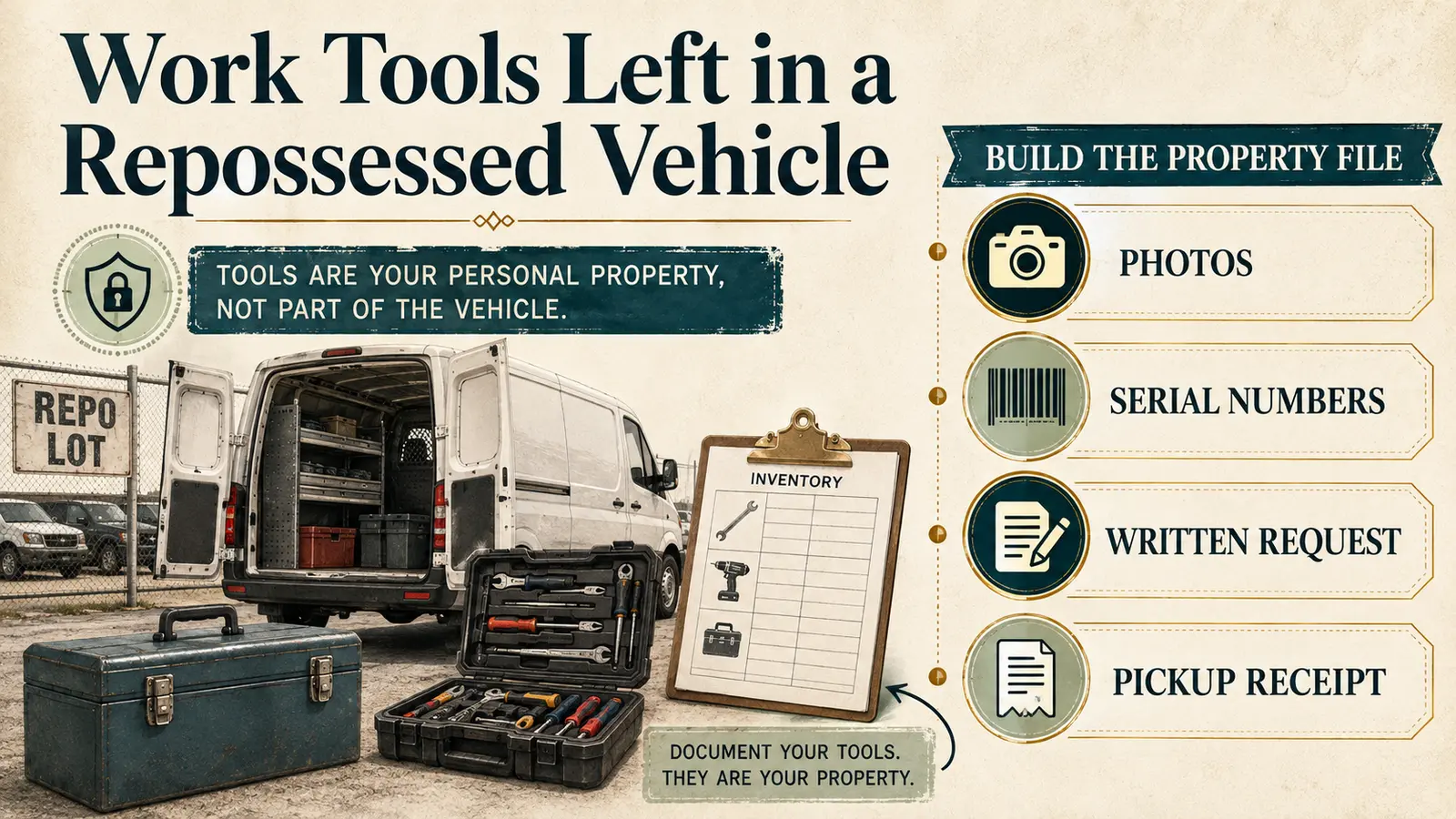
Distinguish attached vehicle equipment from loose personal property
A permanently installed rack, stereo, lift, or tool body can raise a different collateral question from a removable drill, laptop, hand tools, or uniform.
Photographs and purchase receipts help show what was separately owned and removable. Do not assume every accessory is outside the security interest.
Create an itemized work inventory
List brand, model, serial number, approximate value, and where each item was stored. Attach pre-repossession job photos or receipts when available.
A generic statement such as “all my tools” is harder for a lot employee to match to an inventory.
Request a pickup window that minimizes loss
Tell the custodian that the property is required for work and ask for the earliest available appointment.
Keep the request professional and separate from any argument about the loan. The person handling property release may have no authority over reinstatement or deficiency.
Document missing or damaged tools immediately
Photograph the property as returned and compare it with the list before leaving. Ask the lot to note any dispute on the receipt.
Keep replacement estimates or repair invoices. Potential remedies depend on state law and proof of custody.
Check repossessor licensing or bond rules
Some states regulate repossession agencies or require bonds that can be relevant to property damage or conversion claims.
Colorado, for example, has an attorney-general administered repossessor bond requirement. Other states use different regulators. The state page should identify the actual agency.
Do not trade away loan rights casually to get tools back
A release form presented at pickup may cover vehicle condition or personal property. Read it before signing, especially if it contains broad waivers unrelated to property receipt.
If the form appears to release deficiency, damage, or repossession claims, get advice before assuming it is a routine inventory receipt.
Prove which tools were in the vehicle before retrieval becomes a memory dispute
Make an itemized list with brand, model, serial number, approximate value, and the part of the vehicle where each tool was kept. Use jobsite photographs, purchase receipts, equipment registrations, inventory software, or employer records where available. Distinguish loose tools from fixtures or accessories attached to the vehicle because the security agreement and state property law can treat them differently.
Contact both the creditor and the repossession or storage company. Ask where the property is held, pickup hours, identification or proof-of-ownership requirements, and whether another person can retrieve it with authorization. Save the response. If the tools are needed for scheduled work, document the affected jobs and dates, but do not assume lost income is automatically recoverable; that is a separate state-law damages question.
Close the file with a signed or photographed inventory
At pickup, compare every returned item with the list and record missing or damaged property before leaving. If staff refuse to note a discrepancy, document who was present and the time. Keep any property-release form, but read its scope so a personal-property pickup does not inadvertently become a broad settlement of the vehicle debt or repossession dispute.
Distinguish retrieval from a damage claim
The immediate priority is recovering property that is not collateral. A later claim for missing tools, damaged equipment, or lost work is a separate question that can involve proof of ownership, causation, value, and state law. Keeping those issues separate helps the pickup request stay simple while preserving evidence for any later dispute.
Prove ownership and replacement cost without turning the pickup into a loan negotiation
For trade tools, ownership can be harder to show than for a wallet or phone because equipment may be unmarked and interchangeable. Gather purchase receipts, serial numbers, jobsite photos, employer records, or earlier inventory lists before the pickup appointment. Photograph the returned items as a group and then individually if something is damaged. If a tool is missing, write down the make, model, identifying marks, and estimated replacement cost while the memory is fresh.
Keep the property-release conversation narrow. Whether the borrower owes arrears, repossession expenses, or a later deficiency is a different issue from identifying and returning loose personal property. CFPB guidance specifically tells consumers to contact the lender to arrange retrieval and to document what was left in the vehicle. If the custodian presents a release form, read it before signing; a receipt confirming that certain tools were returned is different from a broad waiver of unrelated claims. Preserve a copy of whatever document the lot asks you to sign.
Frequently asked questions
- How do I get work tools back from a repossessed vehicle?
- First separate attached vehicle equipment from loose personal property, then create an itemized work inventory and request a pickup window that minimizes loss. Document any missing or damaged tools immediately.
- How do I prove the tools were mine and were in the car?
- Receipts, photos, and a dated inventory made before retrieval, so it does not become a memory dispute. Close the file with a signed or photographed inventory at pickup.
- Should I trade loan rights to get my tools faster?
- No. Keep retrieval separate from any loan negotiation, and separate a damage claim from the pickup. Prove ownership and replacement cost without giving up rights under the contract or Article 9.
Sources checked for this page
- CFPB — What happens if my car is repossessed?Federal consumer overview of repossession, belongings, sale, redemption, deficiency, and credit reporting.
- FTC — Vehicle RepossessionFederal consumer guidance on default, repossession, personal property, sale, and deficiency.