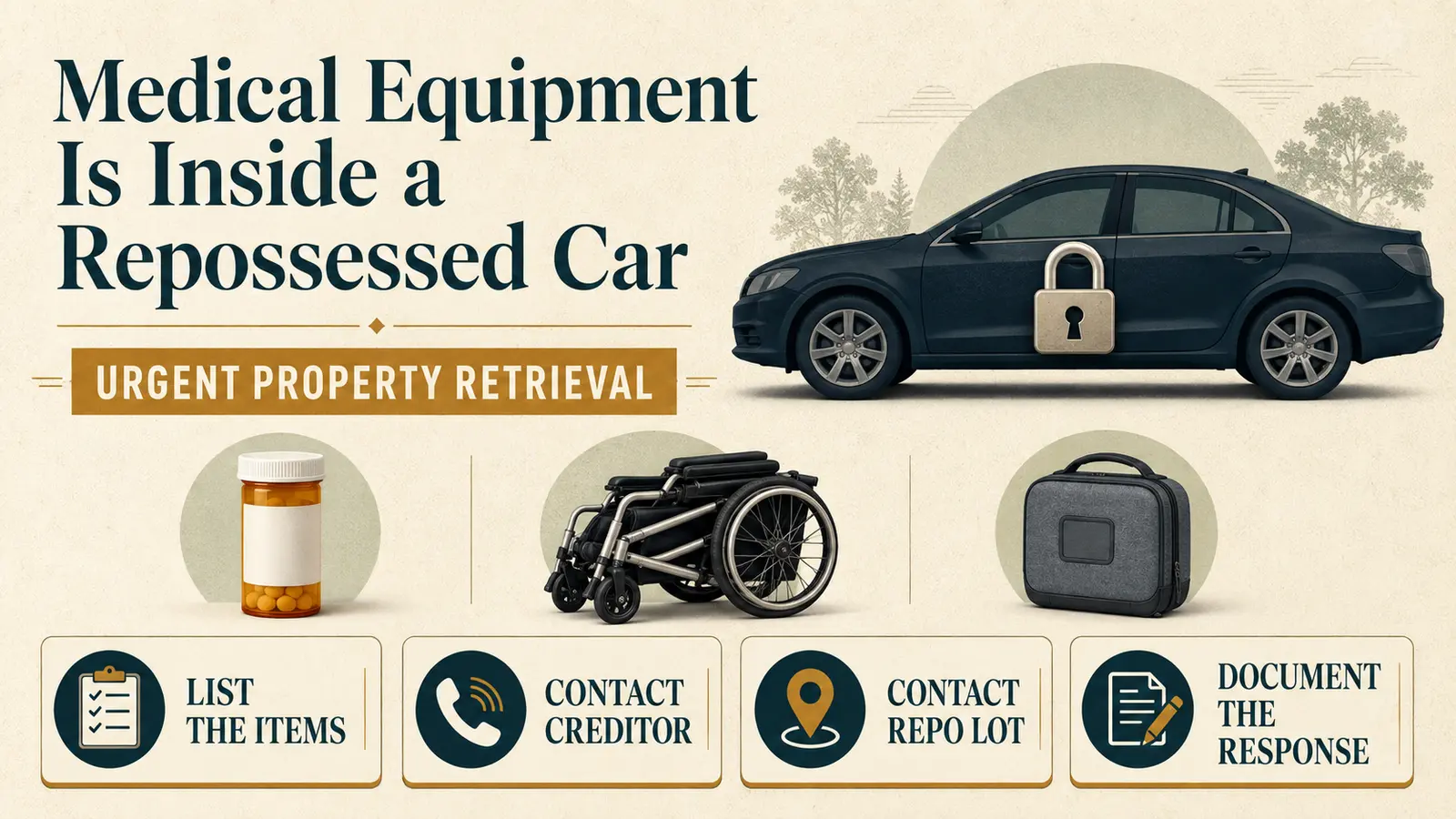
Identify the item and why prompt access matters
Write the exact item, quantity, and location in the vehicle. Examples can include medication, mobility-device components, medical records, chargers, or adaptive equipment.
Avoid sending unnecessary diagnosis details. The repo company usually needs enough information to locate and release the property, not a full medical history.
Contact both lender and physical custodian
Ask the lender for the repossession company or lot and contact that custodian directly. State that the request concerns personal property, not recovery of the vehicle.
Record call times, names, and promised pickup windows. Follow phone calls with an email or secure message if possible.
Ask for expedited access in writing
If ordinary pickup hours would create a serious problem, request an earlier appointment and explain the specific property involved.
The law on after-hours access or fees varies by state, so do not promise a universal entitlement. The written request shows that the custodian knew the item was medically important.
Bring identification and a narrow inventory
At pickup, focus first on the urgent property. Photograph what is returned and note missing items immediately.
If the lot refuses access unless unrelated vehicle fees are paid, ask for the demand and basis in writing. CFPB has criticized practices that condition return of personal property on upfront fees.
Escalate through the right regulator
Depending on the state, repossessors may be licensed or bonded, and attorney-general or consumer-protection offices may accept complaints.
Use the state page to identify the regulator. Emergency law-enforcement or medical decisions depend on the actual facts and local resources, not on a website checklist.
Keep health information out of the deficiency file
The later sale and deficiency dispute usually does not require medical details. Keep the retrieval correspondence in a separate folder and share only what is necessary.
This reduces privacy exposure while preserving the evidence needed for the property dispute.
Treat urgent retrieval as an inventory-and-escalation task
Identify the equipment or supplies precisely: name, quantity, serial number if applicable, prescribing provider or pharmacy if relevant, and where the item was stored in the vehicle. Tell the lender and storage location that the request involves medical equipment or supplies and ask for the earliest available retrieval process. If a device is needed for immediate health or mobility, use the appropriate medical or emergency channel for the person’s condition rather than waiting for a property dispute to be resolved.
Keep the request narrow. The objective is access to the item, not resolution of the auto debt. Ask for the property location, hours, identification requirements, appointment procedure, and an escalation contact if the first-line representative cannot authorize release. Keep call times, names, ticket numbers, emails, and any refusal or delay in writing.
Document condition and completeness at pickup
When the equipment is returned, check accessories, batteries, chargers, cases, medication containers, or other components that make the item usable. Photograph damage if appropriate and record anything missing before leaving. This creates a factual file for later state-law review without making unsupported claims that federal repossession law itself creates a special medical-equipment remedy.
Keep sensitive information to the minimum needed
A retrieval request usually does not require sending a complete medical history. Identify the item and urgency, and provide only the documentation the property holder reasonably requires for release or proof of ownership. Store prescription or medical documents separately from the ordinary loan file so they are not repeatedly forwarded to collectors or auction personnel who do not need them.
Use an urgency script that identifies the item without oversharing medical details
The retrieval request should be concrete: identify the device or medication, where it was stored, and why access cannot wait for the ordinary property-release schedule. For example, the custodian may need to know that a mobility component is in the trunk or that temperature-sensitive medication is in a cooler. It usually does not need a full diagnosis, medical history, or unrelated records. Keep the request narrowly focused on access and preservation of the property.
If the lot cannot release the item immediately, ask who has authority to approve an exception and what identification is required. Note the name, time, and response of each contact. CFPB consumer guidance treats personal belongings as distinct from the vehicle collateral and advises consumers to contact the lender promptly to arrange retrieval. If a company conditions release of personal property on an upfront payment, preserve that demand exactly as made and escalate it through the lender, regulator, or legal help rather than arguing at the storage gate.
Frequently asked questions
- Medication or a medical device is in my repossessed car — how do I get it fast?
- Treat it as an inventory-and-escalation task: identify the item and why prompt access matters, contact both the lender and the physical custodian, and ask for expedited access in writing. Bring identification and a narrow inventory to the pickup.
- Who do I escalate to if access is refused?
- The right regulator for repossession or towing conduct in your state, plus the lender’s complaint channel. Document the condition and completeness of the item at pickup.
- Should health details go in my loan file?
- Keep health information out of the deficiency file. Use an urgency script that identifies the item and the need for prompt access without oversharing medical details.
Sources checked for this page
- CFPB — What happens if my car is repossessed?Federal consumer overview of repossession, belongings, sale, redemption, deficiency, and credit reporting.
- CFPB Bulletin 2022-04 — Mitigating Harm from Repossession of AutomobilesCFPB supervisory and enforcement discussion of wrongful repossessions and servicing practices.