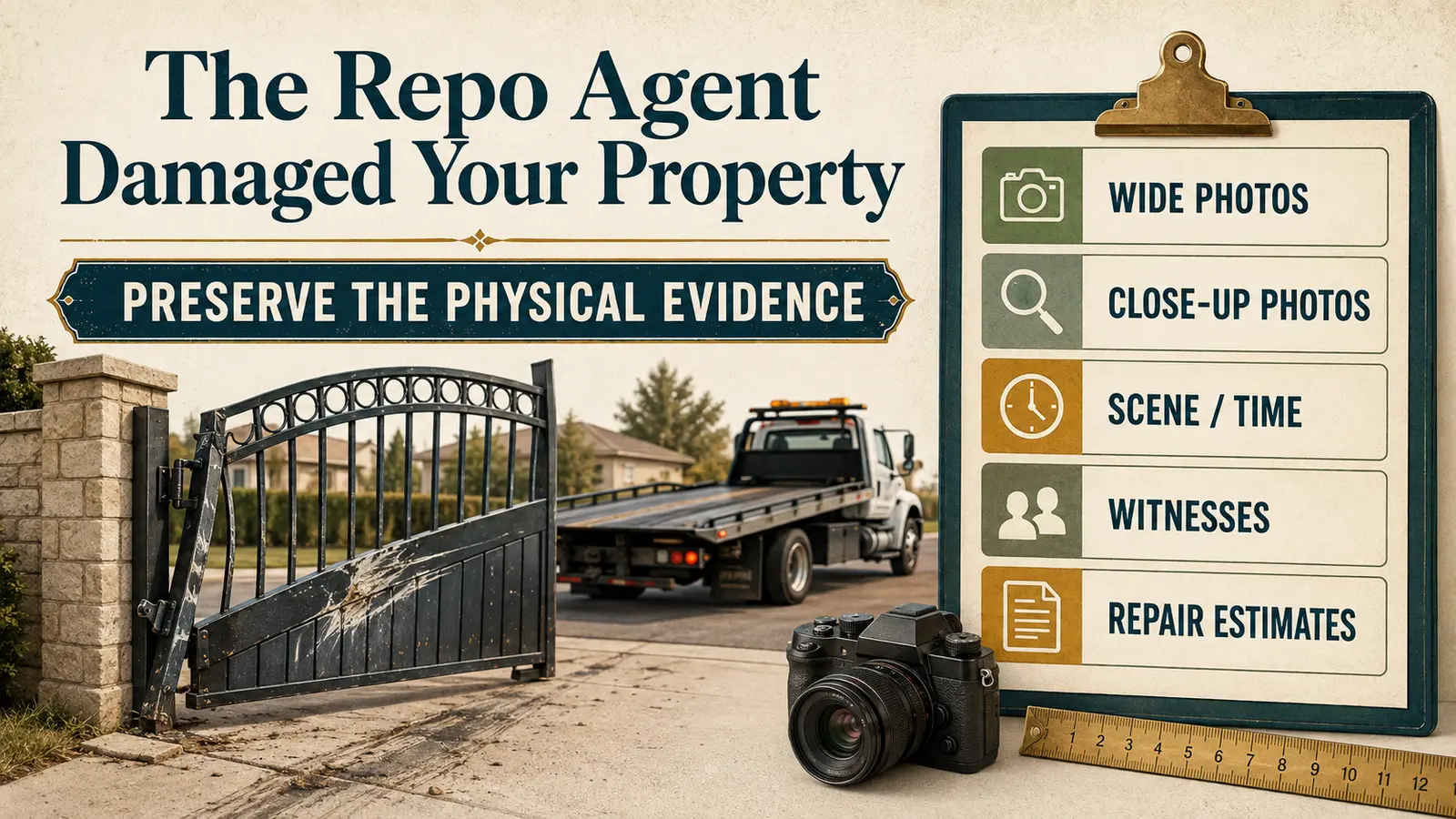
Photograph the scene before repair
Capture wide views showing the vehicle location and access route, then close-ups of locks, gates, garage doors, pavement, landscaping, or vehicle damage.
Preserve doorbell and security-camera footage in its original format with timestamps.
Identify the repossession company and agent
Ask the lender or local police notification system for the repo company name, address, and available incident information.
Some states license or bond repossessors, creating a regulator or bond claim path separate from the lender.
Get neutral repair documentation
Obtain estimates or invoices that describe what was damaged and the work needed.
Avoid asking the repair company to give a legal opinion about repossession conduct; factual descriptions are more useful.
Record witness accounts quickly
Ask witnesses to write what they personally saw or heard, with date and contact information.
Do not coach them to use the phrase “breach of the peace.” The legal label comes later.
Analyze breach of peace under state law
Model § 9-609 requires self-help repossession without breach of the peace, but state courts define the boundary. Forced entry into a locked structure can be especially significant, while other damage may support a different theory.
Use the state page for controlling cases rather than a national checklist.
Keep damage costs out of the deficiency math unless the creditor actually charges them
The creditor may separately charge repossession expenses to the account. Your own property damage claim is not automatically a credit against the deficiency unless resolved or recognized under governing law.
Track both ledgers so a settlement does not accidentally waive one issue while resolving the other.
Photograph first, characterize later
If a gate, garage door, driveway, vehicle, lock, landscaping, or other property appears damaged, make a dated photo and video record before repairs alter the scene. Photograph wide views showing location and close views showing the damage. Save security-camera clips, doorbell video, tow-company paperwork, witness names, police incident information if a report was made, and preexisting photographs that show prior condition. Obtain repair estimates or invoices that identify the damaged component rather than submitting only a round-dollar demand.
Keep property damage and breach of the peace as separate questions. Model § 9-609 conditions nonjudicial possession in states following that language on proceeding without breach of the peace, but whether particular conduct crosses that line is heavily dependent on state law and facts. Physical damage may be evidence relevant to that analysis, yet the amount of repair cost and the legal consequence of the repossession are not the same issue.
Report the event through traceable channels
Notify the creditor and repossession company in writing, identify the date and location, attach representative photographs, and request the repo agent’s incident or damage-claim process. Keep claim numbers and insurer information if supplied. Do not repair a safety-critical condition merely to preserve evidence; document it first when feasible and keep the invoice and replaced parts or photographs afterward.
Preserve third-party video quickly
Apartment complexes, neighbors, businesses, and traffic cameras may overwrite footage on short retention cycles. Ask promptly and in writing when practical. If the property manager will not release video directly, ask that it be preserved while the creditor, insurer, attorney, or court process determines how it can be obtained.
Preserve evidence that shows both the route taken and the physical force used
Scene photographs are stronger when they explain sequence. Capture the latch, gate, garage opening, tire marks, scrape pattern, broken hardware, and where the vehicle had been parked. Take wide shots that establish location and close-ups that show damage. If the tow truck crossed a barrier or entered an enclosed area, photograph the access point before repair. Save doorbell or security footage in its original file format when possible, not only as a screen recording sent through a messaging app.
Then separate two legal questions. UCC § 9-609 permits nonjudicial possession only if the secured party proceeds without breach of the peace under the model text, while § 9-625 provides remedies for Article 9 noncompliance. State law determines how those provisions apply to the facts and what additional tort or property-damage rules may exist. A repair invoice proves cost; it does not by itself prove the repossession was unlawful. Preserve neutral evidence first, then let the state rule and factfinder supply the legal characterization.
Frequently asked questions
- The repo agent damaged my gate or garage — what should I do first?
- Photograph the scene before any repair, identify the repossession company and the specific agent, and get neutral repair documentation. Record witness accounts quickly.
- Is property damage a breach of the peace?
- It can be. Damage caused while forcing entry or moving the vehicle is analyzed under your state’s breach-of-peace rule and may overlap with repossessor-licensing issues. Photograph first and characterize the legal claim later.
- Should the damage cost go into the deficiency math?
- Keep damage costs out of the deficiency calculation unless the creditor actually charges them. Report the event through traceable channels and preserve any third-party video quickly before it is overwritten.
Sources checked for this page
- UCC § 9-609 — Secured party’s right to take possession after defaultModel UCC text; the controlling law is the version enacted in the relevant state.
- CFPB — What happens if my car is repossessed?Federal consumer overview of repossession, belongings, sale, redemption, deficiency, and credit reporting.
- UCC § 9-625 — Remedies for secured party’s failure to complyModel remedies provision; consumer-goods consequences vary by state enactment and case law.