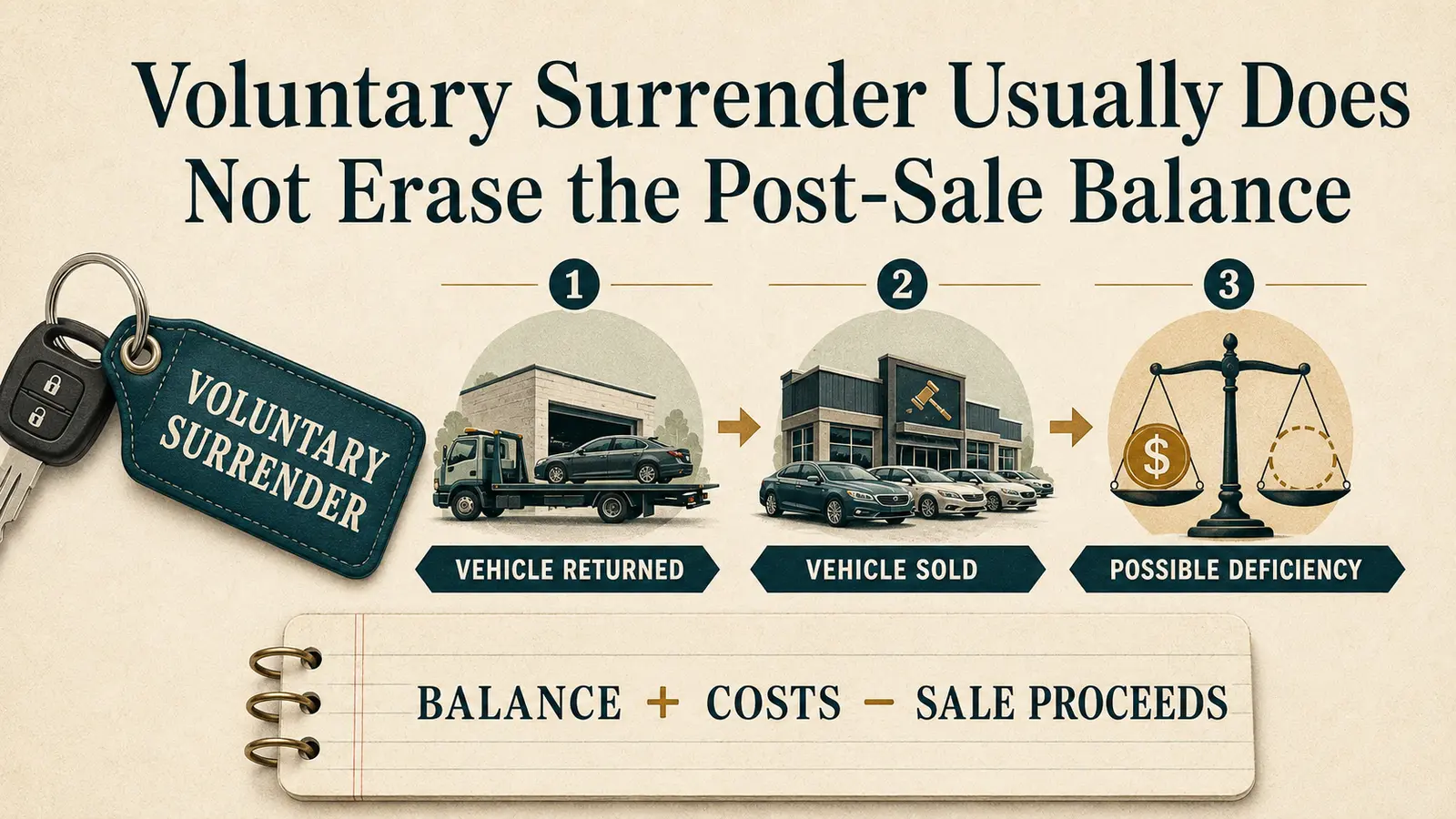
Voluntary surrender changes possession, not the accounting formula
FTC guidance warns that even with a voluntary repossession, a consumer may still be responsible for the difference between what is owed and what the creditor receives from selling the vehicle. The creditor can also report late payments or the repossession status to consumer reporting agencies.
The practical benefit, when it exists, is narrower: avoiding a forced pickup may reduce some repossession costs or conflict. Get any promised fee reduction or deficiency waiver in writing before surrendering the keys. A verbal statement that “turning it in will take care of it” is too ambiguous to rely on.
Ask what the creditor is agreeing to before delivery
There are several very different arrangements that can sound similar in conversation: a voluntary surrender with full deficiency rights reserved; acceptance of collateral in full satisfaction; a settlement that waives part of the deficiency; or a simple promise to reduce repossession fees.
If the creditor is offering satisfaction of the debt by taking the vehicle, the Article 9 acceptance rules may be relevant. Model §§ 9-620 and 9-622 address acceptance of collateral in satisfaction, and consumer-goods transactions have restrictions. Do not assume a routine voluntary surrender is the same as legally effective acceptance in full satisfaction.
Document condition and mileage at handoff
Take dated photographs of all sides of the vehicle, interior, odometer, keys, and accessories being delivered. Obtain a receipt that states the date, location, vehicle identification details, and who accepted possession.
Those records can matter if later fees include damage, missing-key charges, transport, or condition adjustments. They also establish when the creditor obtained possession for purposes of the next notice and sale sequence.
The disposition notice still deserves the same scrutiny
After surrender, the creditor generally proceeds toward disposition under the same Article 9 framework used after an involuntary repossession. Read the public/private sale information, redemption language, and timing just as carefully.
Do not throw away sale notices because you chose to surrender the vehicle. The creditor’s compliance with the sale process and the resulting price still affect the post-sale accounting and, depending on state law, deficiency recovery.
A deficiency waiver must be explicit
If the goal is to avoid a future deficiency, ask for a written term stating what happens to the remaining balance after disposition. “We will close the account” can mean operational closure while a balance remains collectible. “We will not pursue you” may also leave questions about assignment or credit reporting.
A settlement document should identify the account, the vehicle, the amount or formula being settled, whether the balance will be considered satisfied, and what happens if the sale produces a surplus. If a release is important, have the exact language reviewed rather than relying on a phone summary.
Surrender does not eliminate state-law questions
State law can add notice, cure, reinstatement, deficiency, licensing, or personal-property rules. A surrender may also affect whether a cure notice is required in states that condition the right on the consumer retaining possession.
Before assuming surrender is the cheapest path, compare the written agreement, likely fees, state procedure, and any realistic cure or redemption option. This site explains the paperwork; it does not decide whether surrender is financially best for a particular borrower.
Ask what the lender says the surrender accomplishes
A clean handoff of keys can reduce confrontation and sometimes reduce repossession logistics, but it does not by itself answer the debt question. Ask for a written receipt identifying the vehicle, date, mileage, and where it was delivered, then ask whether the creditor intends to dispose of the vehicle under Article 9 or is proposing acceptance of the collateral in satisfaction of the obligation. Those paths have different consequences.
Model UCC § 9-620 requires a defined acceptance process. In a consumer transaction, partial satisfaction is not available under the model rule, and full satisfaction depends on the creditor’s proposal or authenticated agreement plus the statutory consent/objection process. A routine voluntary surrender followed by a sale is therefore not the same thing as a written agreement that the vehicle satisfies the debt in full.
Preserve the same sale evidence you would preserve after an involuntary tow
After surrender, save the disposition notice, envelope or delivery record, auction or private-sale information, final sale statement, and account history. The creditor still has to account for proceeds and any claimed deficiency under the law that applies. If someone promised orally that surrender would “wipe out” the balance, write down who made the statement, when, and through which number or branch, but do not treat the oral description as a substitute for the actual written terms.
Frequently asked questions
- Does voluntarily returning the car erase what I owe?
- Usually not. Voluntary surrender changes possession, not the accounting formula: the lender still sells the vehicle and can pursue any shortfall between the net proceeds and the balance plus expenses. A deficiency waiver only applies if it is explicit and in writing.
- What should I get in writing before handing over the keys?
- Ask exactly what the lender is agreeing to — whether it is waiving the deficiency, how it will report the account, and where the sale notice will be sent. Document the vehicle’s condition and mileage at handoff.
- Does surrender remove the state-law questions?
- No. The disposition notice, the commercial reasonableness of the sale, and your state’s deficiency rules still apply. Preserve the same sale evidence you would keep after an involuntary tow.
Sources checked for this page
- FTC — Vehicle RepossessionFederal consumer guidance on default, repossession, personal property, sale, and deficiency.
- UCC § 9-620 — Acceptance of collateral in satisfactionModel strict-foreclosure rules and consumer-goods limits.
- UCC § 9-622 — Effect of acceptance of collateralModel effect when collateral is accepted in full or partial satisfaction.
- UCC § 9-611 — Notification before dispositionModel UCC text; state enactments can add requirements.
- UCC § 9-615 — Application of disposition proceeds; deficiency and surplusModel rules for applying sale proceeds and calculating deficiency/surplus.