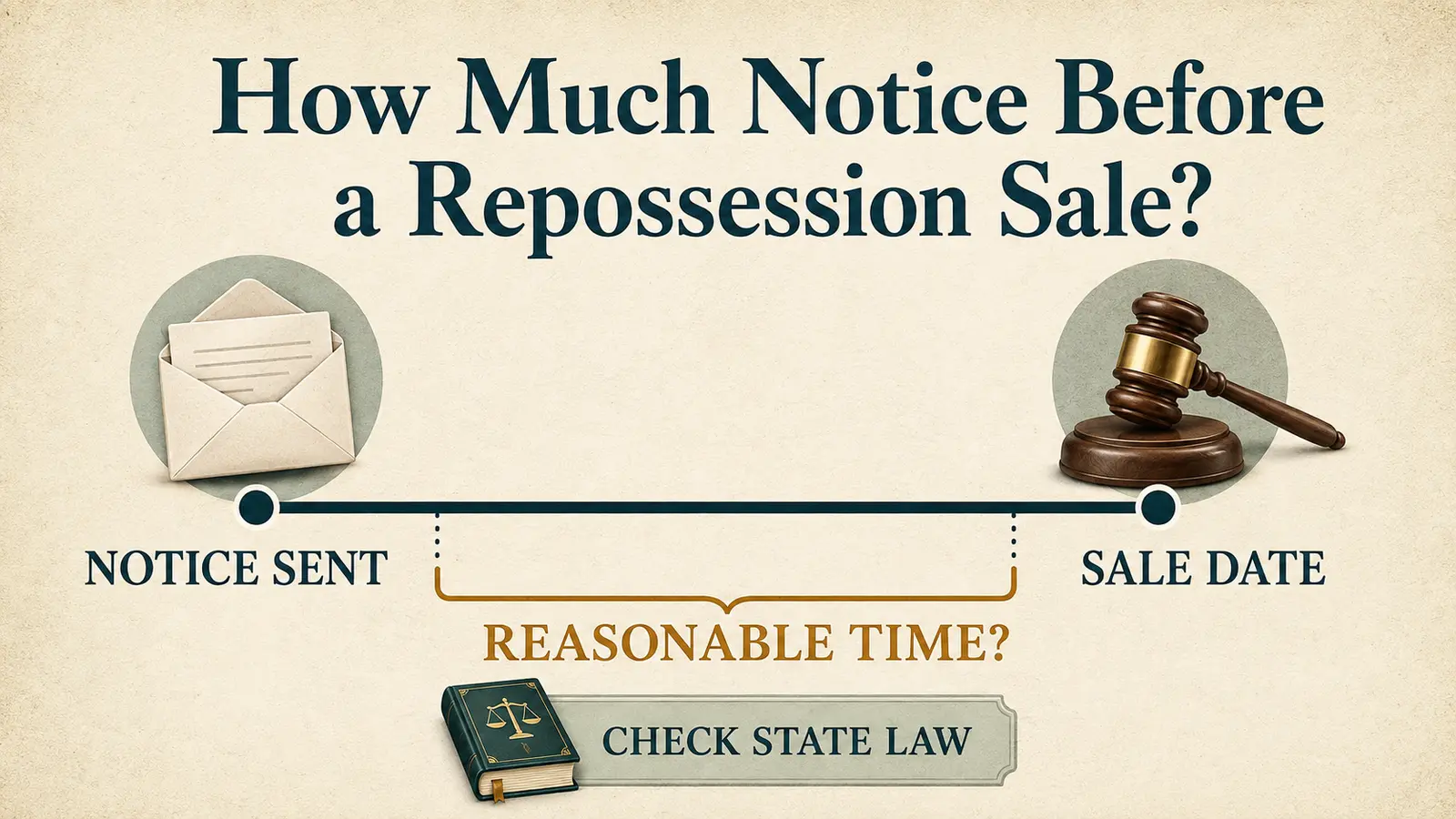
Model § 9-612 treats consumer timing differently from nonconsumer timing
The model section creates a ten-day safe-harbor concept for nonconsumer transactions but does not declare a comparable numerical safe harbor for consumer transactions. Reasonableness in consumer cases is therefore shaped by state enactments, other statutes, and case law.
That distinction is easy to lose when secondary articles quote “10 days” without specifying the transaction type. Do not transplant a commercial-collateral rule into a personal auto repossession.
Read the state motor-vehicle statute alongside Article 9
Several states regulate retail installment vehicle repossessions outside the UCC and may specify notice periods, post-repossession reinstatement windows, or sale waiting periods.
A state page should list both sources and explain which one supplies the numeric deadline. If the state code has no extra number, the article should say the timing standard is reasonableness rather than inventing a day count.
Measure from the sending event the statute uses
Article 9 generally speaks in terms of sending an authenticated notification. Receipt can still matter factually, but the statutory trigger may not be “the day you opened the letter.”
Preserve postage marks, electronic timestamps, and returned-mail records. A notice dated Monday but not actually sent until Friday creates a different timeline from a letter mailed on Monday and opened on Friday.
Public and private sales use different notice endpoints
A public-sale notice identifies the scheduled time and place. A private-sale notice states a time after which disposition may occur.
For a private sale, the actual transaction might happen days after the stated “after” date. That does not automatically extend redemption indefinitely; verify the creditor’s written cutoff and the state’s enacted redemption rule.
Reasonableness is evaluated in context
Courts can consider the purpose of notification—allowing the debtor and other parties to protect their interests—and the circumstances of the transaction. A notice technically sent before sale can still be challenged if the interval was unreasonably short under controlling law.
Conversely, a longer interval does not cure missing content or an otherwise defective sale. Timing is one part of the notice and disposition analysis.
Use the deadline strip only when the source supplies a real rule
For state pages, a numeric strip should cite the exact official source. If the only governing rule is “reasonable notification,” the strip should say that rather than manufacture precision.
A consumer facing an actual upcoming sale should confirm the date directly with the creditor and local counsel or legal aid if the timing is disputed. The website’s role is to identify the controlling source, not to guess a safe day count.
Do not import the model ten-day safe harbor into a consumer auto case
Model UCC § 9-612 says reasonableness of timing is generally a question of fact and then provides a ten-day safe harbor only for a transaction other than a consumer transaction. That distinction matters. A consumer auto article should not announce “the lender must give ten days” merely because § 9-612 contains the number 10. State retail-installment statutes can impose their own minimum periods, and those state-specific rules are the place to publish an actual day count when verified.
For a consumer case, build a timing table with the date the notification was sent, the date it was received if known, the public-sale time or private-sale earliest date stated in the notice, any postponement, and the actual disposition date. Also record weekends, holidays, returned mail, address changes, and requests for a redemption quote. Those facts make the timing question concrete without manufacturing a national deadline.
A changed sale date should be documented, not guessed
If an auction is postponed or a private-sale window changes, save the creditor’s or auctioneer’s update and identify whether a new notice was sent. Do not assume every postponement automatically requires a fresh notice or that none ever does; the answer can turn on state enactments and case law. The useful editorial rule is to publish the dated sequence and the cited local authority, not a one-size-fits-all countdown.
Frequently asked questions
- How many days of notice must a creditor give before selling a repossessed car?
- There is no single national consumer day count. Model § 9-612 treats consumer timing differently from nonconsumer timing, and a state motor-vehicle statute may supply its own rule. Reasonable time is evaluated in context.
- Does the model 10-day safe harbor apply to my car?
- That 10-day rule is a nonconsumer safe harbor and should not be imported into a consumer auto case. Read the state statute alongside Article 9 and measure from the sending event the statute actually uses.
- What if the creditor moved the sale date?
- A changed sale date should be documented rather than guessed. Public and private sales use different notice endpoints, so confirm which one applies and what new date was communicated, in writing.
Sources checked for this page
- UCC § 9-612 — Timeliness of notificationModel UCC text; consumer-transaction timing is often left to state law and case law.
- UCC § 9-614 — Contents of notification: consumer-goods transactionModel consumer-goods disposition notice rules and safe-harbor form.
- UCC § 9-623 — Right to redeem collateralModel redemption right before disposition, collection, or acceptance.