Path one: the entry is inaccurate
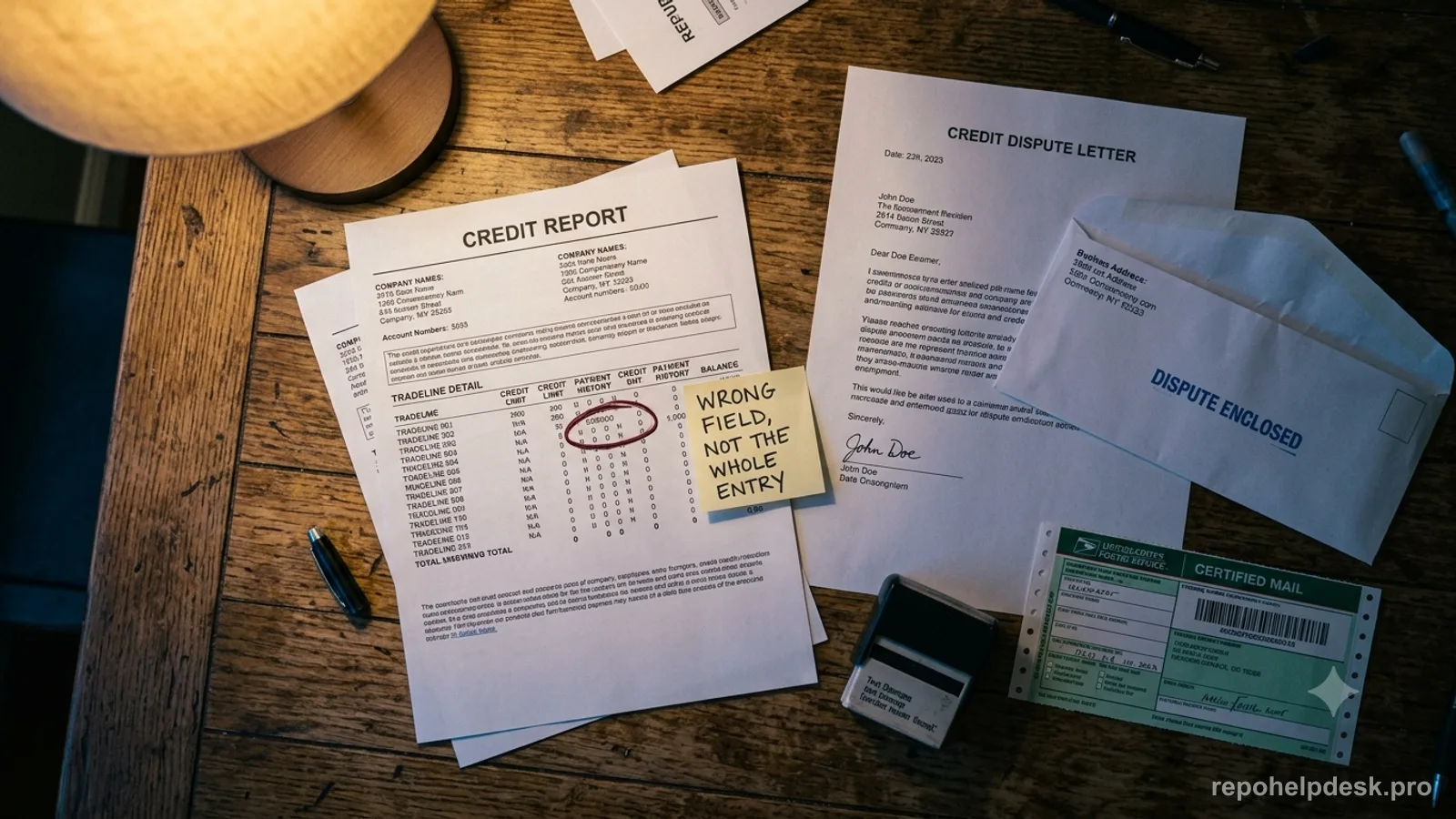
If a field on the repossession tradeline is wrong, the Fair Credit Reporting Act gives you a dispute right. Common inaccuracies include a status that says repossession after the servicer admitted the repossession was in error, a balance that does not match a correct post-sale accounting, a date of first delinquency later than your records support, and the same debt reported twice by the original creditor and a collector.
File the dispute with each bureau that shows the error, and separately with the furnisher, and attach the specific proof — the servicer’s correction letter, the sale reconciliation, or your payment records. Frame it around the wrong field, not around disliking the entry.
Path two: the reporting period ends
An accurate repossession generally reports for about seven years from the date of first delinquency. That date does not reset when a collector buys the debt or when you make a payment, so an accurate entry ages off on its own schedule and cannot be disputed away before then.
Path three: a negotiated reporting term
When settling a deficiency, a creditor may agree to update how the account reports. Any such term has to be in the written settlement agreement, signed by the party with authority over the account, before you pay. A verbal promise to "take care of the credit report" is not enforceable and often does not happen.
Note that many furnishers will not agree to delete an accurate entry, and a request to do so is not something the FCRA requires them to honor.
What does not work
- Disputing the word "repossession" in the abstract when every field is accurate.
- Paying a collector on the theory that payment forces deletion — it generally updates the balance, not the presence or age of the entry.
- A "pay for delete" understanding that is not written into the agreement before payment.
- Re-disputing the same accurate entry repeatedly after the bureau has verified it.
Keep the credit dispute separate from the sale challenge
A challenge to the commercial reasonableness of the sale or to the deficiency amount runs under state law, on its own deadline, in front of a different decision-maker. Resolving the accounting can give you the evidence to fix a credit-report balance field, but the two processes are not the same filing.
Frequently asked questions
- Can I get a repossession removed from my credit report?
- Only if it is inaccurate and gets corrected, if it reaches the end of its roughly seven-year reporting period, or if a creditor agrees in writing to change how it reports as part of a settlement. An accurate entry cannot be disputed away early.
- Does paying the deficiency delete the repossession?
- No. Paying a collector generally updates the balance to paid or settled but does not remove the repossession status or reset the age of the entry.
- What is the strongest kind of dispute?
- One built around a specific wrong field — a status the servicer admitted was an error, a balance that does not match a correct post-sale accounting, a date of first delinquency that is too late, or the same debt reported twice — with the matching proof attached.
Sources checked for this page
- CFPB — How do I dispute an error on my credit report?The FCRA dispute process with the bureaus and the furnisher.
- CFPB — How long does negative information stay on my credit report?The roughly seven-year window and the date it runs from.
- FCRA § 611 / 15 U.S.C. § 1681iStatutory reinvestigation duty after a consumer dispute.
- FTC — Disputing Errors on Your Credit ReportsConsumer guidance on writing an effective dispute.