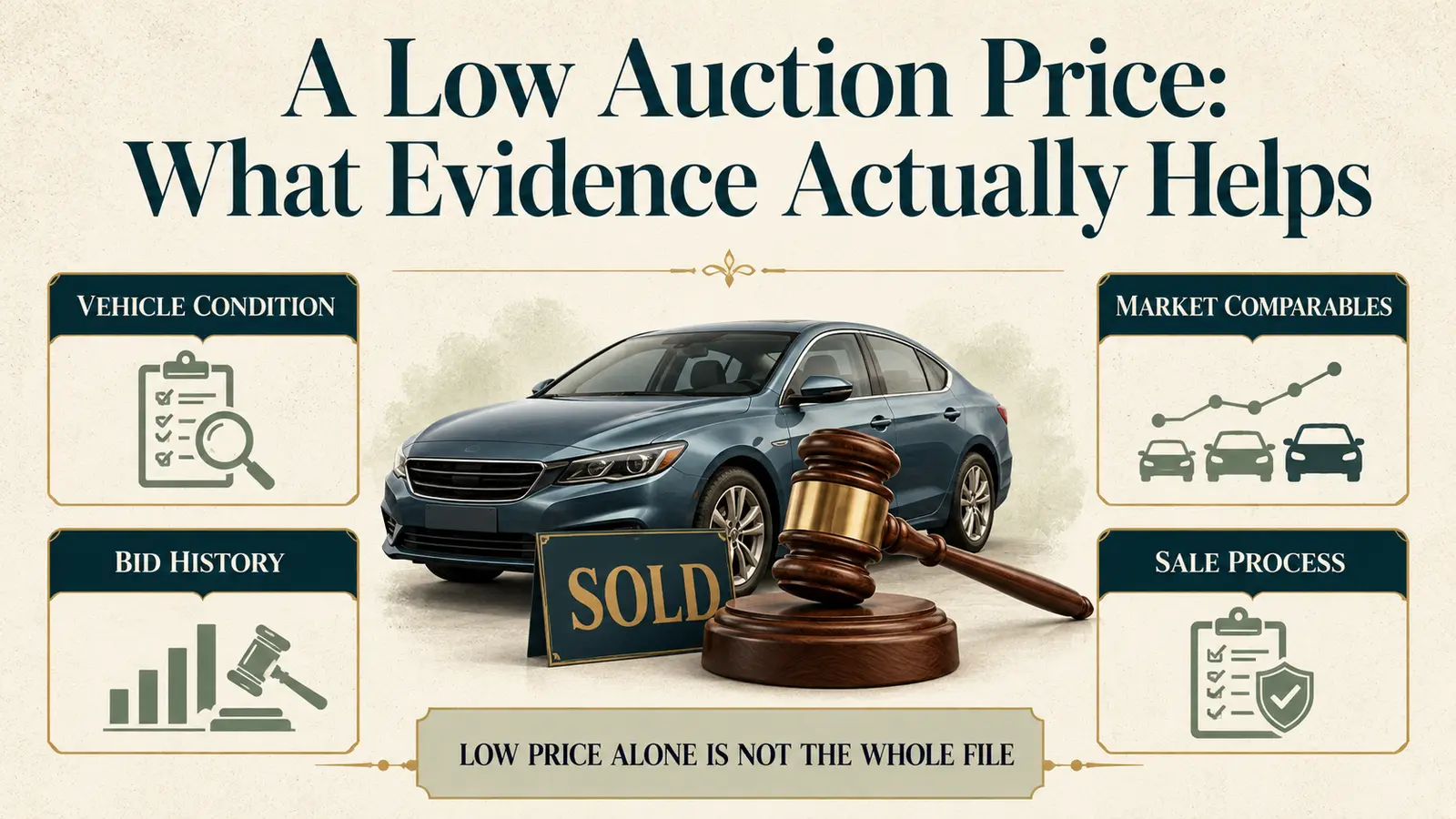
Get the actual sale record first
Ask for the sale date, venue or platform, gross price, net credit, condition report, mileage, title status, and invoices for sale-related fees. A post-sale deficiency statement may show only the credited proceeds, so the underlying sale record is important.
If the vehicle was sold at auction, save any public result, run number, photographs, and bidder information that is available. If it was privately sold, request the bill of sale or other transaction record.
Use comparable values at the correct market level
Retail asking prices often include dealer reconditioning, warranty exposure, financing overhead, and profit. Wholesale auction values reflect a different market. Compare like with like: same model year, trim, mileage band, drivetrain, accident history, title status, and date.
Explain every adjustment. A comparable that is $4,000 higher but has 40,000 fewer miles and a clean title may be less useful than a lower-priced vehicle with nearly identical condition.
Investigate whether condition was accurately presented
A poor condition grade, missing key, mechanical warning, or salvage history can depress auction value. Ask whether the condition report is accurate and whether photographs support it.
If the repo company or auction caused damage, preserve earlier photographs and tow records. A condition issue can affect both property-damage questions and the sale-price analysis.
Connect price to method, manner, time, place, and terms
Model §§ 9-610 and 9-627 make clear that commercial reasonableness concerns the process. Was the vehicle advertised? Was the auction accessible to an appropriate buyer pool? Was there enough market exposure? Was the sale to a related party? Were unusual restrictions imposed?
A low price plus ordinary wholesale procedures may not establish noncompliance. A low price plus thin exposure, defective notice, inaccurate condition information, and a related buyer tells a more complete story.
Watch for the special related-party calculation rule
Model § 9-615(f) addresses certain dispositions to the secured party, a person related to the secured party, or a secondary obligor when the actual proceeds are significantly below specified market measures.
Identify the buyer before assuming the ordinary deficiency math applies. The state’s enacted version and the facts of the relationship control whether the special rule matters.
Keep the remedy question for the state-law page
Even if the sale was not commercially reasonable, consumer deficiency consequences vary by jurisdiction. Model § 9-626 does not impose one national consumer rule.
The evidence file should therefore end with two separate questions: what was wrong with the sale, and what does this state do to a deficiency when that kind of noncompliance is proven?
Document the vehicle the auction actually sold
A valuation challenge is only as useful as the vehicle description underneath it. Record the VIN, model year, trim, drivetrain, mileage, major options, title branding, collision history, warning lights, tire condition, mechanical defects, keys present, and obvious cosmetic damage. Use pre-repossession photographs, repair invoices, inspection reports, telematics or service records where available. If the auction condition report later shows something materially different, preserve both versions rather than editing one into the other.
When gathering market comparators, separate wholesale transactions from retail asking prices. A dealer advertisement can show market context, but it may include reconditioning and profit that a wholesale sale does not. Same-week auction results for similar trim and condition, recognized valuation data, or an independent appraisal can be more probative. Note the source date and geographic market so a later reader can reproduce the comparison.
Investigate how the sale was exposed to the market
Price can be a symptom of a process problem. Ask whether the vehicle was sold through a dealer-only lane, public auction, online platform, or direct buyer; how long it was listed; whether bidders could inspect it; what condition announcements were made; and whether the buyer was affiliated with the secured party. Model §§ 9-610 and 9-627 focus on the commercial reasonableness of method, manner, time, place, and terms, so those process facts belong beside the price evidence.
Frequently asked questions
- My repossessed car sold for very little — is that a problem?
- It might be, or it might just reflect wholesale reality and the vehicle’s condition. Get the actual sale record first, then compare it to values at the correct market level for the same kind of vehicle and sale.
- What evidence actually helps challenge a low price?
- Evidence tying the price to the process: how the sale was exposed to the market, whether the vehicle’s condition was accurately presented, and how method, manner, time, place, and terms were handled. Document the specific vehicle the auction sold.
- Is there a special rule if the lender or an insider bought it?
- Yes. Model § 9-615(f) can substitute a market-based amount into the deficiency calculation when a related party buys at a low price. Keep related-party status separate from ordinary auction participation.
Sources checked for this page
- UCC § 9-610 — Disposition of collateral after defaultModel UCC text for public/private disposition and commercial reasonableness.
- UCC § 9-627 — Commercial reasonablenessModel guideposts for commercially reasonable disposition.
- UCC § 9-615 — Application of disposition proceeds; deficiency and surplusModel rules for applying sale proceeds and calculating deficiency/surplus.
- UCC § 9-626 — Deficiency or surplus in issueModel burden/presumption rule; subsection (b) expressly leaves consumer-transaction rules to courts.