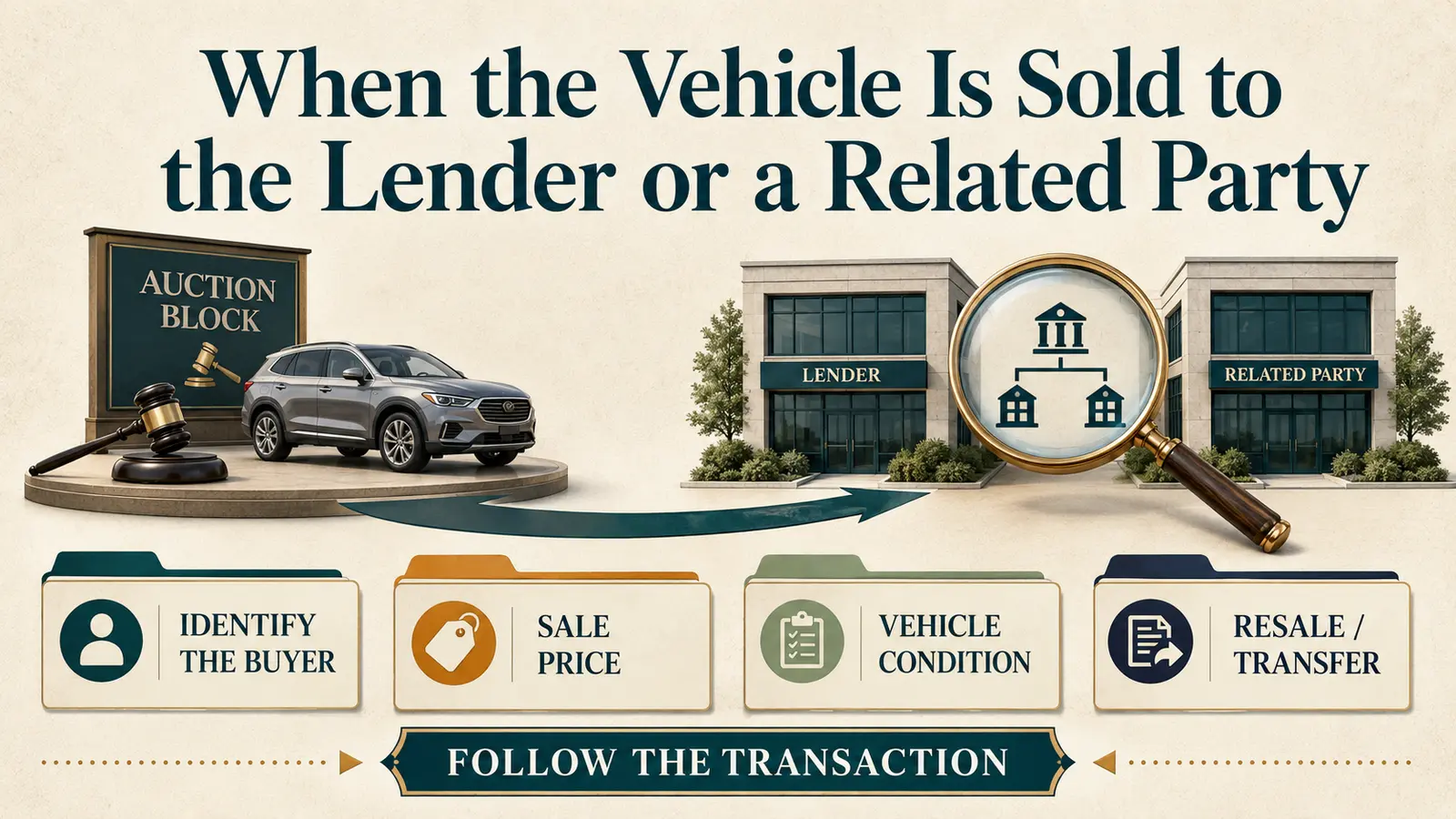
Find out who actually bought the vehicle
The auction name is not necessarily the buyer. Ask for the sale report or bill of sale showing purchaser identity or category, the gross price, fees, and date.
If the creditor purchased the vehicle at its own public disposition, note that fact. Model § 9-610 permits a secured party to purchase at a public disposition and permits a private purchase only in specified market circumstances.
Model § 9-615(f) can substitute a market-based amount in the deficiency calculation
When the secured party, a related person, or a secondary obligor buys the collateral and the proceeds are significantly below specified market measures, the model rule calculates deficiency as if the proceeds were the higher qualifying amount.
This is technical and fact-dependent. The relevant state enactment controls, and the “recognized market” or standard price-quotation concepts are narrower than ordinary internet asking prices.
Related-party status also deserves process scrutiny
A relationship does not automatically make the sale unreasonable. But it increases the importance of market exposure, competing bids, valuation records, and the reasons for the chosen channel.
Save evidence of who could participate and whether the creditor had a reserve or credit-bid mechanism.
Public and private purchase rules differ
Model § 9-610 expressly distinguishes when the secured party may purchase at public versus private disposition.
If a creditor acquired the car through a private transaction, verify whether the collateral was of a kind customarily sold on a recognized market or subject to widely distributed standard price quotations as the statute requires.
The deficiency statement should still be reconcilable
Even if a special calculation applies, the creditor’s final balance should be explainable. Ask how the credited proceeds were determined and whether any market-substitution rule was used.
A collector may receive only the final number, so the original creditor is often the better source for this sale-specific evidence.
State cases can refine the rule
Courts differ on what markets qualify and how related-party transactions affect commercial reasonableness.
Use the state article and controlling cases before assuming the model text alone resolves the deficiency.
Section 9-615 contains a special calculation rule for certain low related-party sales
Model § 9-615(f) addresses a disposition to the secured party, a person related to the secured party, or a secondary obligor when the proceeds are significantly below the range a complying disposition to an unrelated transferee would have brought. In that situation, the model text calculates surplus or deficiency using the amount that would have been realized in a complying disposition to an unrelated transferee. The state enactment and case law still need to be checked before applying the rule to a particular consumer transaction.
The first factual task is therefore to identify the buyer and relationship, not merely the price. Look for auction records, dealer or affiliate names, business registrations, sale invoices, title-transfer information, and any evidence that the buyer was the creditor itself or connected to it. Then gather condition-adjusted market evidence so the “significantly below” question is supported by more than a retail advertisement.
Keep related-party status separate from ordinary auction participation
A creditor being present at an auction, setting a reserve, or credit-bidding where permitted does not automatically prove an improper related-party sale. The relevant details are who acquired the vehicle, how the transaction was conducted, and whether the statutory conditions are met. Describe those facts precisely; avoid turning a corporate-name similarity into an accusation without records.
Test the relationship with records
Useful records can include the auction bill of sale, title assignment, buyer entity name, state business filings, creditor corporate disclosures, and subsequent resale listing. A quick resale at a much higher price can be context, but condition changes, repairs, transport, and retail markup must be considered before treating the later price as the value on the original sale date.
Compare the related-party price with evidence from the same sale channel
A weak comparison uses a retail asking price from a dealer website and calls it proof that an auction price was too low. A better file compares the transaction with evidence that resembles the creditor’s actual disposition: condition reports, mileage, title status, auction lane, sale date, location, transportation costs, and contemporaneous wholesale data where available. Those details matter because § 9-615(f) is triggered by a related-party disposition that is significantly below the range a complying disposition to an unrelated person would have produced.
Keep the purchaser-relationship question separate from the commercial-reasonableness question. A lender or related person buying collateral is not, by that fact alone, proof of an invalid sale. The useful inquiry is whether the statutory purchase rules were satisfied, what process produced the price, and whether the special deficiency calculation applies. Save the bill of sale, auction report, purchaser identity, and any later resale record in the same folder so the price path can be reviewed without relying on assumptions about affiliation.
Frequently asked questions
- Why does it matter who bought the repossessed vehicle?
- If the lender, its affiliate, or an insider bought at a low price, model § 9-615(f) can substitute a market-based amount into the deficiency calculation instead of the actual sale price. Buyer identity also invites extra scrutiny of the sale process.
- How do I find out who actually bought it?
- Ask for the sale record and the buyer’s identity. Test the relationship with documents, and compare the related-party price against evidence from the same sale channel.
- Is a lender bidding at its own auction automatically improper?
- No. Public and private purchase rules differ, and a secured party can sometimes buy at a public sale. Keep related-party status separate from ordinary auction participation and reconcile the deficiency statement either way.
Sources checked for this page
- UCC § 9-610 — Disposition of collateral after defaultModel UCC text for public/private disposition and commercial reasonableness.
- UCC § 9-615 — Application of disposition proceeds; deficiency and surplusModel rules for applying sale proceeds and calculating deficiency/surplus.
- UCC § 9-627 — Commercial reasonablenessModel guideposts for commercially reasonable disposition.