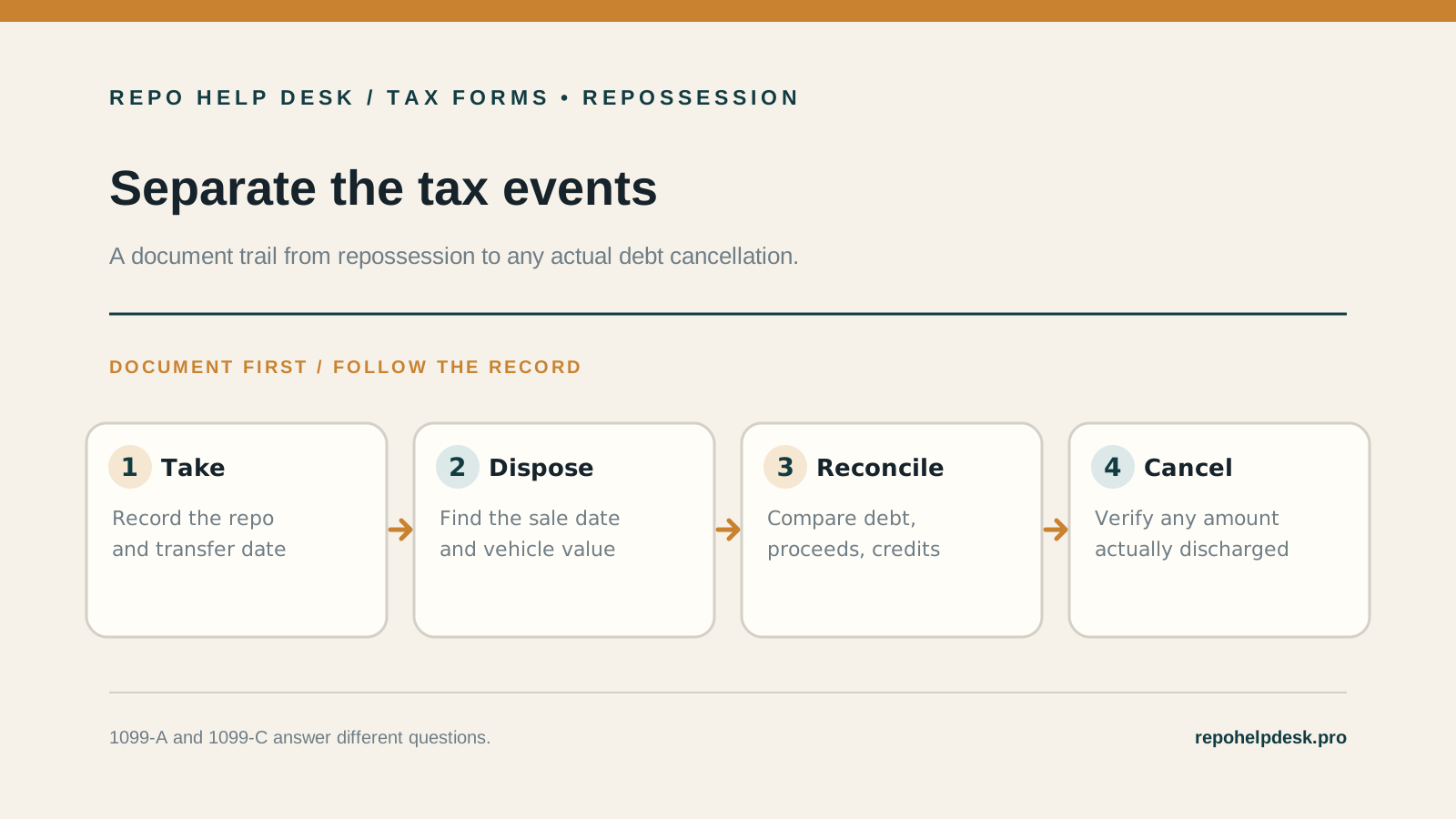
Start by separating the four events
A lender taking a vehicle is not automatically the same event as selling it, calculating a deficiency, forgiving the remaining debt, or reporting canceled debt to the IRS. A vehicle may be repossessed in one year, sold later, and the remaining balance may not be discharged until a still later settlement, court event, or actual cancellation. The tax year and form should follow the event the lender reports and the facts of the account, not simply the date the tow truck arrived.
Make a one-page chronology with the default date, repossession date, sale or other disposition date, date the creditor says the account was canceled, and dates you received Forms 1099-A or 1099-C. Keep the auction or sale statement, notice of disposition, final account history, settlement agreement, court paperwork, and correspondence that says whether collection continues. If a collector is still demanding money, do not assume a tax form alone proves the debt was legally released.
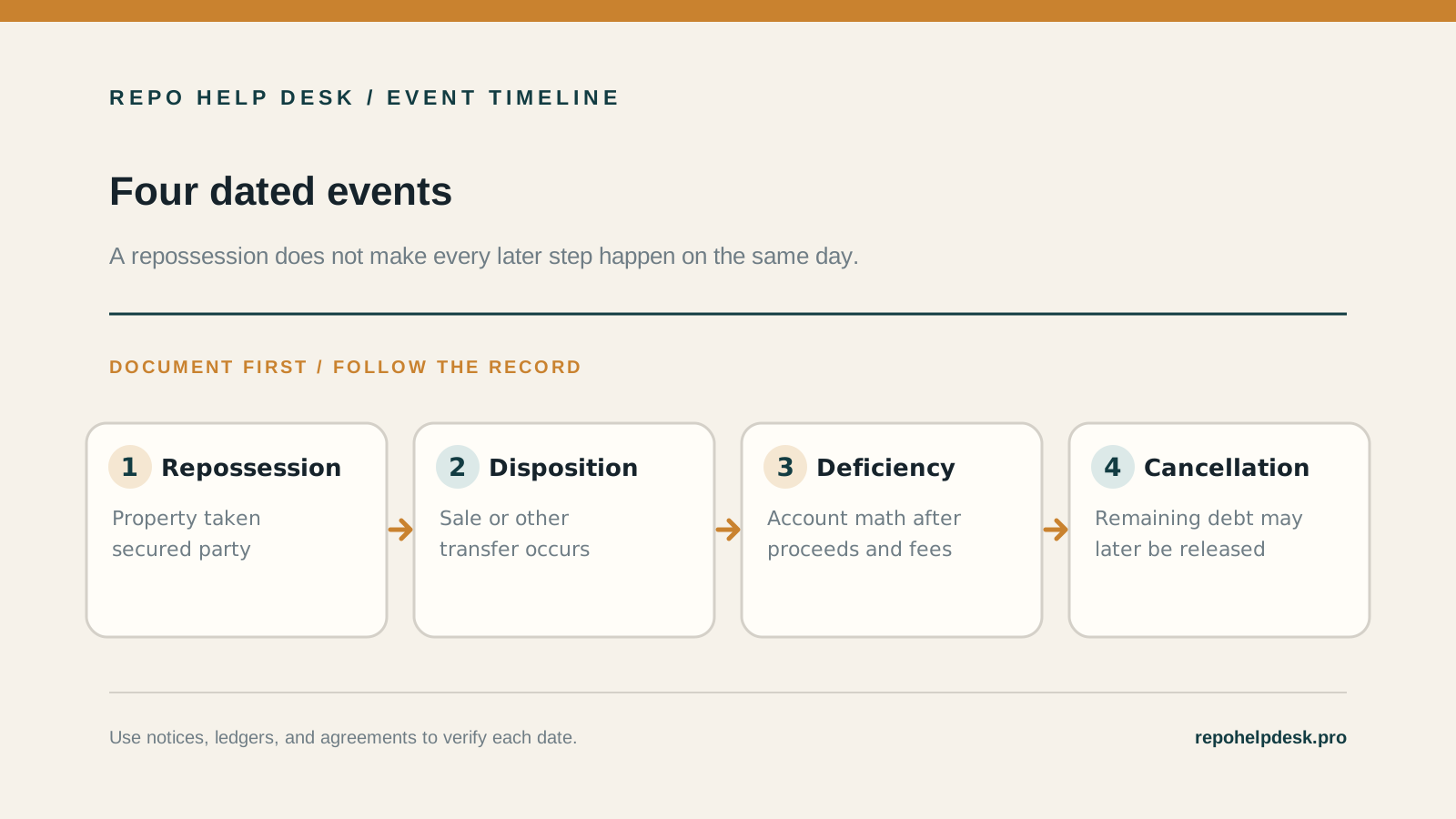
Build the timeline before totaling forms
- Record the repossession and transfer date.
- Get the sale/disposition statement and final proceeds.
- Ask whether the creditor discharged any remaining balance and when.
- Match every IRS form to the event date and tax year it reports.
Read Form 1099-A and Form 1099-C as different records
Form 1099-A is about a lender acquiring an interest in property that secured a debt or learning that the property was abandoned. For a vehicle, review the balance shown, the fair market value field when completed, and whether the form indicates that you were personally liable. Those fields help analyze the property disposition; they do not by themselves state that the lender erased the deficiency. A creditor may send a combined form or issue a separate 1099-C, so check both sides of the paperwork and the account history.
Form 1099-C reports a debt cancellation event. Box 1 gives the date of the identifiable event, Box 2 the amount of debt discharged, Box 3 any interest included in Box 2, Box 5 whether the debtor was personally liable, and Box 6 the event code. Box 7 may report fair market value when the form also covers a foreclosure or similar disposition. Read the instructions for the tax year on the form: a 1099-C can be issued after the year of the underlying repossession, and the event date is not necessarily the year the car was taken.
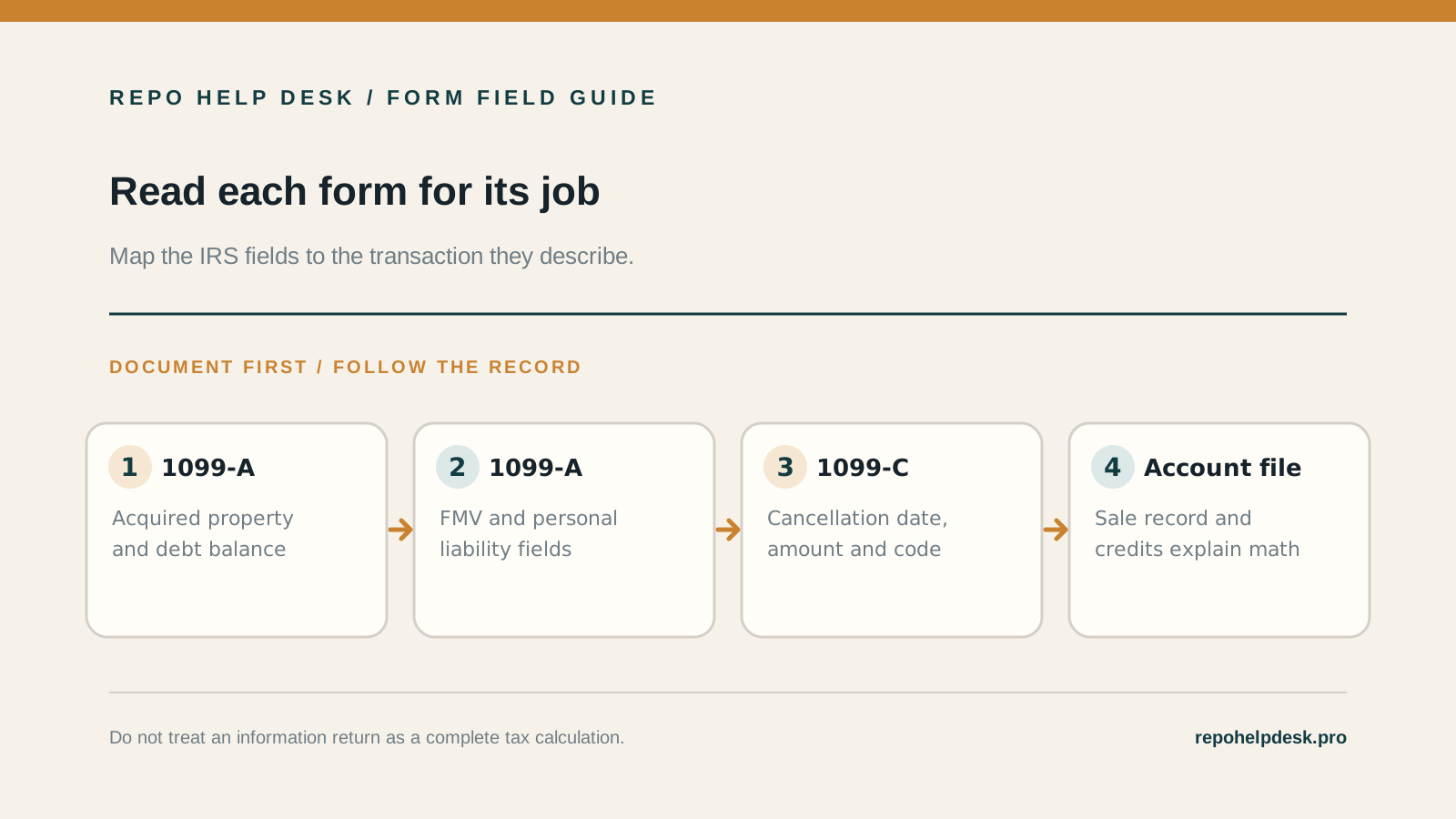
| Record | What to inspect | What it does not establish by itself |
|---|---|---|
| Form 1099-A | Acquisition date, debt balance, fair market value, personal-liability box | That a remaining deficiency was canceled |
| Form 1099-C | Identifiable-event date, discharged amount, interest, liability box, event code | That the reported amount is automatically taxable in full |
| Sale/account statement | Gross proceeds, fees, credits, balance before and after sale | Your federal tax result without the debt classification and basis facts |
Recourse and nonrecourse debt change the calculation
For a personal vehicle, the loan agreement and applicable law determine whether you were personally liable for the debt. A recourse debt generally allows the creditor to pursue you personally for an unpaid balance, subject to state law and any defenses. A nonrecourse debt generally limits collection to the collateral. Do not decide from the lender name, the fact the car was surrendered, or the balance printed on one form; review the contract and any later modification, settlement, or court order.
The IRS explains that repossession of property securing recourse debt can be treated as a disposition of the car and may also create cancellation-of-debt income if the lender forgives debt above the vehicle’s fair market value. The disposition side compares fair market value with adjusted basis; the debt-cancellation side is analyzed separately. For nonrecourse debt, the amount realized on disposition generally includes the full unpaid debt, and the transaction does not create ordinary cancellation-of-debt income simply because the loan exceeded the car’s value. A personal-use vehicle loss is generally nondeductible. These are federal framework descriptions, not a calculation for a particular contract or state.
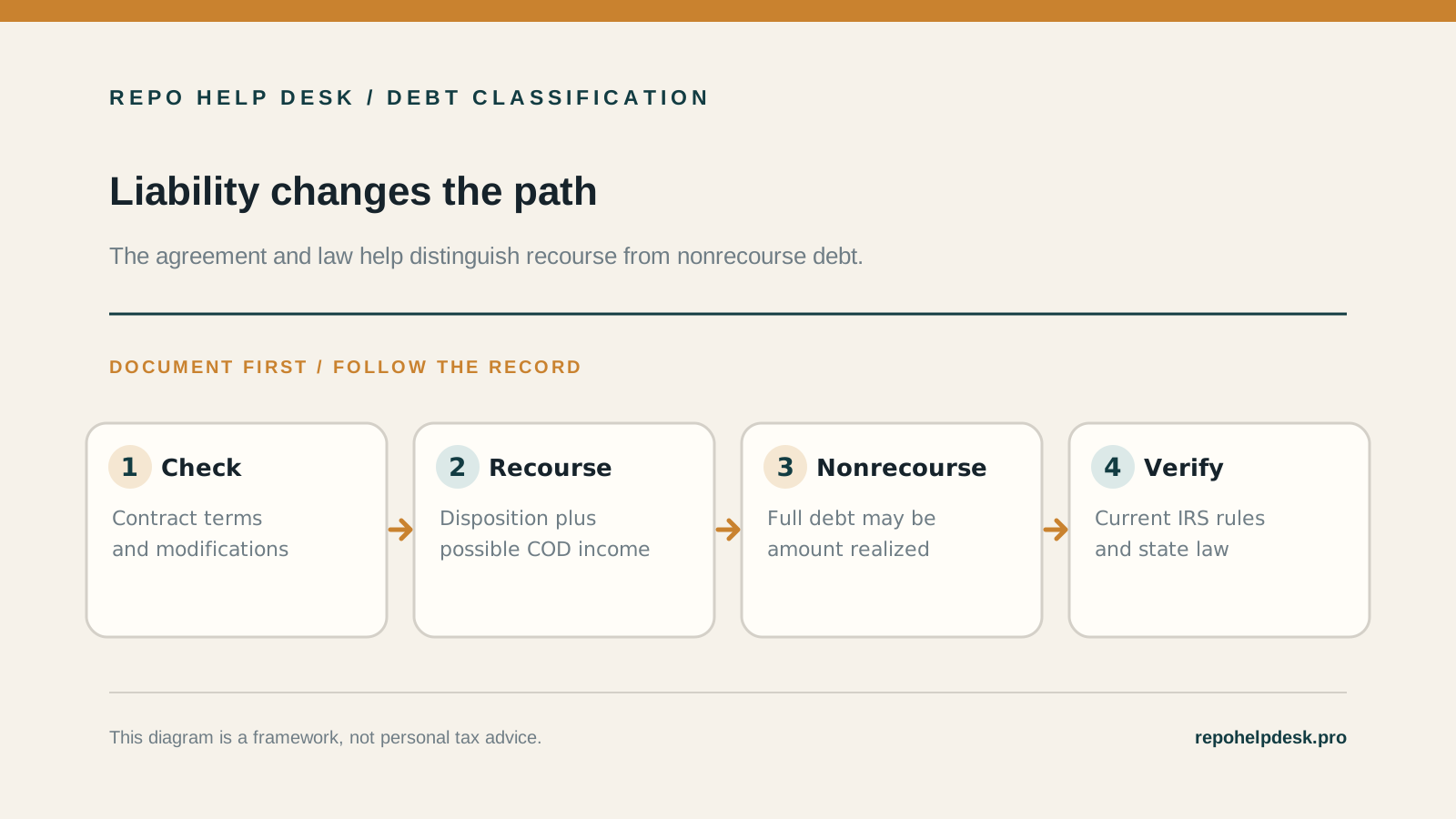
| Debt type | Disposition amount used in the IRS example framework | Possible separate cancellation income |
|---|---|---|
| Recourse | Generally the property FMV for the disposition side when the debt exceeds FMV | Possible if the lender forgives the excess balance, subject to exclusions |
| Nonrecourse | Generally the full unpaid debt is included in amount realized | No ordinary COD income solely from repossession of collateral |
A reported amount may be taxable, excluded, or reported incorrectly
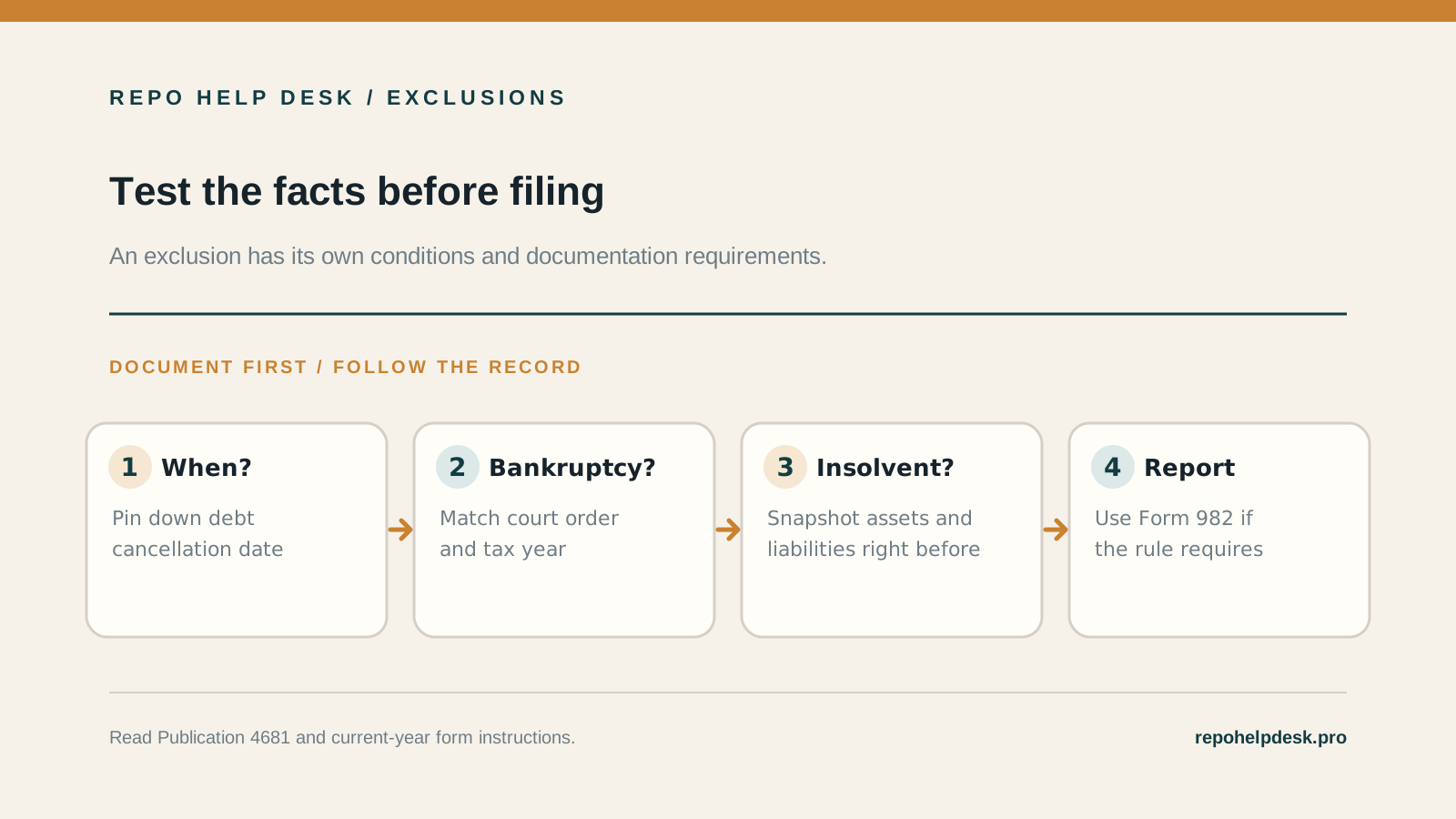
Canceled debt is generally included in income when you were personally liable, but the IRS lists exceptions and exclusions. Bankruptcy and insolvency immediately before cancellation may exclude some or all of otherwise taxable canceled debt. The insolvency calculation compares the fair market value of all assets with all liabilities right before the cancellation; it is not just whether the borrower had cash in a bank account. Other exclusions have their own conditions and may not apply to an ordinary auto loan.
A 1099-C is an information return, not a final IRS determination that every dollar in Box 2 is taxable. Conversely, not receiving a form does not by itself decide whether a cancellation occurred or whether an amount is reportable. If an exclusion applies, Form 982 may be required, and exclusions can trigger tax-attribute reduction rules. Follow the current-year IRS instructions and Pub. 4681, and get professional help where bankruptcy, insolvency, nonrecourse debt, community-property rules, or a disputed amount changes the result.
- Ask the lender to correct a form if the account, event date, amount, personal-liability status, or property value is wrong.
- Keep proof that a debt was discharged in bankruptcy or that an enforceable settlement released the balance.
- For insolvency, prepare an asset-and-liability snapshot for the moment immediately before cancellation, not a general monthly budget.
- Keep Form 982 and supporting schedules with the return when an exclusion and attribute reduction apply.
Reconcile the tax forms with the deficiency accounting
The post-sale deficiency statement and the 1099-C can use different figures because they answer different questions and may include different timing or reporting rules. Reconcile the principal balance, accrued interest, repossession and sale expenses, sale proceeds, payments, insurance or add-on refunds, and any settlement credit. Ask the creditor which amount was actually discharged, whether it continued collection rights, and how it determined Box 2. Do not copy the deficiency figure straight to a tax return or subtract every disputed fee without support.
If the account statement is incomplete, request a complete transaction history and disposition accounting. Compare the sale proceeds and credits with the agreement, notices, and any applicable state-law rights. Keep an evidence packet containing the retail installment contract, all notices, valuation or auction documents, account ledger, settlement or bankruptcy records, information returns, and your written questions. This packet also helps a tax preparer distinguish the property calculation from any cancellation income.
Reconciliation packet
- Loan contract and modifications → establish liability terms.
- Disposition records → establish dates, FMV or sale proceeds.
- Final account ledger → explain balances, fees, credits, and refunds.
- 1099-A/1099-C + cancellation proof → determine the tax questions to resolve.
When to bring in a tax professional
Get help before filing if the lender reports cancellation in a different year from the sale, the 1099-C amount does not match the account history, you are unsure whether the debt is recourse, the car had mixed personal/business use, or a bankruptcy or insolvency exclusion may apply. Also get advice if the creditor keeps collecting after the date on the form or if several borrowers appear on the loan. A tax preparer can work from the records, but legal questions about enforceability or state repossession law may require a consumer-law attorney.
A useful first question for a preparer is not “Do I owe tax on this 1099-C?” but “Which transaction does each form report, was the debt personally enforceable, what was the vehicle’s adjusted basis and value at disposition, was debt actually canceled, and does an exception or exclusion apply?” That framing prevents the most common mistake: treating repossession, sale proceeds, deficiency, and cancellation as one number. Use the current IRS publication and tax-year forms because federal rules and form instructions can change.
Frequently asked questions
- Does a 1099-C after repossession automatically mean I owe tax?
- No. It reports a debt-cancellation event, but recourse status, the vehicle disposition, bankruptcy or insolvency exclusions, and the accuracy of the form all matter. Check current IRS Publication 4681 and the form instructions.
- Is a repossession date the same as the cancellation date?
- Not necessarily. The lender may repossess and sell the vehicle before it cancels any remaining balance. Compare the form’s identifiable-event date with the sale statement, account history, and any discharge agreement.
- What is the difference between Form 1099-A and Form 1099-C?
- Form 1099-A reports acquisition or abandonment of secured property and related fields. Form 1099-C reports a cancellation event and amount. A lender may issue one, both, or a combined information return depending on the facts and reporting rules.
- Can insolvency exclude canceled auto debt?
- Potentially, to the extent you were insolvent immediately before cancellation and satisfy the IRS rules. The calculation includes all assets and liabilities, not only cash, and Form 982 may be required.
- Should I report the deficiency balance as canceled debt?
- Not solely because the lender calculated a deficiency. Determine whether and when any amount was actually discharged and match that to the tax forms and account records.
Sources checked for this page
- IRS Publication 4681 (2025) — Canceled Debts, Foreclosures, Repossessions, and AbandonmentsCurrent federal guidance for recourse/nonrecourse debt, vehicle repossessions, disposition, canceled debt, bankruptcy and insolvency exclusions.
- IRS Instructions for Forms 1099-A and 1099-C (2025)Information-return box instructions, identifiable events, canceled amount and reporting.
- IRS About Form 1099-CIRS overview and current Form 1099-C resources.
- IRS Form 982 — Reduction of Tax Attributes Due to Discharge of IndebtednessForm and instructions used when an exclusion and related tax-attribute rules apply.
- CFPB — What happens if my car is repossessed?Consumer overview of repossession, sale, deficiency, notices and credit reporting.