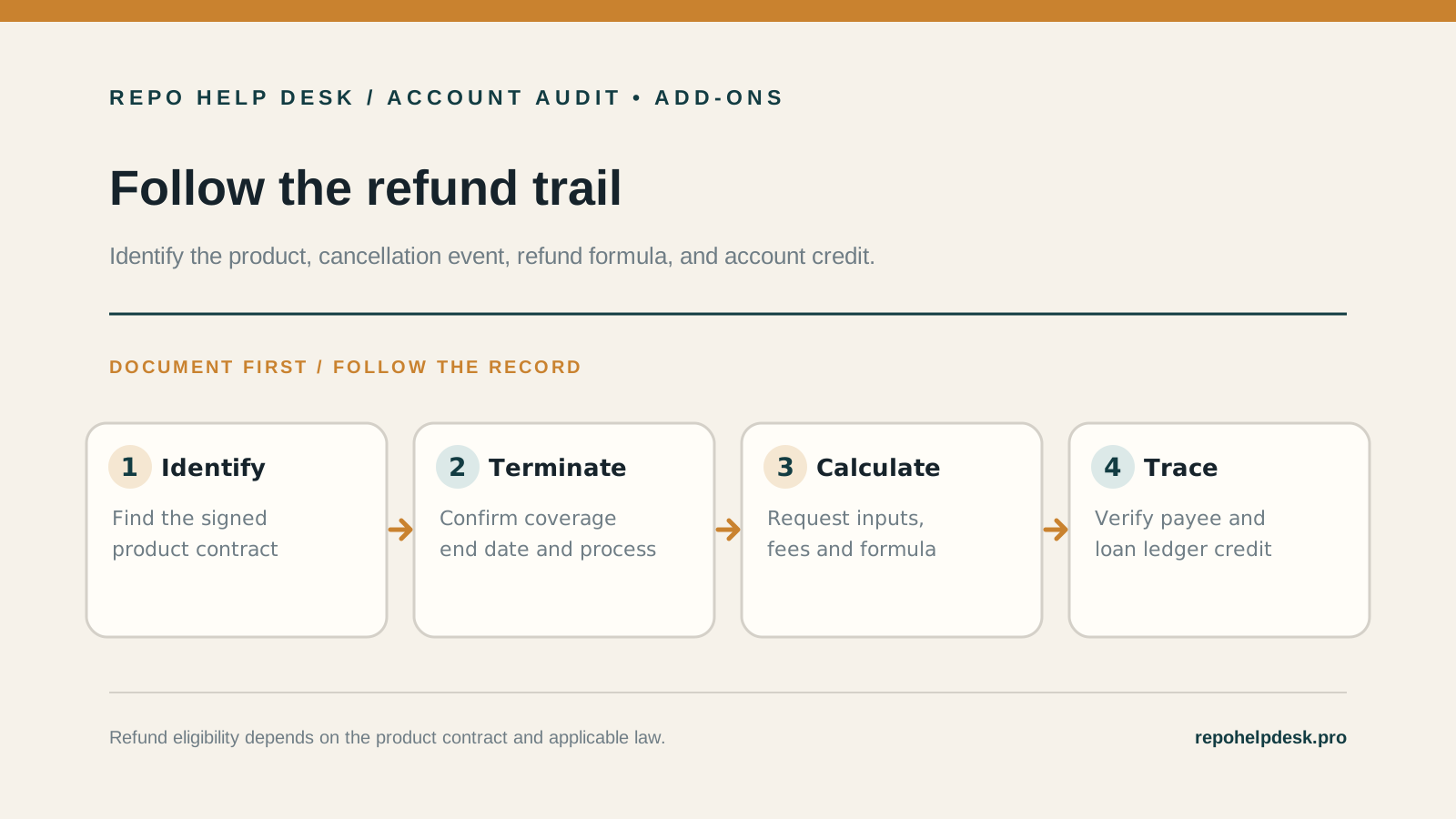
Treat every add-on as a separate contract
A financed vehicle may include GAP coverage or a waiver, a vehicle service contract, credit life or disability insurance, guaranteed-asset products, maintenance plans, or other optional items. They may appear on one retail installment contract but have different administrators, cancellation terms, refund formulas, and state-law rules. A repossession does not establish that every product ended on the same day or that each product owes a refund.
Start by gathering the signed purchase or finance paperwork and each product certificate, waiver, or service contract. Record the product name, administrator, contract number, sale price, amount financed, cancellation clause, person allowed to request cancellation, and any exclusions. Separate lender-required collateral coverage from optional products sold at purchase; the rules and money flow are not the same. Do not rely on a dealer worksheet label if the actual contract names a different administrator.
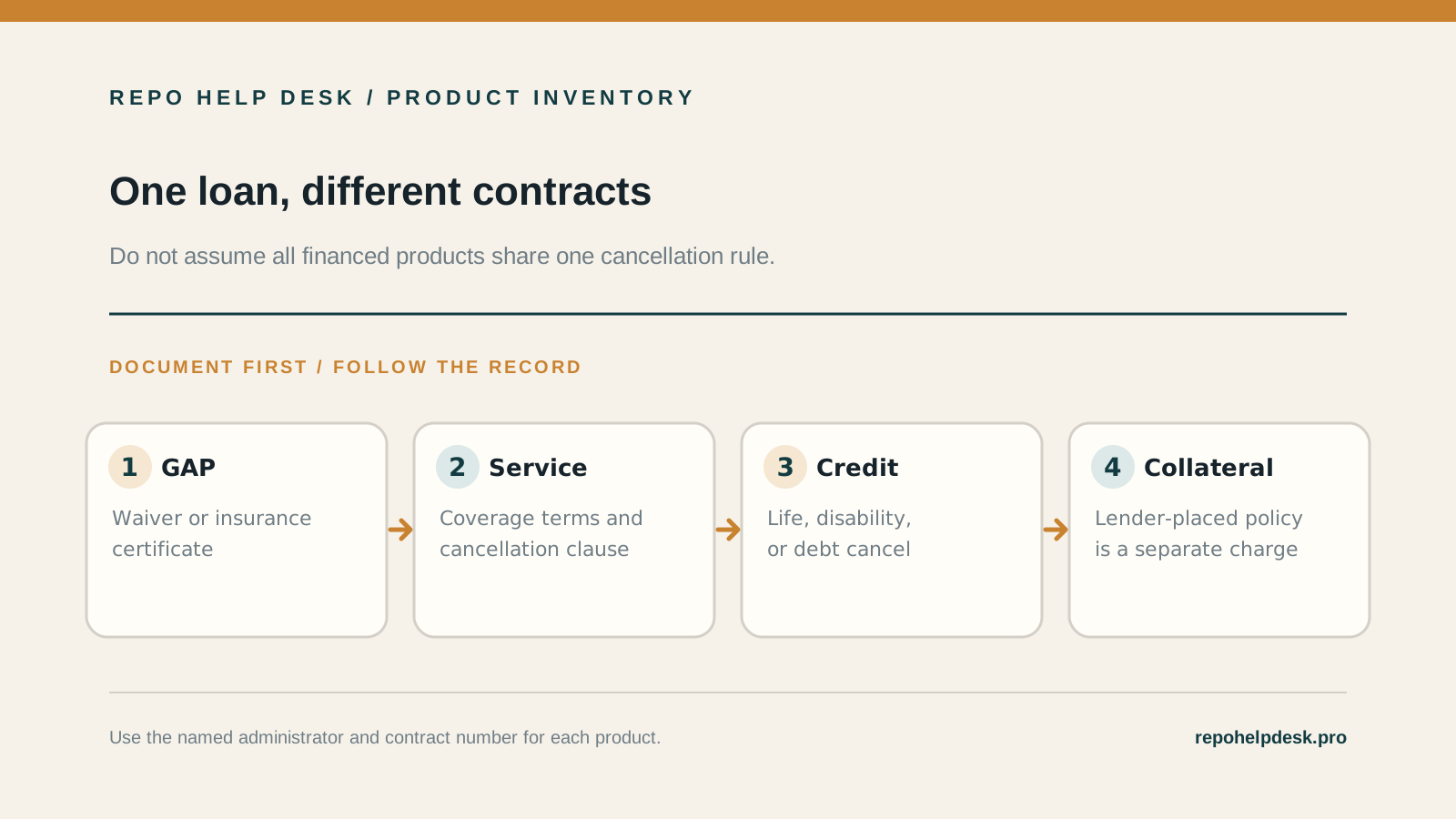
| Product family | Document to locate | Question to ask |
|---|---|---|
| GAP insurance or waiver | Certificate or waiver agreement | What event ends coverage, and who calculates the unearned amount? |
| Vehicle service contract | Service contract and cancellation clause | Does repossession or loss of possession end coverage, and what formula applies? |
| Credit life/disability or debt cancellation | Insurance certificate or addendum | Who is insured, what triggers termination, and what notice is required? |
| Lender-placed insurance | Creditor notices and policy details | Was coverage charged by the lender, and for what actual coverage period? |
Confirm the event that ended each product
The product agreement may terminate coverage at repossession, at sale, after a stated waiting period, when the loan is paid off, or on another defined event. A service contract may end when the vehicle is no longer owned or used by the buyer; an insurance product may have a separate cancellation method. The sale date and cancellation effective date can be different, so write down the date you gave notice, the date the administrator accepted it, and the date the contract says coverage ended.
Ask the administrator in writing whether the product remains active, what event triggered any termination, and which clause controls the effective date. If the creditor or servicer controls the request, ask it to submit cancellation and tell you when it did so. Keep confirmation numbers and copies. A phone representative saying “it should be canceled” is not a substitute for a written status or a transaction record, especially if the loan account is already in repossession or charge-off processing.
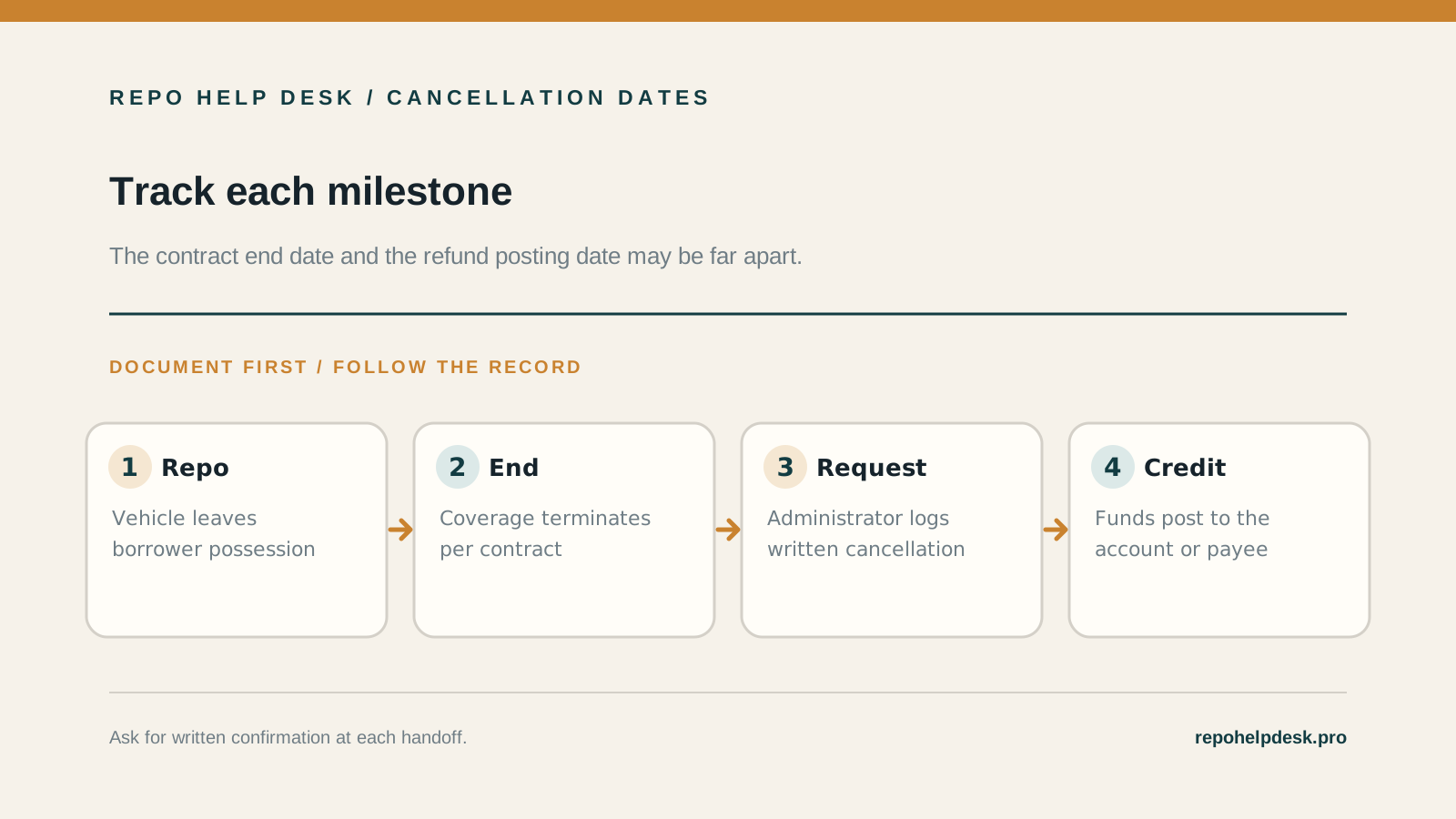
A traceable cancellation request
- Identify product and contract number.
- State the repossession and sale dates; request the controlling termination date.
- Ask who must submit cancellation and when it was received.
- Request a written refund calculation and destination for the funds.
Do not assume the refund is a simple day-by-day proration
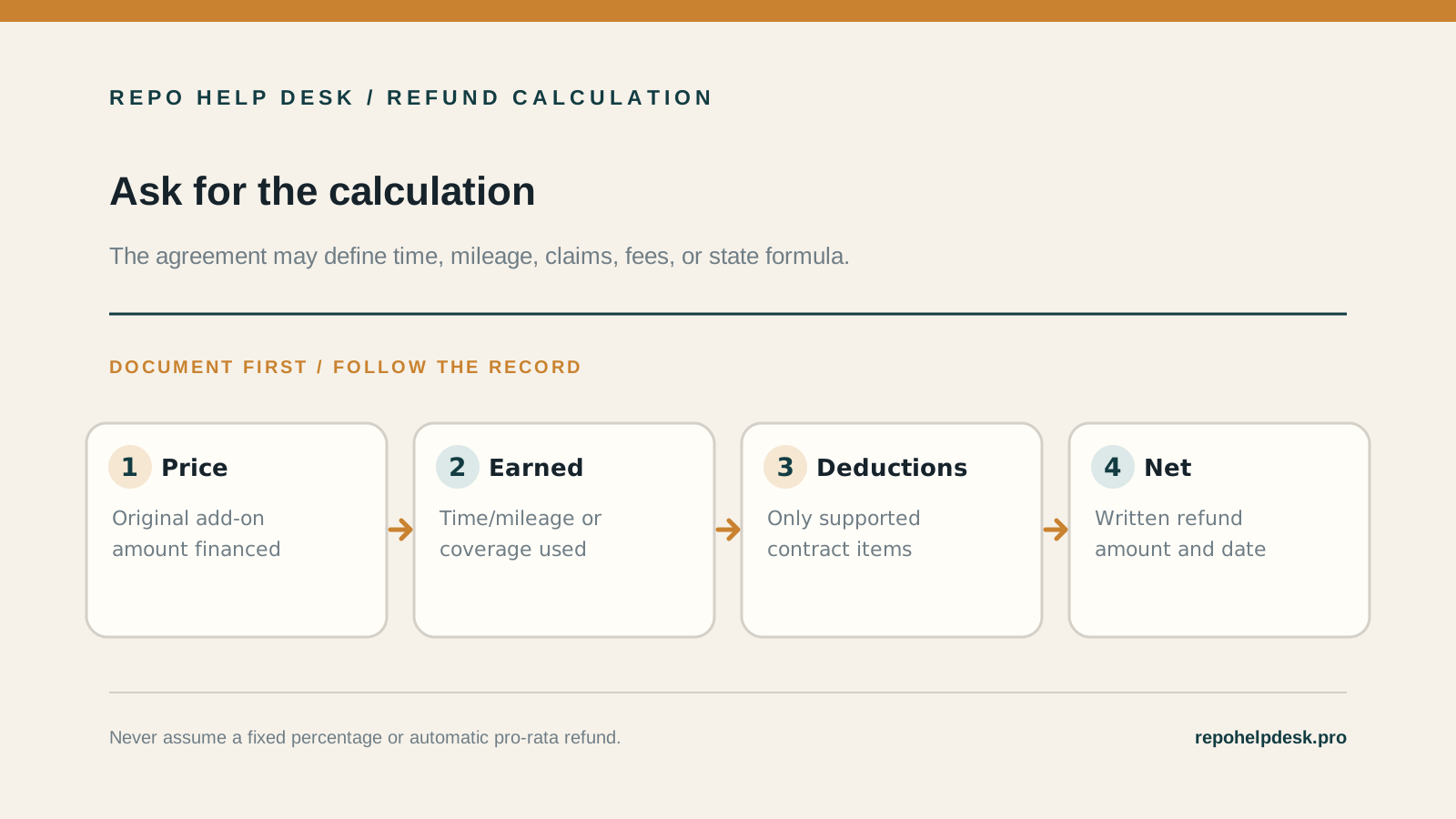
Some agreements calculate an unearned portion using a time-based method; others use mileage, a stated fee, minimum earned premium, claims already paid, or a formula imposed by state law. The product contract and applicable law control. Do not promise that repossession guarantees a full or pro-rata refund, and do not accept a number without asking how the administrator reached it. Compare the purchase price, coverage start and end dates, claim history if relevant, cancellation fee, and the method printed in the agreement.
Ask for an itemized calculation that identifies the gross product price, any amount already earned, permitted fee or claim deduction, and net refund. If the product was financed, request the amount actually remitted and the date. A credit on the loan is not necessarily cash paid directly to the borrower, and a product refund may be applied to the account under the finance documents. The final statement should show where the credit landed and whether it changed the payoff or deficiency balance.
| Ledger item | Evidence | Reconciliation check |
|---|---|---|
| Original add-on charge | Signed buyer order / finance contract | Does the amount match the product agreement? |
| Cancellation calculation | Administrator’s written worksheet | Are dates, mileage, fees, and any claim deductions explained? |
| Refund issued | Check, remittance record, or administrator confirmation | Who received the funds and on what date? |
| Loan account credit | Servicer transaction history | Does the account ledger show the same net amount once? |
Trace the refund through the loan and sale accounting
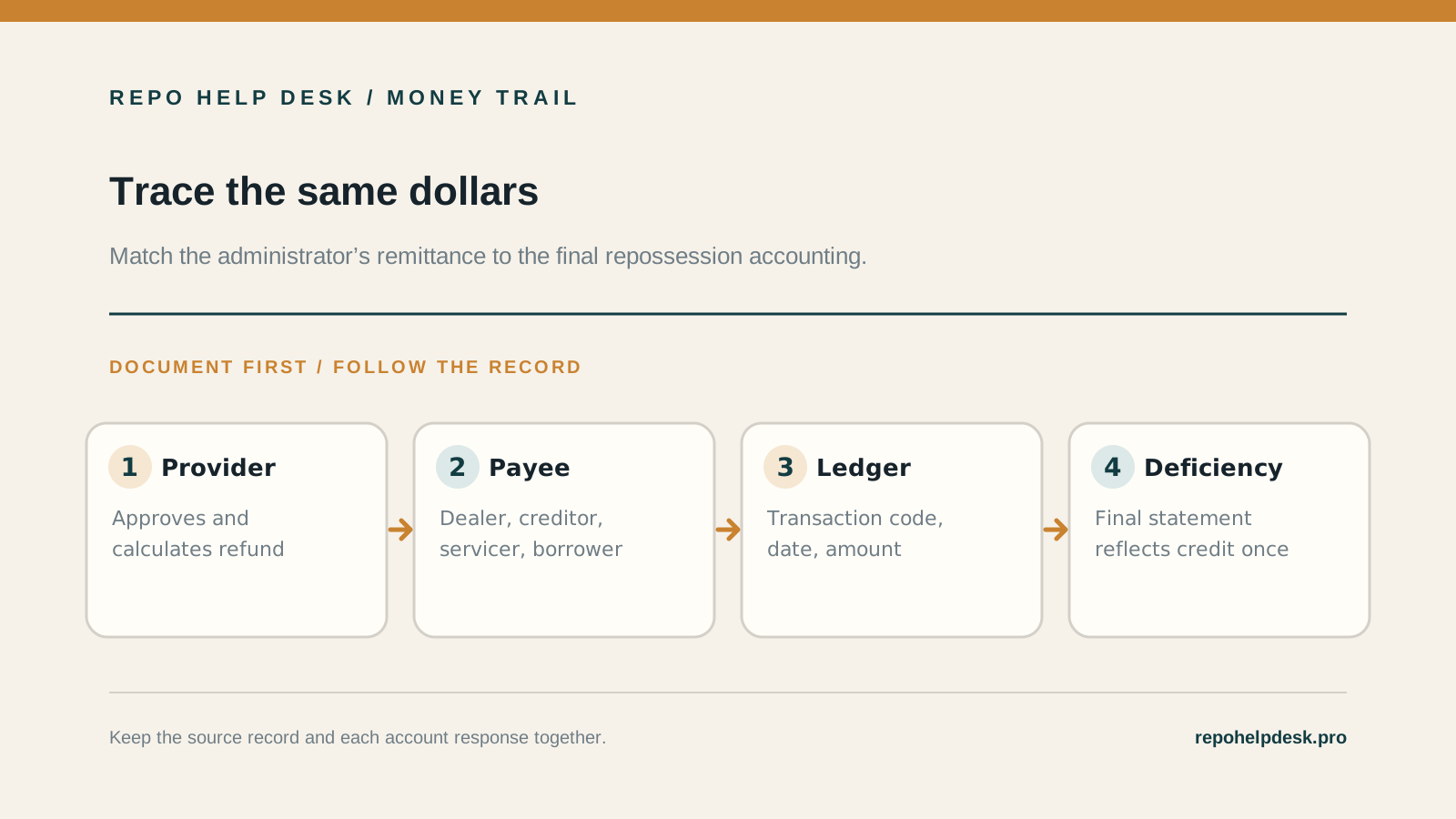
When an add-on was financed, the refund can move from the product administrator to the dealer, creditor, servicer, or account. Identify each handoff. Ask the product company for its cancellation confirmation and net refund; ask the servicer for the posting date, transaction code, and account balance before and after the credit. If the vehicle has already been sold, request a final disposition statement that shows whether the refund reduced the debt before the deficiency was calculated.
CFPB examiners have found servicers that failed to ensure consumers received unearned premiums after early termination, including in default or repossession scenarios, and have also documented inaccurate refund calculations and long delays in posting credits. Those findings show why tracing is worthwhile; they do not prove that a particular borrower is owed money or that every product ended on repo day. Use them as a reason to ask for records, not as a substitute for the contract or a finding about your account.
Close the money trail
- Administrator confirms eligibility and net refund.
- Identify the payee and remittance date.
- Servicer posts the refund to the account ledger.
- Final repossession accounting reflects that credit before any remaining balance is evaluated.
Dispute a missing credit with a specific record request
If the lender’s final balance does not show a refund that the administrator says was issued, send a concise written request to both parties. Identify the product and contract number; attach the termination or refund confirmation; state the amount and issue date; and ask the servicer to trace receipt and posting. Request the full payment and transaction history, the date the deficiency was calculated, and a corrected final accounting if the refund was omitted. Keep proof of delivery and every reply.
If the product administrator says no refund is due, request the exact contract provision, the effective cancellation date, and the calculation or reason for denial. If the two companies disagree about who received the funds, ask each one to name the next recipient and date. If ordinary servicing channels do not resolve a documented issue, you may contact the relevant state insurance or consumer-protection agency, the state attorney general, or the CFPB where it accepts that product type. A complaint is separate from any deadline to answer a lawsuit.
- Do not subtract a disputed refund from a court judgment or payment demand without legal advice.
- Keep the complaint, administrator response, servicer ledger, and final sale accounting together.
A practical file to finish the review
Make one folder for the retail installment contract, buyer’s order, each add-on agreement, repossession and sale notices, administrator cancellation requests, refund worksheets, remittance confirmations, and the lender’s account ledger. A simple table with product, termination date, refund due or denied, paid date, credited date, and remaining question makes gaps visible. Save the original email or PDF rather than only a screenshot, and note the date of each phone call and the name or reference number supplied.
The goal is a verifiable ledger, not an assumption that every item produces a refund. Once each add-on has a documented status and every issued amount is traced to its destination, compare the resulting account balance with the post-sale deficiency explanation. If the contract is ambiguous, state law may control cancellation rights; a local consumer attorney or regulator can review the specific agreement and timeline.
Frequently asked questions
- Does repossession automatically cancel GAP or a service contract?
- Not always. Each product agreement defines its termination event and cancellation procedure. Check the contract and ask the administrator for written status and the effective date.
- Will every canceled add-on produce a refund?
- No. Eligibility and amount depend on the contract, coverage period, claims, cancellation method, fees, and applicable state law. Request an itemized calculation.
- Who gets a refund for an add-on that was financed?
- The agreement and financing documents determine the payee and application. The creditor or servicer may receive and credit it to the loan; trace the administrator’s remittance into the account ledger.
- Can a missing refund affect the repo deficiency?
- It may affect the accounting if the contract and records show that an eligible refund was issued or should have been credited. Ask for the final ledger and disposition accounting; do not assume a refund without documentation.
- What should I do if the administrator and lender blame each other?
- Send both parties the contract number, cancellation confirmation, refund amount, and dates. Ask each to identify the next recipient and provide its transaction record, then escalate the documented issue to the appropriate regulator if needed.
Sources checked for this page
- CFPB Supervisory Highlights, Issue 30 (Fall 2024) — Auto finance add-on productsDocuments examination findings about unearned add-on refunds, repossession, cancellation, and account credits.
- CFPB — What happens if my car is repossessed?Consumer overview of repossession fees, sale, deficiency and other rights.
- CFPB — Difference between a manufacturer warranty and an extended service contractExplains the distinct nature of service contracts and consumer cancellation rights.
- FTC — Financing or Leasing a CarFederal consumer guidance on optional products commonly offered with auto financing.
- CFPB report — Repossession in Auto FinanceResearch on repossession process and post-sale deficiency accounting.